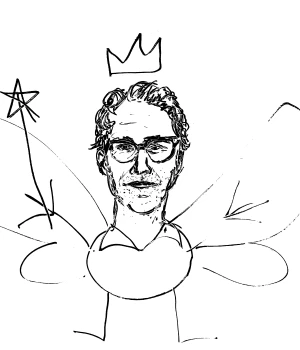
Ivan Ascher
- Associate Professor, Political Science
- Director of Undergraduate Studies, Political Science
- Internship Coordinator, Political Science
Education
PhD, Political Science, University of California, Berkeley
Office Hours
Tuesday & Thursday 2:30 pm - 4:00 pm & By Appointment
Courses Taught
- Modern Political Thought (POL SCI 382)
- Contemporary Political Theory (POL SCI 386)
- Biology, Digitality, Carbon (Spring 2020)
- Political Ideologies (POL SCI 255: Great Issues)
- The Politics of Neurodiversity (POL SCI 255: The Body Politic)
- First Year Seminar (POL SCI 193)
- Capitalism & Its Critics (Fall 2025)
- Democracy in America from Tocqueville to the Present
Research Interests
Professor Ascher specializes in modern political and social theory. His current research is on autism and political theory. He also has hopes of completing a graphic novel inspired by Tocqueville's Democracy in America.
Selected Publications
Ascher, Ivan. America's Autism Obsession, Project Syndicate, 2026. Spanish version available here: La obsesión de Estados Unidos con el autismo (La Prensa, Nicaragua)
Ascher, Ivan. Portföy Toplumu: Kapitalist Öngörü Tarzı Üzerine (Turkish translation of Portfolio Society) Istanbul: Açılım Kitap. 2018.
Ascher, Ivan. Why Markets Can't Cool the Planet, Project Syndicate; French version published in Les Échos, 19 April 2018.
Ascher, Ivan. Donald Trump, Wolf of Wall Street, Progress in Political Economy (reprinted in Union for Radical Political Economy; published in French as Donald Trump, Loup de Wall Street?, trans. Nicolas Bouleau). 2017.
Ascher, Ivan. Portfolio Society: On the Capitalist Mode of Prediction Zone/MIT Press. 2016.
Ascher, Ivan. “The Subprime Subject of Ideology” After Capitalism Ed. Petro, Patrice S., and Ferguson, Kennan. (2016).
Ascher, Ivan. "Moneybags Must Be So Lucky": Inside the Hidden Abode of Prediction, Political Theory 44. (2015): 4-25.
Ascher, Ivan. “Critical Exchange. Specters of Weber: Science as a Vocation in the Age of Neoliberalism” Contemporary Political Theory 14.4 (2015).
Ascher, Ivan. “Capitalism” Encyclopedia of Political Thought Ed. Gibbons, Michael, Coole, Diana, Ellis, Elisabeth, and Ferguson, Kennan. Wiley-Blackwell. (2014): 430-441.
Ascher, Ivan, and . “We Are All 'Occasional Politicians: For a New Weberian Conception of Politics” Constellations 20.1 (2013): 138-149.
Ascher, Ivan. “Difference Theories” Encyclopedia of Political Theory Ed. Bevir, Mark. SAGE Publications, Inc.. (2010).
Ascher, Ivan. “Max Weber and the 'Spirit' of The Protestant Ethic” Journal of Classical Sociology 10.2 (2010): 99-108.
Ascher, Ivan. “Deciding on the Borderland: The Ukrainian Elections of 2004” Theory & Event 8.2 (2005).