Researchers are invited to use the Optical Micro-Spectroscopy Imaging Facility located in the Kenwood Interdisciplinary Research Complex Building, Room 2060. The Facility can be reserved for use, with fees for use based on user class. The Facility Reservation and Billing Policies (DOCX) and the Billing Authorization Form (PDF) must be printed and submitted prior to reserving time in the Facility.
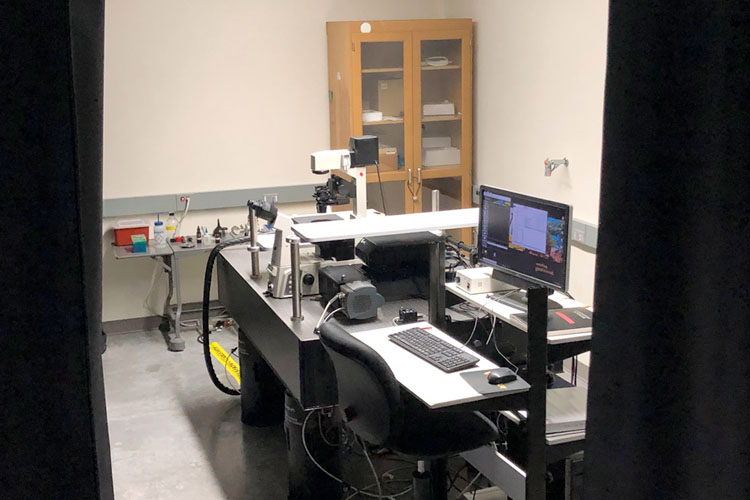
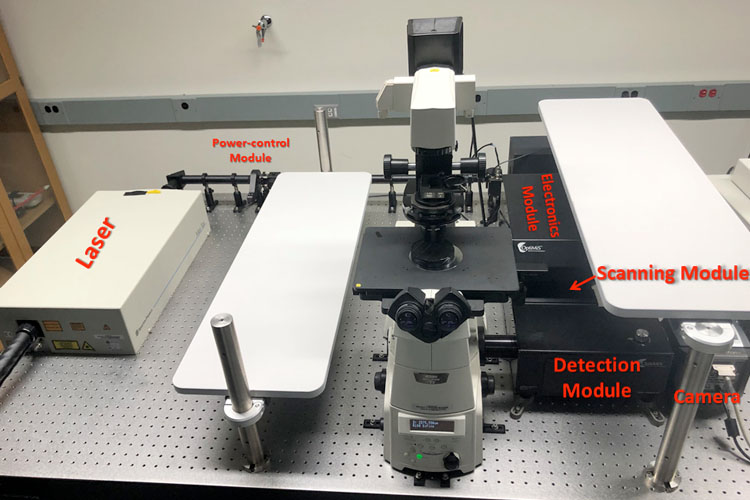
Microspectroscope #1
Technical Specifications
- System Overview: Two-photon line excitation with spectral resolution
- Laser: Spectra-Physics MaiTai HP with wavelength range of 750nm – 1040nm
- Detector: Andor iXon X3 electron multiplying CCD
- Microscope Stand: Nikon Eclipse Ti-E inverted
- Objectives: 100x 1.45 N.A. oil, 60x 1.40 N.A. oil, 20x 0.75 N.A. dry
- Emission detection range and spectral resolution: Detection range of 400-650nm with a resolution range of 1-20nm. Broadband scans also available.
- Scanning Speed: 3 frames/second for 512 pixels × 100 pixels with 20 nm spectral resolution; 1 frame/second for 512 pixels × 300 pixels with 20 nm spectral resolution
- Applications: FRET, fluorophore characterization, Z-stack measurements, emission and excitation spectra, time series
Microspectroscope #2
Technical Specifications
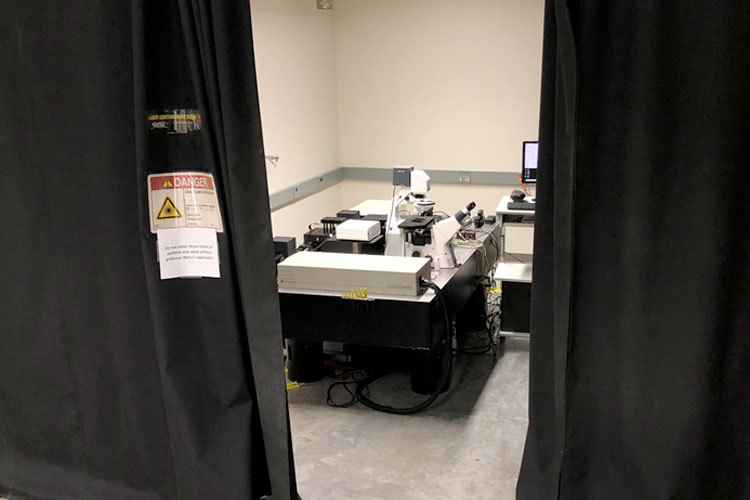
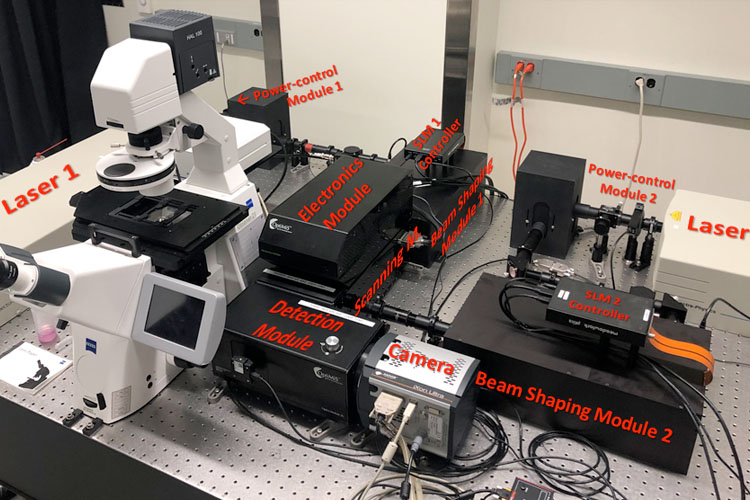
- System Overview: Two-photon excitation with multiple options for beam shapes (point, line, and 10×4 array of points). Two lasers incorporated for simultaneous excitation of sample at two preselected wavelengths.
- Laser 1: Spectra Physics Mai Tai Deepsee with wavelength range 750-900 nm.
- Laser 2: Spectra Physics Mai Tai HP with wavelength range 900-1040 nm.
- Detector: Andor iXon Ultra electron multiplying CCD
- Microscope Stand: Zeiss Axio Observer inverted
- Objectives: 63X 1.3 N.A. water immersion with corrective collar, 10x 0.25 N.A. dry
- Emission detection range and spectral resolution: Detection range of 400-650 nm with a resolution range of 2-40nm. Broadband scans also available.
- Scanning Speed: 1.7 frames/second for 400 pixels × 300 pixels with 20 nm spectral resolution for line scan; 0.1 frames/second for 400 pixel × 320 pixels with 20 nm spectral resolution for point-array scan with soft pinhole detection. Faster speeds possible for smaller fields of view.
- Applications: FRET, FRAP, soft pinhole scanning, fluorophore characterization, emission spectra, Z-Stack measurements, time series.
Optical & Force Microspectroscope #1: Fully Functional Prototype
Technical Specifications
- System Overview: Multimodal instrument combining magnetic tweezers and spectrally resolved fluorescence microscope enabling simultaneous force and fluorescence spectroscopy measurements of single molecules and molecular aggregates
- Excitation source: Spectra-Physics Tsunami BB, with wavelength range of 750nm–860 nm, combined with BiB3O6 (BIBO) crystal for second harmonic generation of femtosecond pulses in visible range of 375-430 nm
- Detectors: Andor iXon Ultra electron multiplying CCD, Allied Vision Pike F-032b CCD
- Microscope Stand: Nikon Eclipse Ti-U inverted
- Objectives: 100x 1.45 N.A oil, 20x 0.75 N.A. dry
- Fluorescence emission detection range and spectral resolution: Detection range of 400-560 nm with a resolution range of 2.5-50nm. Broadband scans also available.
- Scanning Speed fluorescence measurements: 55 frames/second for 512 pixels × 1 pixels with 25 nm spectral resolution; 5 frames/second for 512 pixels × 100 pixels with 25 nm spectral resolution; 1.7 frames/second for 512 pixels × 300 pixels with 25 nm spectral resolution
- Force spectroscopy molecular extension and force resolution: Molecular extension measured with resolution of 10 nm under mechanical perturbations applied with forces ranging from 0.1 pN to 1 nN range.
- Frame rate molecular extension measurements: 1 kHz
- Applications: Multimodal fluorescence microscopy and force spectroscopy FRET, fluorophore characterization, time series, Z-Stack measurements, emission spectra.
Optical & Force Microspectroscope #2: Under Development
Technical Specifications
- System Overview: Multimodal instrument combining magnetic tweezers and spectrally resolved fluorescence microscope enabling simultaneous force and fluorescence spectroscopy measurements of single molecules and molecular aggregates
- Excitation source: Spectra Physics Mai Tai with wavelength range 750-1040 combined with BiB3O6 (BIBO) crystal for second harmonic generation of femtosecond pulses in visible range of 375-520 nm
- Detector: Andor iXon Ultra electron multiplying CCD, Allied Vision Pike F-032b CCD
- Microscope Stand: Zeiss Axio Observer inverted
- Objectives: 100X 1.57 N.A oil with corrective collar
- Fluorescence emission detection range and spectral resolution: Detection range of 400-560 nm with a resolution range of 2.5-50nm. Broadband scans also available.
- Scanning Speed fluorescence measurements: 55 frames/second for 512 pixels × 1 pixels with 25 nm spectral resolution; 5 frames/second for 512 pixels × 100 pixels with 25 nm spectral resolution; 1.7 frames/second for 512 pixels × 300 pixels with 25 nm spectral resolution
- Force spectroscopy molecular extension and force resolution: Molecular extension measured with resolution of 10 nm under mechanical perturbations applied with forces ranging from 0.1 pN to 1 nN range.
- Frame rate molecular extension measurements: 1 kHz
- Applications: multimodal fluorescence microscopy and force spectroscopy FRET, fluorophore characterization, time series, Z-Stack measurements, emission spectra
Please contact Prof. Raicu at vraicu@uwm.edu with questions about the facility.
Measurement schemes that are different from the standard ones offered will require communication with Prof. Raicu well ahead of experiment time, as extensive preparations are required and might incur additional costs.