
A Note from the Director
This latest year shined a bright spotlight on the UWM Libraries, and the impact rippled outward.
We welcomed our new Chancellor Thomas Gibson with a tour of the Golda Meir Library in February, and I was privileged to be a guest on his radio program, “UWM Chancellor’s Report,” in January. We discussed the critical services and spaces the Library provides for the campus community. In June, I joined interim Provost Tina Freiburger and the executive director of the Center for Advancing Student Learning in a presentation to the Board of Regents Education Committee on our initiatives to address textbook affordability for UWM students. We reported savings of $1.7 million in last year alone!
The American Geographical Society Library made waves with local media outlets this year. Georgia Brown highlighted the world-renowned collection and elevated the AGSL’s presence in the community with features on TMJ4 and CBS58, as well as a radio interview with 620 WTMJ. We’re grateful for the opportunity to highlight this treasure trove of maps, atlases, photographs, and other resources that come from all corners of the globe and date back to the 15th century.
Over the summer, we consolidated all borrowing services at the main desk on the first floor in the west wing of the Golda Meir Library. We continued efforts to make improvements to open study areas and refreshed over 20,600 square feet of library space with new carpeting and paint. It was gratifying to see students settle into their new, favorite locations in the Library.
We said goodbye to several staff members who left to explore other career opportunities or enter retirement and we made new hires in key areas. We welcomed Isabella Kostolni as our communications manager, Shauna Edson as our health sciences librarian, Megan Smith as the business librarian, and Karen Cherone as the borrowing services head. We also congratulated Georgia Brown on her promotion to the head of American Geographical Society Library.
As we reflect on this past year, it’s clear the changes we’ve made have strengthened the Library’s role as a hub for student learning and the campus community. We look forward to the coming year and all the excitement it has to offer.

Michael Doylen, Associate Vice Provost & Director of the Libraries
Student Success
Libraries Lower Textbook Costs for Students
For over the past decade, the Libraries have led the way in reducing textbook costs for UWM students, and 2025-26 was no exception.
With the UWM Center for Advancing Student Learning, the Libraries supported faculty and instructors in adopting open textbooks in their courses. The UWM Libraries and CASL employed a “bottom-up” approach, encouraging affordable textbook adoption in lower-level undergraduate courses to reach large portions of the student population. More than 18,000 students were enrolled in courses using OERs in the 2025-2026 academic year.
Additionally, the Libraries purchased e-books assigned by faculty for their courses, thus savings students the expense. E-books included not only traditional textbooks, but also fiction, foreign-language materials, and anthologies. This program tended to have greater impact for students in upper-division undergraduate and graduate classes.
Through both efforts, the Libraries helped students save nearly $1.7 million in textbook and other course material costs in 2025-26. The Libraries’ textbook affordability efforts reflect the campus’s broader commitment to reducing barriers to student success and improving access to higher education.
Consolidation of Borrowing Services
In August 2025, the Golda Meir Library completed a major service improvement by merging its Circulation and Reserve & Equipment Service Desks into a single one known as Borrowing Services. The initiative, which took place throughout the summer of 2025, was designed to simplify the user experience and provide a more convenient, centralized location for borrowing and returning library materials and equipment.
The new Borrowing Services Desk now serves as a one-stop destination for users’ borrowing needs. Patrons can check out and return physical materials, pick up reserve items, and borrow equipment such as laptops and other technology from a single location on the Library’s first floor. By eliminating the need to visit multiple service desks on different floors, accessing resources has become faster, easier, and more intuitive for students, faculty, and staff.
Since opening, Borrowing Services has become a true hub, offering a streamlined experience centered on user convenience. The successful merger reflects the Libraries’ commitment to providing accessible, efficient services while ensuring that users can find the materials, technology, and support they need at one service desk.
Library Satisfaction Survey Provides Insight Into How Faculty, Staff, and Graduate Students Use Library Resources
In fall 2025, the UWM Libraries solicited input from all research and instructional staff and graduate students to improve services, collections, and spaces to meet the changing needs of these users, and to inform our strategic planning and budget decisions. Over 550 people completed the survey. Overall, faculty, staff, and graduate-student respondents are satisfied with the services and spaces provided.
In particular, InterLibrary Loan and support for teaching and research are viewed as highly successful and valuable services. Respondents also identified areas of concern and areas for growth or improvement. One such area for growth is communication to increase awareness of Library services and events, as well as communicating how to get help from the right staff member.
92% of respondents indicated that “paying for resources I need, from academic journals to books to e-databases,” is the most important service provided by the UWM Libraries.
Respondents use the Library differently depending on their role and whether they are remote employees or online-only students. The Library’s Grind coffee shop is valuable for meetings and taking a break, and several comments suggest that small improvements to study spaces could improve the graduate-student experience. The new Graduate Student Commons has caught on, with nearly 40% of graduate-student respondents using the space.
As for respondents’ most frequently utilized resources, online journals have the highest use among collections resources by graduate students (65%) and faculty (70%) with Library collections or subscriptions being their first choice for access followed by freely available. Comments regarding the Libraries’s collections reflected anxiety about cuts to the collection, affirming their support of the Libraries as a pillar of academic success.


Wag More Wednesdays Helps Students De-stress
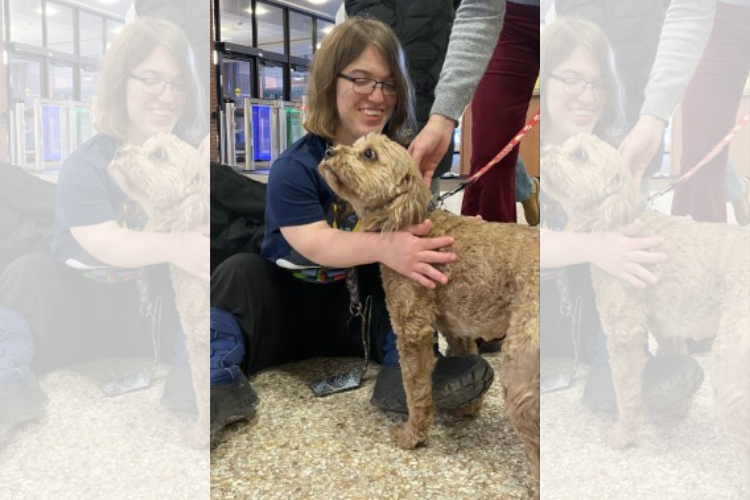
College can be demanding, so the UWM Libraries supports students by providing them a chance to de-stress during the busy school year. Each fall and spring semester, volunteers from the Alliance of Therapy Dogs and Pet Partners bring their furry companions to the Daniel M. Soref Learning Commons for students to interact with. Each volunteer’s hour-long visit gives students an opportunity to pet a friendly dog while chatting with their peers.
Chancellor’s Study Break Connects Students with University Leadership
Finals week can be hectic for students, so the UWM Libraries and Chancellor Gibson teamed up to provide students an opportunity to refuel with free coffee and donuts while getting to know the university leader. Each semester the event draws a crowd of students eager to connect with the Chancellor in the comfort of the Golda Meir Library — a popular study space during finals week and throughout the academic year.

Research Excellence
AGSL Acquires ‘The Atlas of Middle-Earth’ Maps and Fonstad Collection
AGSL acquired the Karen Wynn Fonstad Collection, including the original manuscript maps of The Atlas of Middle-Earth. A cartographer from Oshkosh, Fonstad was a lifelong fan of J.R.R. Tolkien’s work. Upon her passing in 2005, Fonstad left an archive of nearly 1,000 map drafts, many of them based on Tolkien’s The Lord of the Rings, The Hobbit, and The Silmarillion.
Fonstad’s meticulous readings of Tolkien’s books informed her cartography as she translated written descriptions into tangible maps. Houghton Mifflin published Fonstad’s The Atlas of Middle-Earth in 1981. Her atlas informed the filming locations for the movie adaptation of The Lord of the Rings series in the early 2000s. The success of her work inspired Fonstad to create atlases for other fantasy series such as the Dragonriders of Pern and role-playing games such as Dungeons & Dragons.
The collection also includes 40 books containing her extensive geographic notes, pencil drafts, and drafting equipment, providing a look into Fonstad’s cartographic process. The Fonstad Collection is currently being processed by Library staff, and digital versions of many maps are now available online.
Archives Acquires Public Programming Records from UWM’s Institute of World Affairs
Following the closure of the Institute of World Affairs housed in UWM’s Center for International Education, the Archives acquired the institute’s public programming records.
Established in 1960, the Institute of World Affairs was a cornerstone of both the UWM campus and greater Milwaukee community. It was a driving force behind students’ engagement with international affairs and it stimulated broader conversations regarding global events. During its 65-year run, the institute brought prominent figures to campus, like former US Secretary of State Henry Kissinger, former President Bill Clinton and former Vice President Al Gore.
With the acquisition, the Archives will preserve recordings of the institute’s live public programming, as well as house DVDs of its Milwaukee PBS program International Focus. The collection is now available for research use and can be viewed using the finding aid.
Special Collections Acquires Unique ‘Standing Book’ for Renowned Book Arts Collection
Special Collections grew its highly esteemed Book Arts Collection with the acquisition of AI 003, a unique ‘standing book.’ Created by C.K. Wilde, Kurt Allerslev, Marshall Weber, and Sophia Kramer of the artmaking group Organik, AI 003 departs from traditional rectangular book format — a liberation akin to that of architects breaking free from typical design constraints.
As described by New York-based art non-profit Booklyn, AI 003 is “extremely energetic and willful.” The book features rubbings from Manhattan’s architectural plaques, which “form the templates for the complex collage work that manifests in both the second, third and fourth (physically interactive within time/space) dimensions.”


Donors Support AGSL
AGSL will conserve rare atlases thanks to a $25,000 grant from the Gladys Krieble Delmas Foundation. The grant will facilitate the repair of five maritime navigational atlases dating from 1693 and other rare atlases.
Part of a more than 20,000-item rare collection, the navigational atlases (also called pilots or neptunes) to be conserved include: Le Neptune Francois ou Atlas Nouveau des Cartes Marines, 1693; Suite de Neptune Francois ou Atlas Nouveau des Cartes Marines, 1700; De Nieuwe Groot Licthende Zee-Fakkel, 6th volume, 1753; and The East-India Pilot, and Oriental Navigator, two volumes, 1780.
In addition to the conservation project, the AGSL acquired and restored materials thanks to a gift from the John Quincy Adams Foundation of the Order of Founders and Patriots of America. The two acquired maps depict the fledgling United States; a French-language 1776 map from German cartographer Matthäus Albrecht Lotter highlights the Biritsh Colonies and portions of the Great Lakes Region at the outbreak of the American Revolution, and a 1777 map from French cartographer Maurille Antoine Moithey traces the early events of the Revolutionary War. Both maps have been digitized by Library staff and are available to view online.
Beyond the maps, the AGSL also restored two atlases from 1776: the Description of North America, which highlights first-hand accounts of the British Colonies from the point of view of British soldiers, and the American Military Pocket Atlas, which includes six maps of the British Colonies based on surveys done by the British navy and army. Both atlases are available for viewing in the AGSL.
The UWM Libraries is grateful for the support from both the Gladys Krieble Delmas Foundation and the the John Quincy Adams Foundation of the Order of Founders and Patriots of America.


Read and Publish Agreement Benefits UWM Authors
The UWM Libraries entered into a new read and publish agreement with American Chemical Society Publications, allowing UWM authors to publish ACS journal content. This agreement enhanced an initial contract authorizing UWM students, faculty, and staff to read paywalled articles in over 80 ACS journals.
Through this arrangement the UWM Libraries cover article processing charges associated with publishing ACS journal content. UWM authors can publish articles in 13 open access journals and 73 hybrid journals (publications where some articles are paywalled).
This transformative agreement supports long-term goals of making research articles immediately available online and represents a major step in the UWM Libraries’ initiative to support university-affiliated authors in publishing their research to the widest possible global audience. The agreement also encourages a move away from expensive, subscription-based publishing and toward a more sustainable and open access model.
Community Engagement
Major Lectures Examine Latino/a Immigrants’ Resilience and Consider Methods for Mapping Brazil
With the 2025 Morris Fromkin Memorial Grant, UWM Assistant Professor of Psychology and Principal Investigator for EQUITY Research Group Gabriela Nagy began developing a book challenging the pervasive notions of insufficiency that cloud the perception of Latino/a immigrants. Instead, she opted to ground her research in the “remarkable resilience and the protective factors that safeguard their mental and physical health despite chronic stressors, trauma, and systemic oppression,” Nagy said.
In October, she presented her findings with the lecture “Resilience, Resistance, and Rhetoric: What Latino/a Immigrants Teach Us About Health and Humanity,” which explored how Latino/a immigrants resist oppressive systems and rebound from chronic stress and trauma in the US.
AGSL welcomed University of São Paulo Associate Professor Julio Pedrassoli for the annual Maps & America: Arthur Holzheimer Lecture Series in April. Pedrassoli’s presentation, “Mapping Brazil from Within: Remote Sensing, Collaboration, and Counter-Cartographic Perspectives,” covered his work leading urban mapping with MapBiomas, a Brazilian-founded initiative producing large-scale maps showing environmental changes over time.
By considering maps that challenge dominant power structures, the lecture also examined how this dynamic shapes data transparency, methodological openness, and the public circulation of territorial information, particularly in deforestation, land-use change, climate governance, and land conflicts.


Exhibits Showcase Unique Collections
More than a dozen exhibits were on display this year in the Golda Meir Library, including library-wide pop-ups celebrating Latine Heritage Month and Black History Month, as well as displays celebrating the city’s storied history, like the Archives’ exhibit “Mothers of Milwaukee Modernism: Building the Layton School of Art.”
In the fall, the AGSL turned heads with its exhibit “Whose North Is It Anyway?” While north is the direction at the top of most maps, some maps defy this cartographic convention. Whether for aesthetics, religion, nationalism, or perspective, this display highlighted different styles of map facing every direction on the compass.


Archives Highlights LGBTQ+ Television in Milwaukee at PrideFest
In June 2026, the Archives hosted a panel discussion about the history of local LGBTQ+ television during Milwaukee’s 2026 PrideFest. Archivist Abbi Nye was joined by guests Dan Fons and Michael Lisowski, who reflected on their groundbreaking public access series The Queer Program.
AGSL Hosts Milwaukee County Genealogical Society
In March 2026, the AGSL hosted the Milwaukee County Genealogical Society for a tour of its holdings and to teach society members how to use the extensive collection for their research. The Milwaukee County Genealogical Society viewed gazetteers and historical maps that assisted members in their quests to locate places of interest associated with their ancestors. Two of the Milwaukee County Geological Society Members donated their personal map collection to the AGSL on the day of the tour.


UWM Libraries by the Numbers

Thank You
The UWM Libraries gratefully acknowledge the following individuals and organizations who gave monetary gifts from July 1, 2025 to June 30, 2026.
Jo Don Anderson. Margo Anderson. Anonymous. Ronald Aplin. Cheryl Bourne. Cynthia Broecker. Regina Scott Brooks. Georgia Brown. Ryan Christoph. Woonsup Choi and Hyejin Yoon. Lisa Clemente. John Conley. Janice Curnes. Francis Deisinger and Judith Markowski. Chrystah Derbi. Christopher Doll. Michael Doylen and Doug McDonald.Terry Hanna. William and Ethan Elser. Mary and John Emory. Margaret Erbes. Alison Ferrentino. John Firer. Phil Fisher. Judith Goetz. Kristine Gohsman. Charles Hanson. Erin Harrass. Edward Heinzelman. John and Michelle Hess. Frederick and Joanne Hinz. Ryan Holifield and Kristin Sziarto. John and Pamela Holloway. Andrew and Paula Holman. Ruth Holst and Robert Thiel. Emma Horvath. Mary Huelsbeck. Christine Jameson. Antonio Carlos Jansch Porto. Wendell Jean. Deborah Kern. Val Klump and Sory Marocchi-Klump. Brian Kiedrowski. Kerry Korinek. Susan Laskowski. Avrum and Dannette Lank. Jane Layman. Mordecai Lee. Wan-Chen Lee. Ellen Lensing-Kitzman. Nora and David Lewis. Wangjie Lian. Victoria McKenna. Connie and Stephen Menchal. Julie Merck. Michael Mikos. Lisa Moore-Kelty. Frederick Nelson and Margaret Burke. Tom and Linda Neubauer. William and Lois O’Brien. John Ogilvie. Charles and Marjorie Olsen. Nicole Palasz and Timothy McKeehan. John Pfankuch. Dianne and Michael Phillips. Treshani Perera. Kari and William Pink. John Pinkstone. Richard Radtke. Ruth Renzelmann. Douglas Richardson. Jovanka Ristic. Anna Rohl. Jennifer Salentine. Warren Scherer and Kevin Flaherty. Amy Schindler. Joy Schnupp. Richard Schwartz. Michael Seidel. Emma Seymer. Carol Shaffer. Scott Silet. Joy Simmons. Lyndsay Smanz. Heather Smedberg. Lynn Smith. Nancy and John Snyder. Daniel Soyer. David Staats. Phillip and Patricia Stroupe. Anne and Donald Taylor. Walter Theis. Raven Varnado-Glenn. Jonathan Ward. Ashley Wehrli. Harry Weiner. Michel Wendt. Todd Wesolowski. Janet Wilgus. Phillip Wilke. Daniel Wollenzien. Claudia Wardius.
Cream City Foundation. General Society of Colonial Wars. Gladys Krieble Delmas Foundation. Greater Milwaukee Foundation, Inc. John Quincy Adams Foundation. Reginald & Lenore Horsman Joint Trust. Society of Colonial Wars in the State of Wisconsin.
And many thanks, as well, to the following individuals and organizations who gave gifts-in-kind — books, maps, DVDs, and other library materials — from July 1, 2025 to June 30, 2026.
Susana Antunes. Bettina Arnold. Lois Baer Barr. Mostafa Baladi. Venkata Krishna Bathala. Jennifer Benka. Dallas Berka. Dorothy Boxhorn. Cynthia Brinich-Langlois. Ray Bromley. Justin Court. Jean Creighton. Megan Eskey. Gustavo Fares. Cesar Ferreira. Andrew Fitch. Mary Ann Fitzgerald. Todd A. Fonstad. Patrick Ford. Warren Gerds. James Hand. Mark Harris. John S. Heywood. Karl Hooyman. Neil Horsky. James La Brasca. Daniel Lee. Mordecai Lee. Sergio Lopez-Pineiro. Holly Loveland. Thaddius Martin. Douglas Metoxen Kiel. Edith Moravcsik. Tsunao Nakamura. Ann Oppenhimer. Manuel A. Ossers. Christian Parker. Xiao Qin. Carol Seery. Sally Seluka Schaefer. Yuting Spiegelhoff. David and Deirdre Stam. John Stropes. Linea Sundstrom. Michael Tarabulski. Mary Thundercloud-Eary. Vince Tripi III. Eric Turcat. Katie VanBommel. Melissa Wagner-Lawler. DeShanda Williams.
American Academy of Allergy, Asthma & Immunology. Ancient Earthworks Society of Wisconsin. City of Glendale. Deeper Learning Institute. Japan Institute of International Affairs. Milwaukee Press Club. Radius Books. River Falls Public Library. SITE Galleries at the School of the Art Institute of Chicago. UW-Green Bay Archives Department. UWM Center for Excellence in Teaching & Learning. UWM Center for Latin American and Caribbean Studies. Woman’s Club of Wisconsin.