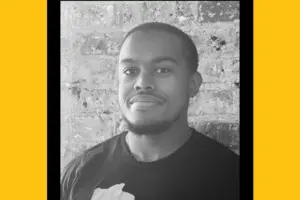
Every year, graduates from the College of Letters & Science enter the workforce and begin to contribute thousands of dollars to their local, state, and national economies. They bring the skills and knowledge they gained at UW-Milwaukee to their jobs, along with their ambitions and fresh perspectives.
In this article series, we highlight some of the recent Letters & Science alumni who have found fulfilling roles in their chosen fields.
Name: Jon McCray-Jones
Graduation Year: 2021
Major: Philosophy and Political Science
Job: Policy Analyst at Wisconsin ACLU
Jon McCray-Jones was worried he wasn’t qualified to work at the ACLU because he doesn’t have a law degree. But he did have a philosophy major.
“A big reason why I got this job was because of how my philosophy degree and political science degree really complemented each other,” he said. “(A philosophy major) teaches you a lot of essential skills: How to think critically, how to write, how to read, how to analyze data, how to view current events and be able to digest them … and produce something out of that information for others to consume and read.”
McCray-Jones is a policy analyst for the ACLU of Wisconsin, or the American Civil Liberties Union. The ACLU is a nonpartisan, nonprofit organization dedicated to protecting Americans’ rights, especially those guaranteed by the First Amendment. As a policy analyst, it’s McCray’s job to keep an eye on bills making their way through the Wisconsin Legislature and help the Wisconsin ACLU decide whether to support, oppose, or remain neutral about them.
He does that by researching similar bills and laws in other states and analyzing their impact.
“The first thing I look at is, will this bill disproportionately affect the marginalized, the poor, queer people? Does it limit individual freedom? What are the bills rooted in? What are the trade-offs?” he said.
And every bill involves trade-offs. Recent legislation on surveillance technology is one example. Supporters argue that tools such as Flock cameras can help law enforcement investigate crimes, identify suspects, and deter criminal activity. Civil liberties advocates, including McCray Jones, contend that expanding the use of surveillance technologies, like Flock cameras or drones at protests, raises concerns about privacy and could discourage some people from exercising their First Amendment rights to free speech and peaceful assembly.
In fact, he’s become something of an expert when it comes to surveillance legislation and regularly speaks to the media about what he views as the dangers of technology like Flock cameras. That’s thanks in large part to his UWM philosophy major.
“Learning about existentialism, I got really interested in individual freedom, and from that I realized that one of opponents to the freedom of dissent and freedom of expression is surveillance,” he said. “I went into the ACLU with an understanding of surveillance … and I’ve been able to bring that understanding into my job and help lead the ACLU of Wisconsin to focus on surveillance over the last couple of years. That has really helped us prepare to meet this moment that we’re in now.”
UWM also helped him in another way: Reading bills and then rapidly preparing a policy analysis is a little like writing a college paper the night before it’s due.
“College and ADHD definitely prepared me for how to put together a paper in one day,” he joked.
And he points to his UWM classes on queer theory and LGBTQ rights as inspiration for some of the blogs he has written for the Wisconsin ACLU about queer history in Milwaukee.
McCray-Jones is a Milwaukee native and chose UWM because it allowed him to stay close to home and care for his aging relatives. “It ended up being one of the best decisions I’ve ever made,” he said. “I made some life-long friends and (had) life-altering experiences there.”
He became interested in politics following the 2016 election and chose to major in political science, but he added his philosophy major after taking a class with Philosophy Senior Teaching Faculty Agust Magnusson. Those classes – plus meeting new people in UWM’s nightlife scene – helped McCray-Jones broaden his perspectives, which he described as “stringent” thanks to a religious upbringing. Those new views were helpful when McCray-Jones began working with Wisconsin Anti-Violence Effort at the time of his graduation in 2021, and when he later became a staffer in Congresswoman Gwen Moore’s office before joining the Wisconsin ACLU.
A philosophy major paved the way for McCray-Jones’ career, but he thinks philosophy is essential beyond a job.
“Just being a good citizen and living a good life requires being involved in some form of politics and philosophy,” he said.
By Sarah Vickery, College of Letters & Science