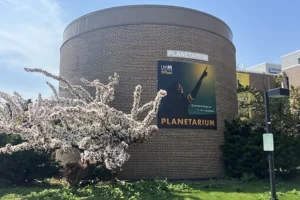
UWM has something to celebrate in 2026: The UWM Planetarium turns 60!
Often recognized as a hidden gem on campus, the UWM Planetarium has been projecting the stars and planets onto its 30-foot dome since 1966, inspiring audiences to identify constellations, notice patterns in celestial motion, and find answers to questions like, “What causes the phases of the Moon?” Like a time machine, the Planetarium’s projectors can show the sky at different times and places. The beautiful space offers an intimate experience, with live, interactive shows actively encouraging audience participation and connection with the presenter and each other.

What’s special about the Planetarium’s 60th anniversary? For one, the Planetarium has enjoyed record-high attendance over the last few years, with nearly 23,000 visitors in 2024 (thanks, solar eclipse!) and over 17,000 visitors in 2025. Keeping live, interactive, educational programming alive post-COVID has been no small feat! Through innovative programming and outreach, the Planetarium bridges departments across UWM to collaborate on interdisciplinary programming ranging from theatre and the arts to humanities and geology. Of note is the “Our Shared Sky” series of cultural programming, featuring guest speakers who highlight their countries, cultures, and connections to the night sky.
Celebration of space is timely: Physics faculty, staff, and students play an essential role in the North American Nanohertz Observatory for Gravitational Waves (NANOGrav), which recently announced the detection of gravitational waves from supermassive black holes. The Planetarium also highlights the latest astronomical discoveries for both public audiences and visiting school groups, including new and exciting discoveries from the James Webb Space Telescope, the search for life on Mars and the moons of Jupiter and Saturn, and NASA’s Artemis program to return to the Moon.
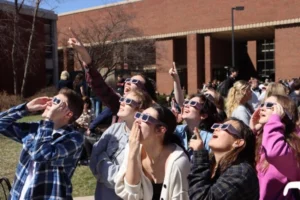
The Planetarium’s 60th anniversary comes at the heels of another astronomical milestone: The planetarium as an invention turned 100 years old in 2023, coinciding with not one but two (!) partial solar eclipses during the 2023-24 school year that together drew over 4,000 people to campus and saw the distribution of 10,000 solar eclipse glasses throughout the community. The 2023 school year also kicked off a new partnership with Milwaukee Public Schools to bring all third graders, an astounding 4,000+ students, to the Planetarium as part of their Extended Learning Journey program each school year.
Crucial to such a monumental operation are the UWM students who design, advertise, and present some of the planetarium programming. We asked them to brainstorm 60 things they are proud of about working at the UWM Planetarium. Below, we listed 10. Follow along on our social media (Instagram/Facebook) as we celebrate more things we are proud of all year long.
- Students have opportunities to develop their leadership skills
- The Planetarium offers programs and events that cross age/cultural background boundaries
- The Planetarium unpolluted skies accessible via the dome
- Staff are able to interact with all kinds of people at events
- Staff help connect people to space (sharing stories and heritage of different cultures)
- Grade school shows spark interest in young minds
- The Planetarium is inclusive
- The Planetarium builds community on campus
- This space is something cool that not a lot of schools offer
- We cultivate a collaborative team work environment and encourage our members to share their ideas

Planetariums like UWM’s will continue to play an increasingly important role: Over the last century, as cities have expanded, 80% of people on Earth have lost access to truly dark skies. Times may have changed since 1966, but the mission has not. We want to inspire audiences with the wonders of the cosmos and to connect us.
Since 2006, over 250,000 people have visited UWM’s Planetarium. Help us envision the next 60 years by celebrating with us at one of our upcoming events, such as the Birth of the Universe show from January 23 to February 27.
By Victoria Robinson, Manfred Olson Planetarium