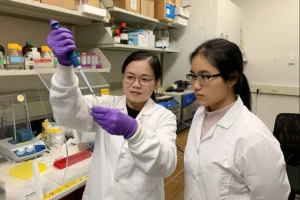
Triple negative breast cancer (TNBC) is one of the most aggressive forms of breast cancer, and it does not respond to any of the hormone therapies designed to treat other types of breast cancer. Instead, the first line of defense for patients with TNBC is chemotherapy with drugs like Paclitaxel or Carboplatin. These medicines do kill cancer cells, but they also attack healthy tissues, leaving patients with side effects that can range from unpleasant to debilitating.
A new start-up founded by two UWM researchers is trying to change that.
SynXT Therapeutics was established last year by Dr. Xiaohua Peng, a UWM Professor of Chemistry & Biochemistry, and her former graduate student, Dr. Taufeeque Ali (’24, PhD Chemistry & Biochemistry). The company is developing a new type of cancer therapy that has shown great promise in treating TNBC without the nasty side effects of traditional chemotherapy.
Ali and Peng founded their start-up with financial backing from several state agencies, as well as support from two Bridge Grants awarded by the UWM Research Foundation. They were just awarded their second Bridge Grant in March.
A novel treatment
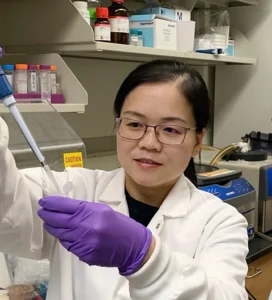
Since she joined UWM’s faculty more than a decade ago, Peng has been devoted to developing anti-cancer drugs with selectivity, meaning that these drugs would only target cancer cells with no toxicity for healthy cells.
“After 15 years of hard work, we identified a pro-drug which is highly promising, showing strong selectivity and very good efficacy in mouse studies,” Peng said. “We designed compounds … which are not toxic, but they can be selectively, specifically, activated in tumor cells. They are toxic only to tumor cells.”
A “pro-drug” is a drug that remains inactive unless it comes into contact with an activating agent. In this case, said Ali, the activating agent is chemicals known as Reactive Oxygen Species, or ROS. ROS chemicals are byproducts of cellular metabolism, and cancer cells typically have higher levels of ROS than healthy cells. The pro-drug is a DNA alkylating agent, meaning it destroys DNA; in this case, the DNA of the cancer cells.
What makes SynXT Therapeutics’ pro-drug so novel, though, is that Peng and Ali have combined it with Vitamin C – yes, the same Vitamin C found in oranges and lemons. Vitamin C can spur the generation of ROS.
“When Vitamin C generates ROS, our drug can use it to become more accurate,” Ali explained. Combining the pro-drug with Vitamin C allowed the researchers to use one-tenth of the dosage to achieve the same results as with the pro-drug alone.
And the results were amazing.
“We got phenomenal results in cell lines, multiple TNBC and even glioblastoma cell lines,” said Ali. “We carried out some animal studies with three different TNBC models and in two of the models, tumors were completely diminished. Gone.”
Even weeks after treatment, Ali, said, the cancer did not return.
Getting to market

Encouraged by their promising results, Ali and Peng patented their work. In 2024, they began exploring how to bring their pro-drug to market. The pair attended the National Science Foundation’s I-Corps program at UWM and interviewed oncologists, scientists, founders, and cancer patients to determine if there was an audience for their product. In 2025, they founded SynXT Therapeutics, Inc., with Ali as the company’s CEO and Peng as its Chief Scientific Officer.
They are in the long process of getting ready to apply for clinical trials through the Food and Drug Administration. The drug must pass through all three phases of FDA clinical trials before it can be used for cancer treatments.
Currently, Ali and Peng are conducting a small pilot study to test the drug’s efficacy against patient-derived tumors. They’ll increase the scale of the study and conduct further animal testing before they apply for an Investigational New Drug (IND) approval. The process will likely take years and will be expensive.
But even if it’s slow going, there’s room for optimism: Ali said the pro-drug is promising in not only treating triple negative breast cancer, but has also shown signs of efficacy when they performed limited tests on glioblastomas and prostate cancers. For now, though, the team is concentrating on TNBC.
And if the process gets to be overwhelming or frustrating, Peng remembers why she began doing the research in the first place.
“For ‘normal’ breast cancer, we have very good hormone therapy, but 20% of breast cancer patients are triple negative. TNBC is very aggressive, so they really suffer from that,” Peng said. “That’s my goal, is to help these women.”
By Sarah Vickery, College of Letters & Science