The word seva comes from a South Asian dialect and means “selfless service.” It’s the perfect name for Srishti Meera Sardana’s lab, because that’s exactly what she and her students try to provide for others in need.
Sardana is an assistant professor in the Department of Psychological & Brain Sciences at UW-Milwaukee, and she also runs the (mental health) Scientific advancements and Empowerment Initiatives with Vulnerable people Anywhere lab – or the mhSEVA lab for short. Her lab and research focus on assisting survivors of global traumas, like war, trafficking, or genocide, by culturally adapting science-backed mental health approaches to meet their needs.
The lab’s guiding principles are collaboration and reciprocal innovation.
“There is no way to innovate scientifically and meet the unmet mental health needs of underserved communities without learning directly from them,” Sardana said. “We may be the experts on evidence-based care, but communities are the experts of their lives. They will tell us what’s working for them.”
That holds true whether she’s working with Rohingya Muslim refugees here in Milwaukee or with victims of genocide and torture halfway around the world.
An unconventional career
Sardana didn’t mean to become a professor. It happened by accident and with support from past mentors, she said.
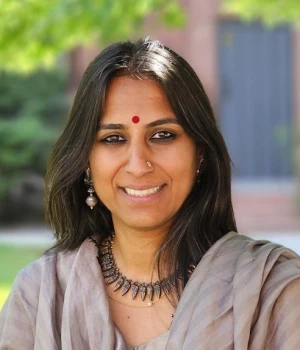
“I’m new to academia, but I’m old to intervention science and working in humanitarian emergency settings. For the last 20 years, since I was quite young, I’ve been working with and alongside communities that are considered to reside on the margins of a society,” she said.
Sardana has lived and worked in ghettos surrounding by sex traffickers and survivors of sex trafficking. She’s seen first-hand how violence, poverty, and disease ravage vulnerable communities. For a while, she worked in law enforcement in hopes of bringing justice to the most vulnerable in society.
But no matter what she did, Sardana realized that there were some problems that she couldn’t fix.
“You could treat people’s wounds at a hospital, but those are just the visible ones,” she said. “What happens to the invisible wounds and the invisibility of distress, the invisible suffering of people on the margins?”
So, she founded the mhSEVA lab at UWM in 2024 to learn how to best address those invisible wounds.
“I thought that (UWM) would be a fitting institution to start a lab. There’s such a zest and enthusiasm in students to learn about this,” Sardana said. “They have communities they care about, and they come from communities I care about. I think there’s been a perfect match.”
Focus on collaboration and reciprocal innovation
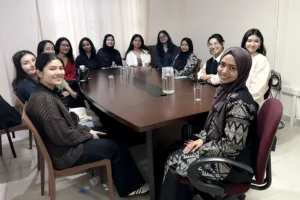
Sardana’s lab operates based on community and governance partnerships, including the United Nations, both here in Milwaukee and around the globe. For instance, one of the partners is the Muslim Women’s Coalition (MWC), which is among the largest refugee response nonprofits in Wisconsin. With the MWC, students in the mhSEVA lab have been working with adolescent survivors of the Rohingya Muslim genocide in Myanmar.
“When we were thinking about the unmet mental health needs of these girls, the founder of the (MWC) said, ‘Well, these are adolescent girls. They have the same problems as every other adolescent girl would and this whole history of violence exposure and the reminiscence of the genocide,” Sardana said.
Another collaboration involves the Asian University for Women (AUW) in Chittagong, Bangladesh. The institution serves women, over half of whom are survivors of torture or abuse. Sardana and her team helped write and distribute a mental health survey for the students and analyzed the results to help the AUW mental health team better focus their efforts for care and healing.
To do the work, Sardana has a cohort of dedicated student researchers in the lab. Several are psychology majors, but some students have backgrounds in social work, economics, and even information technology and engineering.
“The nature of global mental health work is, by design, interdisciplinary,” Sardana explained. “When I was given the opportunity to start the lab at UWM, so much of this is new and the first time that we’re even attempting build an infrastructure that allows for that kind of cross-knowledge exchange.”
Not only that, several researchers — including UWM public health major Rafia Mahboob — bring valuable cultural and linguistic insight to the work. As a Bangladeshi Muslim, Mahboob draws on shared regional and religious context to foster trust and communicate more comfortably with members of the Rohingya refugee community in Milwaukee.
“For my research, I am attending workshops and working with the adolescent girls in person and analyzing their behavior, how they react, how they respond at this moment,” Mahboob explained. “Most of the girls, when they talk about something, they refer to religion or they refer to some region or topic. I can say, ‘Oh yeah, I know what you’re talking about.’”
Mahboob is also working on a mental health needs assessment for students at the Asian University for Women. She recently had an opportunity to meet those students first-hand. With help from Sardana, Mahboob arranged to visit AUW during a previously-planned trip to Bangladesh.
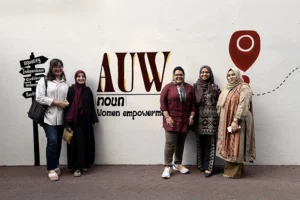
It was a rare and valuable opportunity to see how her student research has tangible effects on the lives of real people.
“I really love what I’m doing. Srishti is a great mentor. I’m learning a lot from the lab,” Mahboob said. “For me, it’s better when I can see that I’m making a difference.”
Mahboob wrote a blog post reflecting on her visit. It is posted below.
Sardana is proud of all of her students and the work that they are conducting. As millions of people are caught in global conflicts, practicing seva to meet their mental health needs and restore dignity and humanity, is becoming more important than ever.
By Sarah Vickery, College of Letters & Science
A Campus Built on Purpose: My Visit to Asian University for Women
By Rafia Mahboob, SURF fellow at the mhSEVA Lab, with Faculty Advisor Srishti Meera Sardana, Assistant Professor in the Department of Psychological and Brain Sciences
From the moment I arrived at Asian University for Women (AUW) in Chittagong, Bangladesh, I felt a quiet sense of warmth. Beyond the visual beauty of the campus, there was something in the atmosphere that stood out, a calm openness that made the space feel genuine. Being there did not feel distant or formal; instead, it felt familiar, as though the campus was designed to make students feel at ease.
AUW operates across three campuses in Chittagong. During my visit, I was able to explore two of them. Although I could not visit the third campus due to time constraints, I heard it is especially beautiful and is often referred to as “Mini Singapore,” a name that reflects the pride students take in their university spaces.
One of the aspects of AUW that inspired me most was how naturally women are represented across all areas of campus life. In Bangladesh, it is still uncommon to see women in certain roles, yet at AUW this felt completely normal. Women were working as shuttle drivers, security guards, and canteen staff, alongside their roles in academic and administrative spaces. Being driven between campuses by a female shuttle driver was a simple moment, but it carried a powerful message about visibility, confidence, and empowerment in everyday life.
A tour to the Goodlife Center was one of the most memorable parts of my visit. The space felt intentionally created for rest and balance. There were areas to lie down and recharge, quiet corners for reading and snack corners, and spaces where students played games simply to clear their minds. The rooftop was especially peaceful, offering a beautiful view of Chittagong and the nearby hill tracts. With its wall art, thoughtful decor, and cozy layout, the Goodlife Center felt comforting and deeply personal, like a place designed with care rather than convenience.
Spending the day with the Mental Wellness Team, learning about their work and touring the campus under their guidance, left a lasting impression on me. It became clear that mental health at AUW is considered an essential part of student life, not an afterthought. Their approach is both compassionate and proactive, emphasizing not only support during challenging times but also the development of resilience and confidence. During my time with them, it was evident that their relationships with students are close and supportive, built on trust and genuine care. The conversations with the team felt thoughtful and sincere, and the advice they offered, grounded in their own experiences, was shared generously, making each moment feel personal and meaningful.
The university library reflected the same sense of care. Spacious, quiet, and comfortable, it felt like a place where students could truly focus, think, and grow. Every part of the space seemed designed to support learning while also respecting students’ need for comfort and calm.
Meeting the Wellness Ambassadors was especially inspiring. Knowing that students are trained to support one another within dormitories showed how much AUW values peer connection and trust. Hearing their stories and seeing how openly they spoke about mental health reinforced how safe and supportive the campus environment feels. I was also able to share my own experience working with the mhSEVA Lab, which made the conversation feel mutual and meaningful.
Having worked as a research assistant with the mhSEVA Lab, much of my engagement with AUW had previously taken place through data, reports, and research projects. Visiting the campus and meeting the students in person added a new dimension to that work. The numbers and findings I had worked with began to feel more personal, grounded in real lives and lived experiences. Being physically present on campus created a quiet sense of reflection, connecting academic projects with the human stories behind it in a way that felt both meaningful and deeply memorable.
By the end of my visit, what stayed with me most was the overall feeling the campus created. AUW felt intentional, thoughtful, and deeply rooted in care, not only for academic success, but for the well-being of every individual. I left feeling inspired and grateful for the experience, with a strong appreciation for how AUW fosters confidence, leadership, and empowerment in ways that feel both visible and genuine.