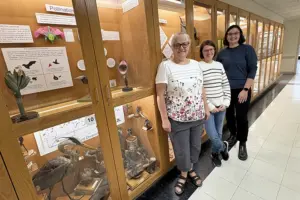
Any student who has ever taken classes in Lapham Hall will recall – perhaps with a shudder – the hallway off the main entrance lined with display cases crowded with old taxidermy animals.
“This was sad. It was sad for a long time,” said Gerlinde Höbel, an associate professor of biological sciences at UWM.
“(The display) was basically just birds on shelves in darkness, collecting dust,” added Wendy Shelton, a laboratory manager for the Biological Sciences Department laboratory courses. “They’ve been sitting here untouched and unloved in our main thoroughfare for decades.”
So, they decided to do something about it.
Now, when students and visitors walk into Lapham Hall, they’ll get to visit the Mini Museum of Natural History.
The Mini Museum opened in August after more than a year of hard work by Shelton, biology graduate student Angela Mish, and a team of more than 25 biology and geology students. Together, the group collected, inventoried, cleaned, and restored hundreds of specimens to display in the (newly refurbished and brightly lit) cabinets. As its name suggests, the Mini Museum is quite small – just the length of the hallway – but visitors will be able to spend hours studying the exhibits.
Building a museum
Shelton was the driving force behind building the Mini Museum. She is a UWM graduate twice over with a bachelor’s and PhD in biological sciences. When she was hired as laboratory manager in 2025, Shelton found herself right back in Lapham Hall staring at the same dusty displays that she had stared at as a student.
“I took classes that used these specimens. I taught a course that used these specimens,” she said.
Shelton, Mish, and Höbel lobbied for funds to upgrade the samples and then hosted workshops for interested students who wanted learn preservation techniques and help the department. Together, they topped up formalin, resealed specimen jars, and cleaned the taxidermy animals (“We polished eyeballs!” said Shelton). They even received some tutoring in preservation from Julia Colby, the Zoology Collections Manager at the Milwaukee Public Museum.
But simply spiffing up the samples wasn’t enough for Shelton and her helpers.
“We didn’t want to just have (the hallway) be storage. We wanted it to be like, here’s all the things you could learn about if you take a class in our department,” said Mish, who is also the vice curator of the Mini Museum.
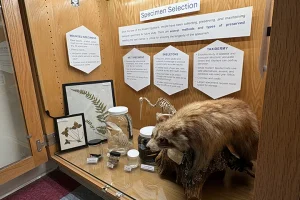
To do that, Mish, Shelton, and several other graduate students began to put together exhibits. Shelton broke the cabinets up into sections that explained over-arching topics, like the importance of scientific collections and taxidermy, animal adaptations and natural selection, the tree of life, and so on. She took special care that the displays featured concepts that students learn about in many of their biology classes, and invited students with relevant expertise to design several individual cabinets.
For instance, Mish designed a display that shows how animals use camouflage to blend in with their surroundings, both to hide from predators and to increase their chances of finding prey. Signage explains some of the methods animals use to adapt to their surroundings, and the in the display itself, visitors can hunt for seven critters hidden among the foliage. If you don’t find them all, don’t worry: The display includes a QR code so you can check your answer on the Mini Museum’s website. There were 18 cabinet authors in total.
Learning at all levels
Designing the exhibits was a fun challenge because Shelton wants the Mini Museum to be accessible to everyone.
“We wanted to help these dead creatures feel alive to people (so visitors) can use them to talk about living systems and to make the cabinets basically accessible to anyone – any education level, any interest, any height,” she said, noting that children will visit the museum during events like Darwin Day and Doors Open Milwaukee.
The new displays should also help UWM students pass the time between their classes, said Mish. They might even help students brush up on their coursework or introduce non-biology majors to some of the exciting things they can learn in a biology class.
Höbel is excited for people to visit the Mini Museum, but she’s also proud of the skills the graduate student volunteers gained as they learned about preservation and creating exhibits.
“I think people may have the misconception that science is all hard data, or it’s all just numbers, or it’s difficult,” she said. “No, no. It’s beautiful, it’s creative, and you can use more skills than you may think you have. It’s another way to teach.”
It may be a mini museum – but Höbel, Shelton, and Mish think it will make a big impact on everyone who visits Lapham Hall. The museum is open 8 a.m.-6 p.m. Monday-Friday and 10 a.m.-5 p.m. on Saturdays.
By Sarah Vickery, College of Letters & Science