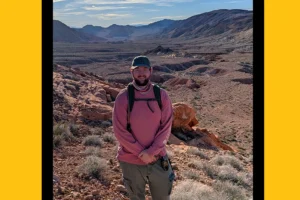
Every year, graduates from the College of Letters & Science enter the workforce and begin to contribute thousands of dollars to their local, state, and national economies. They bring the skills and knowledge they gained at UW-Milwaukee to their jobs, along with their ambitions and fresh perspectives.
In this article series, we highlight some of the recent Letters & Science alumni who have found fulfilling roles in their chosen fields.
Name: Keegan Pinkerton
Major: Anthropology
Graduation Year: 2022
Job: Archaeologist at the Great Basin Institute
For thousands of years, the land around present-day Lake Mead National Recreation Area has been home to several groups of Indigenous people. Nomadic groups of Paiute roamed the Nevada side of the Colorado River. On the Arizona side, the Hualapi and other Yuman-speaking groups made their home. In the north of the park was the furthest-west occupation of Ancestral Puebloans in the American Southwest. The groups continue to have deep ties to the land and its history today.
As an archaeologist with the Great Basin Institute today, it’s Keegan Pinkerton’s job to help uncover and preserve the history and artifacts of those ancient civilizations.
Pinkerton, a 2022 UWM graduate who majored in anthropology, has been a history buff from an early age, and he wanted a hands-on career. Archaeology seemed like a perfect fit. When it came time for college, he chose UWM because it was close to his home in Waukesha, Wisconsin, and it had a respected anthropology program. Unfortunately, Pinkerton’s education was interrupted by the COVID-19 pandemic, and the Anthropology Department’s field schools were cancelled.
Even so, “A lot of the initial skills I needed, I got from UWM. The core principles of anthropology were really well done at UWM, and the classes I took provided a good baseline for archaeological theory,” Pinkerton said. That included classes on software commonly used on archaeological surveys, like ArcGIS.
After graduating, Pinkerton enrolled a field school at San Juan College for the experience (“For people looking into archaeology as a career, field schools are really important. No one will hire you without one,” he explained). Then, he stumbled across a job posting for an archaeologist at the Great Basin Institute.
Most archaeology work for new graduates is short-term contract jobs for local or federal government or private developers. The Great Basin Institute works differently. GBI has a cohort of archaeologists, cultural resource managers, biologists, and botanists that contract with government agencies like the Bureau of Land Management or the National Park Service for long-term contracts, sometimes up to three years in length. Archaeologists like Pinkerton enjoy steady, long-term employment without having to chase down the next contract or continually travel from job to job. Plus, he added, GBI offers good benefits like healthcare and housing when compared to other similar jobs.
Lately, Pinkerton has been helping to manage cultural resources in the Lake Mead National Recreation Area. It’s a huge space – about 1.5 million acres, or the size of the state of Delaware. The basic work of archaeologists falls under the National Historic Preservation Act – specifically, Section 106, which states “if they’re going to build something, essentially, you have to send someone out to check if there’s cultural resources there,” Pinkerton explained.
“Let’s say they’re building a road,” he added. “I have to survey the planned extent of the road out in the desert and make sure there’s nothing out there that they would destroy when they’re building.”
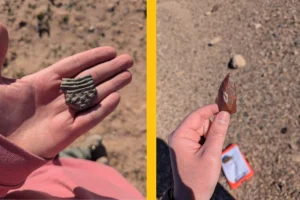
Often, the way is clear and construction can proceed. But sometimes, Pinkerton finds artifacts like lithic stone tools or pottery sherds – remnants from Indigenous people who lived in the area hundreds of years ago. In that case, he and his colleagues document the site and the location and artifacts to a database. Then, he works with the construction crew to perhaps go around the site or find other ways to mitigate the damage the project might cause.
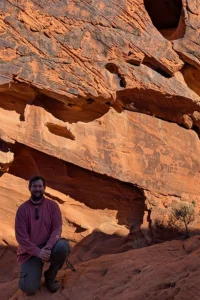
In his work, Pinkerton has seen hundreds of petroglyphs etched on canyon walls. He’s also seen traces left by early settlers and explorers like bottles, cans, and bullet casings. On one memorable occasion, he was part of a team that found a seven-room pueblo that had been forgotten to time. They were the first to record its location.
“To be able to stand in the same place that someone else was standing 1,000 years ago, and you pick up a little piece of pottery that has fingerprints from someone from 1,000 years ago in the pottery as they’re making it – it’s just really compelling to me,” Pinkerton said.
There is a museum at the park, he added, but it contains artifacts collected during past excavations, especially the Lost City excavations in the 1920s. Today, however, the cultural resource department team consults with and respect the wishes of the local Native American tribes, whose ancestors left the artifacts behind. Generally, the tribes want the artifacts to remain where they were found.
For new anthropology graduates, Pinkerton recommends exploring the Great Basin Institute or the American Conservation Experience as a good starter job, or working for the federal government as a seasonal archaeologist. Any of these provide a good stepping stone into an archaeology career, as Pinkerton can attest: He recently accepted a job with the U.S. National Park Service at the Valles Caldera National Preserve and will begin his new role in April.
By Sarah Vickery, College of Letters & Science