Every year, graduates from the College of Letters & Science enter the workforce and begin to contribute thousands of dollars to their local, state, and national economies. They bring the skills and knowledge they gained at UW-Milwaukee to their jobs, along with their ambitions and fresh perspectives.
In this article series, we highlight some of the recent Letters & Science alumni who have found fulfilling roles in their chosen fields.
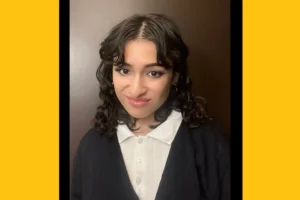
Name: Idalia Rosas
Graduation Year: 2023
Major: Sociology
Job: Agency liaison at the Wisconsin Department of Health Services
Idalia Rosas has always been concerned with fairness.
“Social issues were very important to me at a really young age,” she said. “I wasn’t sure exactly what I wanted to do as a career, but I knew I wanted it to be involved with social justice and equality. I saw sociology as a way to learn more about that topic I was passionate about.”
Rosas grew up in Milwaukee and chose UWM because it was close to home and because the university accepted the International Baccalaureate credits she had earned in high school. She chose sociology as a major so she could follow her passion for pursuing social justice. She chose internships with the Wisconsin Department of Health Services to serve the public, and learned she wanted to work for the DHS as a full-time career.
And after she graduated, she chose to pursue that dream.
Now, Rosas works as an agency liaison at the DHS. Specifically, she is the Pathways to Public Health Strategist, working on initiatives that inform and connect people with jobs in public health.
“I communicate and network and connect with these organizations across all sectors, like academia and nonprofit organizations, to create pathways to public health for students, as well as marginalized communities who don’t have access to workforce opportunities,” she explained.
Right now, Rosas is facilitating a workforce advisory group that brings community-based partners, academics, and government together to address workforce issues. Employment is a large part of public health; people need steady income to afford housing, food, and healthcare. The advisory group is currently working on a project with the five regions of the Area Health Education Center to develop a public health immersion day for high school students so they can learn about career opportunities in the field.
There are a lot of misconceptions about what public health really is, Rosas said. When she was going through school, she was under the impression that it was akin to health care and medicine.
“But once I started working in (public health) as an intern … I realized how much equity work is really based in health outcomes. Racism is a public health issue,” Rosas said. When an LGBTQ+ organization provides sexual health education and testing, that’s public health. When a church group hosts a community wellness event, that’s public health. An information campaign about handwashing, a study on disparities in maternal health outcomes, or a vaccination drive all fall under the public health umbrella.
“We formally define it as the science of preventing disease, prolonging life, promoting health through organized efforts and informed choices of society (with) organizations and public and private communities, as well as individuals,” Rosas said.
She loves connecting with people across the city and state and she likes being able to help others. She hopes that other sociology majors will be able to do the same, no matter where their passions take them.
“Not only can you work in public health with a sociology degree, but you can work in law or environmental (justice) or even politics,” she said. “It’s actually a really valuable degree if you market it well.”
Rosas’ sociology major from UWM gave her the skills necessary for her work. Her classes on statistics and data analysis, even though they were frustrating at the time, have proved invaluable for her current role. She hopes to pass those skills and opportunities on to others.
“I am first-generation, born and raised in Milwaukee. I’m also Latina, so those demographic factors of my background, I see it in my day-to-day work when I’m helping build out these pathway programs for students and other individuals,” she said.
It’s her way of promoting social justice, just like she always wanted.
By Sarah Vickery, College of Letters & Science