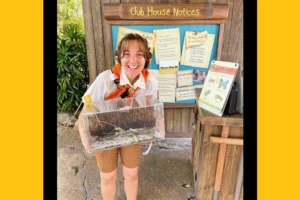
Every year, graduates from the College of Letters & Science enter the workforce and begin to contribute thousands of dollars to their local, state, and national economies. They bring the skills and knowledge they gained at UW-Milwaukee to their jobs, along with their ambitions and fresh perspectives.
In this article series, we highlight some of the recent Letters & Science alumni who have found fulfilling roles in their chosen fields.
Name: Ellie Fix
Major: Conservation & Environmental Science (CES)
Graduation Year: 2021
Job: Animal Nutrition Assistant at Walt Disney World
An adult elephant can eat up to 600 pounds of food per day. Rhinos and hippos can put away up 100 pounds of food in a day, and gorillas typically consume 40-50 pounds.
So when you have a bunch of those animals living in one place – say, in Walt Disney World’s Animal Kingdom – you need a lot of people to help feed those animals.
UWM conservation & environmental science alum Ellie Fix is one of those people.
Fix is an animal nutrition assistant, responsible for prepping thousands of pounds of vegetables, fruit, hay, meat, and vitamins each day to feed the animals that roam Walt Disney World. She works alongside a small team of other nutrition assistants, who also help deliver the food around the park and wash all of the empty dishes that come back.
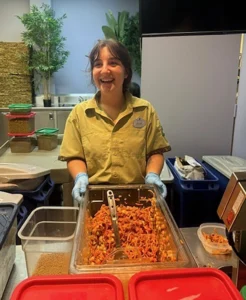
“Your 10-hour shift could be washing dishes all day,” Fix laughed.
Fix grew up in Cedarburg, Wisconsin, and chose UWM because it was close to home and for its engineering program. Early on, however, she switched her major to CES because she’s always loved the outdoors and animals. She thought the program might be a better fit for her than engineering.
It was. Fix thrived in her CES classes. Her favorite was a course on ichthyology, though her class on amphibians and reptiles was a close second. While she took classes, she got some hands-on experience as a volunteer at the aquarium in Discovery World. She also worked in food service to earn extra money while she was going to school.
After Fix graduated in December of 2021, she found a job in UWM’s Student Excellence and Talent center connecting students with job opportunities. She enjoyed the work but soon realized that while she was helping students achieve what they wanted to do, she wasn’t achieving what she wanted to do.
“Then Disney released their ‘Magic of Disney’s Animal Kingdom’ show, and I was like, oh – I could maybe do that as a career,” Fix recalled. “I didn’t think I’d actually end up here, which is wild.”
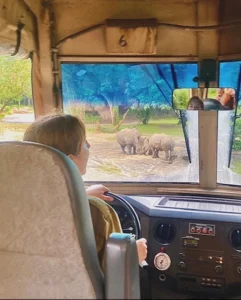
She applied for and was chosen for an internship as a conservation education presenter in Disney’s Wilderness Explorer program. When that ended, she started working as a Kilimanjaro safari guide in the Animal Kingdom and was hired to her current position in 2024.
“I think the combination of managing a restaurant and having all of the animal care experience really got me to where I am,” she said.
That’s because, in essence, Fix is working at a restaurant, but one that serves animals instead of people.
“We’re the meal preppers for all of the animals in Animal Kingdom. We also work in the aquarium over at Epcot, and we (feed) all of the animals for Animal Kingdom Lodge. … We have different aviaries. We have a farmyard. … There’s also the ectotherm team that (cares for) different insects and invertebrates,” Fix explained.
She and her coworkers arrive at work at 5 a.m. to begin prepping the literal tons of food that the animals need. There are different stations where they cook up the “orders.” The diets are determined by animal nutritionists, who work closely with Disney’s veterinarians and animal care teams to ensure the animals are healthy. The work is important not only to ensure that Disney World’s guests have a magical experience, but also because the company is involved in several wildlife conservation efforts, such as sea turtle and manatee rehabilitation. Seeing animals in the Animal Kingdom may inspire guests to take action and support other conservation projects.
“Being able to go and work somewhere doing a lot of good and knowing that I can be a part of it, no matter what my role is, is wonderful,” Fix said. She credits her CES major with not just giving her a background in animal care and conservation, but also helping her develop a broad perspective and being able to talk to people from different backgrounds. It comes in handy when she’s explaining animal nutrition to the park’s guests.
She hopes other students can find jobs that they love, too.
“Take opportunities as they come,” she advised. “(It) may just be a volunteer opportunity, but you never know who you’re going to meet or what it’s going to lead to.”
Fix is grateful that hers led her to some wild adventures.
By Sarah Vickery, College of Letters & Science