President Trump made international headlines when he announced that he wanted to acquire Greenland for the United States. Supporters pointed to Greenland’s strategic location for America’s national security and its resources of rare earth elements. Critics viewed it as imposing on another nation’s sovereignty and warned it would strain relationships with American allies.
But Jessica McBride and her students wondered: What did Greenlanders think about President Trump’s ambitions?
As McBride often tells her students, the best way to find out is to ask.
“The core of journalism needs to be going there,” she said. “There’s no substitute for actually going there in person to the locale and literally talking to people.”
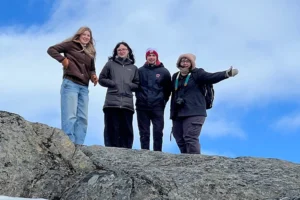
So, she and four UWM students went to Greenland in April.
McBride is a senior teaching faculty member of UWM’s Journalism, Advertising & Media Studies program (JAMS). She also teaches the JAMS Immersion Course, a yearly class where McBride takes several students on a multi-day trip to the field to cover pressing issues of the day. Generally, the trips are funded by a generous grant from the Milwaukee Press Club, but a trip to Greenland was outside of the budget. McBride approached a benefactor, who has chosen to remain anonymous, and asked for a $5,000 donation to match the Milwaukee Press Club’s support.
“He turned around and said, ‘I gave you guys 10 (thousand),’ because he believed in what the students are doing,” McBride said. “This donation does show that the community recognizes the importance of UWM and the work our students are doing, and they support it, which is really great.”
Funding in hand, the students hurriedly applied for passports, packed their bags, and set off.
Greenland on the ground
The first thing that JAMS major Shannon Knowski noticed when she stepped off the plane in Greenland was the wind.
“It was so windy. The first impression was, wow, I can’t stay on my feet,” she laughed. “But my second impression was just how breathtakingly stunning the scenery was. It’s all these snow-covered mountains and hills over the ocean. It’s very desolate, but there’s something gorgeous about it.”
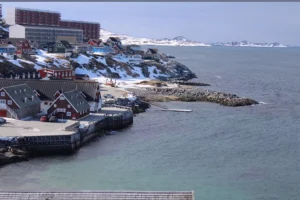
Before they arrived, the students did preliminary research and wrote short articles about Inuit culture, Greenlandic government, and the land’s importance in the race to control Arctic air space. They discovered that Greenland is a territory of Denmark, and Nuuk is its largest city and the seat of its government. The U.S. has had a military presence in Greenland since World War II through an agreement with the Danish government. The Inuit are the original inhabitants of Greenland, but nearly everyone in the territory has a mix of Indigenous and Danish ancestry.
But to truly delve into the culture and the people’s daily lives, the students conducted man-on-the-street interviews. They rented a car and drove around Nuuk, stopping when they saw anyone who looked like they might have something interesting to say.
Knowski and another student wandered into a blacksmith’s shop to talk politics. JAMS major Colby Lamb spent 40 minutes on the deck of a tour boat operator’s vessel, learning about life at Nuuk’s port, before snapping some photos of a Danish Royal Navy ship. The students and McBride also spoke with a unhoused man at shopping mall.
“This man is sleeping in the stairwell while political leaders clash over his country, which his ancestors have been in for thousands of years,” McBride said. “Reporting should be very people-focused. I think we tried to put the people first, not the political clash.”
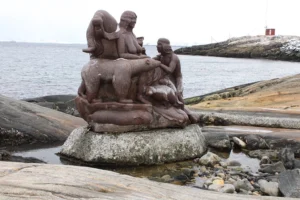
Lamb’s most exciting interview was with a member of the Greenlandic Parliament. He waited all day until Parliament recessed for the evening, and then approached and convinced a member of Greenland’s Democratic party to talk with him about the territory’s governance.
“My confidence has flourished. If I can talk to a Greenlandic Parliament representative, who can’t I talk to?” Lamb said with a smile.
The students were prepared to be rebuffed, but time and again, they found native Greenlanders to be warm and friendly – the exact opposite of the weather, Lamb joked.
The benefits of immersion
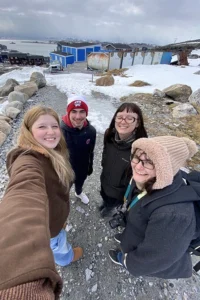
McBride and her then-colleague Jessie Garcia, who is now the news director at channel CBS 58, conceived the JAMS immersion trips in the wake of the 2016 presidential election. The pair took a group of students to Wisconsin’s western border to interview voters who had flipped a stretch of counties from blue to red. The trip was a success and proved to be a great experience for the students, so the pair kept it going.
Now, each year, McBride and the students who sign up for her class spend the first weeks of the course picking that year’s destination. When they return from their trip, students put together multi-media packages of news and feature stories that are posted online. Several students have won state and national awards for their work.
No matter where they go, students agree that the trips helped them grow as journalists.
“I think this trip pushed me to embrace that ‘anyone and everyone’ aspect of who you should be talking to,” Knowski reflected. “I’m a very cautious person, and I think that something that this trip taught me is you don’t need to be so cautious. The worst thing someone can tell you is no. If you put yourself out there, you might get some amazing stories that you wouldn’t have gotten if you weren’t willing to just try.”
“I can’t thank (our donors) enough for a once-in-a-lifetime opportunity,” said Lamb. “They’ve helped lift our careers off the ground. They’ve given us a highlight project and moment in our life that we can carry for the rest of our careers.”
By Sarah Vickery, College of Letters & Science