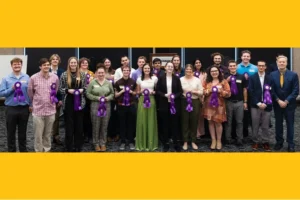
UWM is a top-tier research university, and that’s thanks in large part to our talented student researchers. In April, they were able to show off their accomplishments at the annual Undergraduate Research Symposium, which featured more than 150 scholars in disciplines across the university.
While all of these students have made great strides in their work this year, several were recognized for their research with awards for outstanding posters and presentations. Winners from the College of Letters & Sciences spanned the humanities and social sciences to the natural sciences.
Here are a couple of examples of our wonderful student work.
Humanities/Social Science:
Mason Novak wasn’t trying to win an Outstanding Presentation Award at his first-ever Undergraduate Research Symposium in his first year of college.
“I was just taken aback a little bit, I guess,” Novak admitted. “When I’m doing this type of work, I’m not doing it for recognition or an award. I’m just putting in the effort that I think the project deserves. It does mean a lot that I was recognized for the work that I’ve been able to help with.”
Novak, an urban studies major, is a researcher with the Buildings-Landscapes-Cultures Field School (BLC), a public humanities project overseen by Associate History Professor Arijit Sen. BLC, which has been running for more than a decade, asks students to collaborate with Milwaukee community members in traditionally underserved areas of the city to explore how the history of the neighborhood has impacted the current cultural landscape. They do so by recording locals’ stories, interpreting the data, and presenting it to the community through reports, podcasts, exhibits, and more.

Novak’s presentation explained the work the BLC Field School has done around the Walnut Hill Community Garden, a space on Milwaukee’s northside that has become a gathering place for local residents. Novak helped put together a history of the land by researching permit records, Census data, and even data from a Sanborn Fire Insurance Map. He looked at what buildings used to occupy the space, why they were removed or destroyed, and how Walnut Hill residents reclaimed the land as a garden.
The second part of Novak’s research focused on “asset mapping,” where he and other students collected data from local residents about parks, homes, businesses, hospitals, schools, and more and organized them in a booklet that they gave back to different Walnut Hill community members.
“I really do like this part, because it gives the community a resource that they can show to outside stakeholders or investors (to show) that there’s value and worth in the neighborhood, even though areas like this typically get ignored,” he said.
The final piece of research was “vision-mapping,” where BLC Field School students gathered ideas from community members about how they wanted to cultivate the gardens – and not just in terms of crops.
“(We’re hoping) to install new paths, put a soccer field in the back, install new garden beds, put in several murals, do a lot of painting projects, and install benches,” Novak explained.
Novak began this research before he had even begun classes at UWM. He was part of UR@UWM, a summer program that pairs incoming first-year students with research mentors. He stayed on as a student researcher through the rest of the year and is looking forward to continuing his work next fall.
This work is important, he said, because understanding the history of Milwaukee’s neighborhoods gives people a better understanding of the city’s current conditions.
“There are so many historic actions that have happened and consequences from those actions have built up and explain why certain areas look different from others,” Novak said. “There are so many people who live and thrive here, even though there are challenges in certain areas of the city.”
He can’t wait to see where in Milwaukee his research will take him next.
Natural Science
Physics and philosophy double-major Jack Grummer was excited to win an Outstanding Presentation Award because it meant that he truly understood his work.
“Part of understanding something is being able to communicate clearly. The fact that I could communicate my research well enough for people to think it was outstanding was very rewarding,” he said. “It shows I really did have a good mastery.”
Grummer is a student researcher in the lab of Min Gyu Kim, a UWM assistant professor of physics. His work focuses on antiferromagnetic domains and how they are impacted by changes in temperature.
What does that mean, exactly?
Well, magnetic domains are regions within a magnetic material where the individual magnetic moments of atoms are aligned in the same direction.
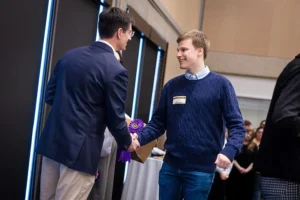
“All our technology uses magnetic domains in some way. You store data in magnetic domains,” Grummer explained.
Most of our technology uses ferromagnets, but they do have some limitations. In contrast, antiferromagnets have domains that are much smaller but have capacities that exceed our current applications. So, naturally, scientists want to know more about antiferromagnetic fields and their capabilities. The problem is, these domain fields are hard to study because there are very few ways to visualize them, since they’re at the atomic level.
One of the goals of Dr. Kim’s lab is to learn more about magnetic domain formation in a sample material called Cobalt-doped FeSn in hopes that they can apply what they learn to other antiferromagnetic domains. To do that, Kim and his researchers headed to Brookhaven National Laboratory in New York, where there is a synchrotron that can make x-rays to image the magnetic domains.
They found that temperature had an interesting effect on AFM domains.
“We would heat up the sample, and we saw the magnetic domains would increase as our temperature increased,” Grummer explained. “But what was really interesting is that they didn’t decrease when the temperature decreased. So you’d have domain freezing, and that has a whole possible host of technological applications.”
Because technological data can be stored inside magnetic domains, he said, scientists may be able to use this information to affect how data is stored and deleted.
Kim’s lab is still analyzing this data and sorting through the implications, but they will have to proceed without Grummer. He is set to graduate this month and will be attending graduate school at the University of Notre Dame.
He has advice for the students still at UWM: Get involved in research. “You will learn a lot of valuable skills and deeper knowledge than what can be given in a classroom setting, making you really well prepared for whatever path you follow after graduating, and making you an attractive applicant for jobs and grad schools,” he said. “(Dr. Kim and this research) helped me grow as a physicist and I would not be as successful as I am without it.”
Other Outstanding Presentation Award winners from the College of Letters & Science include:
- Montana Bruckner, “Effects of a Novel Estrogen Receptor Beta Agonist on Memory and Hot Flashes Related to Menopause” (Psychology)
- Jena Choi, “Geological Process Drawings” (Geosciences)
- Julia Chrupek, “Examining 17β-Estradiol-Induced Regulation of Ubiquitin Proteasome System Activity in the Dorsal Hippocampus Following Object Training in Ovariectomized Female Mice” (Psychology)
- Leila Goodrum, “Implications for Speciation of Genetic Architecture Affecting Signal-Preference Variation in Plant-Feeding Insects” (Biological Sciences)
- Tomás Hill, “Developing Culturally Responsive Research Tools: Assessing Semi-Structured Interview Guides for Native American Communities” (Psychology)
- Cameron Lee, “Grip Strength and Percentage Change Over the Lifespan: NIH Toolbox” (Data Science)
- Allyson Ruffino, “Frequency of Mucoid Mutants with Phage and Antibiotic Selection” (Biological Sciences)
- Nicholas Nelson and Nathan Theis, “The Correlation Between Hydrogen Column Density and Dispersion Measure Using Pulsars” (Physics)
- Parnian Vakili, “The Role of Midkine in Pancreatic Cancer Liver Metastasis” (Biological Sciences)
- Christopher Vician, “Volcanic and Alkaline Mineralogy of Lake Natron’s Margin: Analogues for Planetary Surface Processes” (Geosciences)
- Noelle Wallisch, “Comparative Osteology of the Humerus and Femur of Wisconsin Foxes” (Anthropology)
By Sarah Vickery, College of Letters & Science