UWM’s “campus bubble” can seem like its own little world at times, but the events and stories that happen on campus and in Milwaukee can reverberate around the globe.
Just ask the Panther Tracks podcast team.
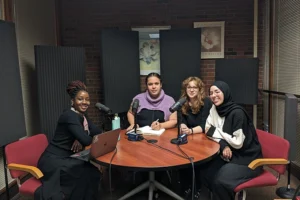
Panther Tracks is a student-run podcast that tackles global stories from a local perspective. Episodes are released weekly and are available on Spotify. Led by Grace Pagel, a journalism, advertising, & media studies major who is an experienced podcaster, the students choose their own stories, record the own interviews, and edit their own content.
“For a lot of our episodes, we try to focus on things that are relevant to students, relevant to Milwaukee community members,” Pagel said.
Serving their community
Panther Tracks is the brainchild of Christine Wolf, the assistant director of UWM’s Global Studies and International Studies programs. It started life as the Panther Planet Podcast but evolved over time into its current format. Now in its fourth season, Panther Tracks is gaining a bit of popularity.
“You want to stay current and relevant, right? … We’re an 80% commuter campus. Every Wednesday morning, we want those commuters turning on Panther Tracks. We keep our episodes to 20-25 minutes, so that way it’s a nice, good commute time,” said Kaye Van Susteren-Wedesky, UWM’s National Resource Center Title VI grant manager, who oversees Pagel and the podcast interns.
“I think doing a weekly episode has really challenged us and helps keep it rigorous, which I think is a great opportunity for all of the interns, myself and Kaye, to grow as professionals, stay organized, and communicate with the team,” Pagel added.
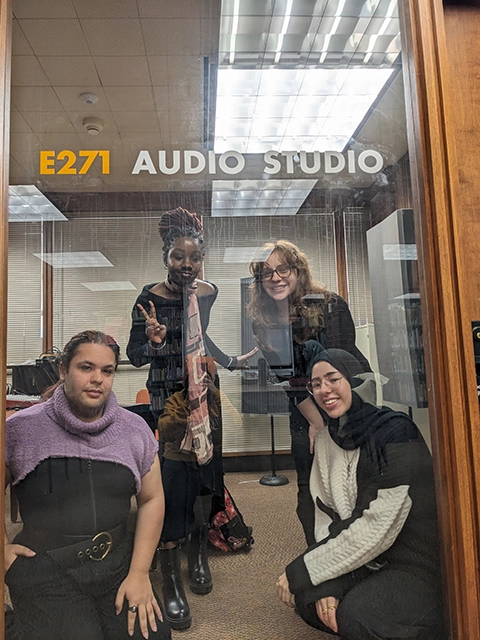
That team includes communication major Cristopher Santos, psychology major Patricia Iwok, and English and psychology double-major Nada Abduljalil. Together, the crew has brainstormed and planned a variety of episodes this semester that cover everything from interviews with international students to spotlights on Milwaukee community organizations.
Take, for example, Episode 8 of Season 4, which features the organization Pretty Girls are Educated. Run by Nicole Goins, the Milwaukee-based group teaches young girls and teens life skills and provides them with support and community. Or take a listen to Episode 14, which talks about Tricklebee Café, a pay-what-you-can vegetarian restaurant that tries to address food insecurity.
Other episodes give listeners a global perspective by covering cultural events, like UWM’s Irish Immersion weekend. But Panther Tracks covers hard-hitting issues and sensitive subjects as well.
“We look at our community of UWM and Milwaukee and think, how does this affect things globally?” Van Susteren-Wedesky said.
It’s hard to choose a favorite, but Pagel recommends listening to the episode that covers Thomas Gibson’s appointment as UWM’s new chancellor.
Creating a lasting impact
The podcast is supported by a U.S. Department of Education Title VI National Resource Center (NRC) grant. The NRC is complex – in fact, Panther Tracks’ first episode of season four is dedicated to explaining what the NRC is and what it does at UWM – but its main purpose is to prioritize the study of critical languages and to educate students about global perspectives.
Panther Tracks is important, Pagel said, because it amplifies voices across Milwaukee that are often left out of the conversation.
“We have met with so many organizations within Milwaukee that a lot of people do not know about but are doing such great work for the community and for our UWM community,” added Pagel. “These stories are very touching and they’re really cool.”
The students are having fun, but more than that, they’re gaining experience. They’ve honed their interviewing skills and improved as writers. They’ve learned about communication technology and how to work within a team.
For Pagel, leading the team has given her a taste of managing others and making editorial decisions. She’ll carry that experience with her as she graduates in a few short weeks.
As much as Pagel and Van Susteren-Wedesky have enjoyed making the podcast, they hope their listeners enjoy hearing it.
“I hope they walk away with a sense of community,” Van Susteren-Wedesky said. “It’s difficult sometimes to look at Milwaukee and find your niche. So, if this is a tool that helps you realize there are communities within communities and they all overlap, that’s really beautiful.”
You can visit Panther Tracks on Instagram and listen to the podcast on Spotify.
By Sarah Vickery, College of Letters & Science