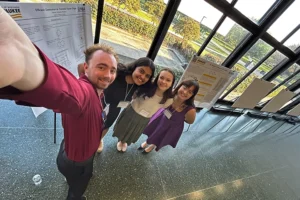
UW-Milwaukee has a phenomenal undergraduate research program where students can learn from faculty and graduate student mentors.
But how does a graduate student learn how to be a mentor?
A new program in the Mathematical Sciences Department aims to educate two birds with one stone by both giving undergraduate math students a research experience opportunity and giving graduate students a chance to design that opportunity. The new Graph Enumeration and Mathematical Studies (GEMS) Undergraduate Program, conceived by math professors Pamela Harris and Gabriella Pinter, is funded by a grant from the Mathematical Association of America (MAA) and debuted this past summer.
“The thing that’s unique about this program is that the graduate students were the leads…. (They) took charge of crafting what the program would look like,” said Harris.
How did GEMS work? Here’s the story.
The methods and the math
Graph theory was the perfect mathematical concept around which to build a research program. Also known as “network science,” it has many practical applications – for example, finding the least amount of cell phone towers needed to service a particular area so there are no gaps in coverage.
“I think graph theory is nice because you can get into it relatively easily. You don’t have to study a whole semester to understand every concept,” said Pinter. “You can come up with new ideas and new questions that no one else has actually looked at before.”
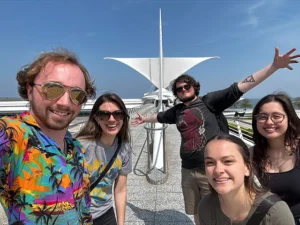
So, graduate students Jillian Cervantes, Kimberly Harry, Matt McClinton, and Melissa Beerbower began to build a curriculum. They created a schedule for the six-week summer program, starting with a week of lectures and skill-building – for example, teaching students to use the mathematical typing software LaTeX or showing them how to write a mathematical proof. After they had the basics down, the mentors coached their mentees to craft a research project that they would later present at the Society for Industrial and Applied Mathematics Great Lakes Sectional Meeting in September.
But the program went beyond mathematics. The mentors also arranged several outings for the undergrads, including trips to the Milwaukee County Zoo, the Milwaukee Art Museum, and a Brewers baseball game.
“We wanted (the GEMS students) to feel connected to the department as well, so we invited other grad students on outings,” Harry said. “(They’re) realizing all of a sudden they can talk to a grad student and tell them about the research they’re doing and have someone be excited about it with them.”
And, perhaps most importantly for the students, they were paid for their work and the program included meals. Harris wanted to ensure that there were no barriers for students who wanted to participate in GEMS, so meals were included as working breakfasts and lunches to ensure the participants never had to worry about food costs.
The mentors
The graduate students blossomed as the program progressed. They learned the best ways to motivate their mentees, how to foster collaboration, and how to prepare the undergraduates to present research.
“What was really lovely to see how they were growing as mentors,” Harris said. “At the end of the day, our graduate students are going to become the professors. What better opportunity than to have them start learning how to be professors by helping students start doing research?”
Though Cervantes had participated in research when she was an undergraduate at UWM, this was her first formal mentoring experience. Harry, on the other hand, never had a research experience as an undergraduate, but did have experience writing lectures and designing homework as a graduate student during her PhD program at UWM (Harry graduated this August). With both of their perspectives, plus those of their collaborators, they were able to design a program they could be proud of.
“I think that each one of us can say we left the program more confident in mentoring students,” Harry said.
“Learning how to mentor is something that I wouldn’t have really been able to learn without getting some practical experience doing it and seeing what challenges come up,” Cervantes added.
The mentees
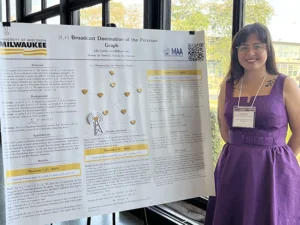
Undergraduate student Lilly Carrillo just changed her major to mathematical sciences last year. She had never participated in undergraduate research or even written a mathematical proof when she enrolled in the GEMS program.
“I started at UWM at the lowest math level and have clawed my way up – and I’m still clawing!” she said. “I started this program feeling like an imposter. I lacked confidence. But the mentors really helped me shine, and they assured me that I’m actually smart and creative. It feels good to have the support that they gave me in writing proofs, supporting my ideas, and letting me venture through these research problems.”
Over the six weeks, Carrillo gained new math skills and learned more about the practical applications of theoretical research. Her project focused on (t,r) broadcast domination of the Petersen Graph – “It’s kind of like placing cell phone towers or satellites where lines meet (which we could call objects), and they emit a reception to other objects that are within the graph,” she explained.
She and her fellow undergraduate researchers created posters and publicly presented their work as a capstone to the GEMS program. This coming year, she plans to present her research at two symposiums. In fact, three of the four GEMS undergraduates decided to participate in the UWM SURF program after their research experience this summer.
What’s next
The GEMS program will continue in a new form for the next three summers, thanks to a grant from the National Science Foundation. It will be similar to the inaugural program, though sadly, said Harris, the new grant will not allow her to cover students’ meal costs. Even so, she anticipates that there will be more faculty members involved and graduate students will still mentor the undergraduate students.
She even plans to open the program to students nationwide, so that they will travel to Milwaukee to participate, and more students at different skill levels will be able to participate.
In the meantime, Cervantes, Harris, and Pinter are scheduled to present on the GEMS program at the Joint Mathematics Meetings later this month. They are excited to share more about the success of GEMS.
“For me … math is secondary. I know that sounds ridiculous, but I think the part that we look for is the building of connections, building relationships and knowing that we’re part of a math community that is supporting each other and creating opportunities for each other,” Harris said.
By Sarah Vickery, College of Letters & Science