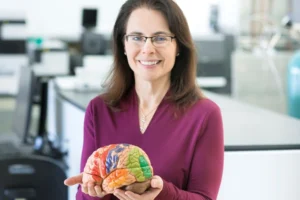
Four years ago, UW-Milwaukee debuted its neuroscience major. The first year, two students enrolled in the program. By the second year, there were 75 neuroscience majors. Now, there are over 150 – and that number is only growing.
“There’s a thirst for knowledge about the brain,” said UWM Distinguished Professor Karyn Frick, who heads the neuroscience program along with Associate Professor of Biological Sciences Christopher Quinn. “Students find the brain really interesting. Now more than ever, I think they’re aware of various mental illnesses that either they, their friends, or people in their lives have been affected by and want to know why.”
Neuroscience is the study of the brain and its functions. It explores the “software” of the brain – how we form memories or process language, how certain drugs affect the brain, how hormonal processes impact cognition, etc. – and the “hardware” – how neural cells develop, how regions of the brain connect, how the spinal cord operates, and more.
“Through the study of neuroscience, we can learn how changes in our genes can cause defects in brain connectivity and disruptions in our behavior. These behavioral disruptions can be manifested in common disorders such as autism, ADHD, and schizophrenia,” explained Quinn.
At UWM, the neuroscience major is interdisciplinary, so students can explore all aspects of brain science. They take courses in psychology and biological sciences, as well as chemistry and physics, to develop a deep understanding of the brain and its mechanisms.
By the time they’re ready to graduate, said Frick, neuroscience majors will be prepared to either take the next step to graduate or medical school, or join the workforce. “There are many avenues in which people could take advantage of they knowledge they’ve learned about brain function and apply it to various kinds of professions,” Frick said, including in science communication, law, ethics, or healthcare.
But the real reasons that you should take a closer look at UWM’s neuroscience program, she added, is the research.
“You can study neuroscience anywhere,” she said. “But what’s unique about UWM is that, as a research university, students get the chance to gain hands-on experience conducting neuroscience research and to actually contribute to our foundational knowledge about how the brain works.”
Hands-on research

Just ask senior Montana Bruckner.
“I like learning about the inner workings of the brain, how it relates to the rest of the body,” she said. “I’m working on research in women’s health and how estrogen receptors relate to certain neurodegenerative diseases such as Alzheimer’s.”
Bruckner, who is double-majoring in neuroscience and biological sciences, got involved in research through the NIH-funded Success Through Aging Research research training program, for which Dr. Frick serves as Principal Investigator. She was matched to Frick’s lab, which focuses on drug development to treat conditions related to menopause, such as memory loss and hot flashes. Right now, Bruckner is assisting in drug efficacy testing in mouse models of menopause.
The research experience will look wonderful on her résumé if she decides to apply for graduate school, but Bruckner has found a different motivation for her studies. Last year, she presented her work at an elder-care facility in Milwaukee. The audience was eager to hear about her findings.
“When you’re working on the research itself, you’re focusing on trying to get the results … but that was the first time where I saw that it really made an impact on people,” she said. “It really hit me why research is done, and I had never had that experience before.”
For sophomore Braden Ruiz, research is what crystallized his decision to attend UWM. He was invited to join the UR@UWM program, which offers matriculating students a chance to get involved in research before they even begin classes at college.

“As you can see, I’ve stayed here ever since,” he joked. Ruiz is working with a graduate student to study what proteins in the brain help with memory recollection, object recognition, and spatial awareness. Identifying those proteins could be the first step to developing treatments to mitigate the effects of dementia and Alzheimer’s disease.
“If the brain at all interests you and you want to go more in depth, I would say just go for it,” Ruiz said. “Research gives you the ability to explore on your own.”
Collaboration with Biological Sciences
A key aspect of the neuroscience major is that it allows students to conduct research and coursework within two distinct departments.
“Students can customize the major according to their interests,” said Quinn. “As they complete introductory coursework, they are likely to develop interests that steer them towards advanced courses and research projects in one, or both, departments.”
In the Department of Biological Sciences, researchers explore neuronal development beginning with migration of neural precursors and brain morphogenesis. They also address what can go wrong in conditions ranging from early-life disorders, like autism, to age-related diseases such as Parkinson’s disease.
“Students are often amazed to learn that we can introduce specific human gene mutations into the brain cells of animal models,” said An Phu Tran Nguyen, Assistant Professor of Biological Sciences, whose laboratory investigates the cellular and molecular mechanisms of neurodegeneration in Parkinson’s disease. “This allows us to see firsthand how those mutations affect the way neurons function and, ultimately, to better understand the mechanisms behind these diseases.”
In addition to his work on Parkinson’s, Tran Nguyen plays a key role as the instructor of the “Cellular, Molecular, and Developmental Neurobiology” class, a key required course for all neuroscience majors.
The neuroscience major has also been instrumental in attracting support from the Shaw Fund of the Greater Milwaukee Foundation for expansion of neuroscience research within the Department of Biological Sciences. For example, the Foundation has provided an early career award to Assistant Professor Nadège Gouignard to support her work on neural crest cell migrations. The Foundation also made a $980,000 gift to support the recruitment of Tran Nguyen and to provide stipend support for graduate students.
The future is bright
The addition of the neuroscience major isn’t the only change to brain sciences on campus; new this year, the Psychology Department is now known as the Department of Psychological & Brain Sciences. The name reflects the strength and research interests of the department’s faculty, said Frick.
“‘Brain science’ informs almost all the research conducted in the department; not only the work of faculty who primarily identify as neuroscientists, but also that of our clinical colleagues,” she added. “We felt like changing the name to Psychological & Brain Sciences more accurately described what we do.”
Faculty in the department are investigating myriad questions, from the effects of cannabis on adolescent brains and mechanisms that increase susceptibility to post-traumatic stress disorder to identifying the neural mechanisms through which the brain categorizes information, pays attention, and forms memories throughout the adult lifespan.
Now, though, despite the growth of psychology and neuroscience majors, faculty in the department are wrestling with the aging infrastructure in Garland and Pearse Halls, the longstanding home of Psychological & Brain Sciences. These connected buildings, which date to the early 1900s, lack lecture halls, student gathering spaces, and, importantly, adequate mechanical systems and facilities for modern neuroscience and psychological research. Frick hopes that capital funding will be approved for a new building so that students and faculty can have access to the space and equipment needed to conduct their cutting-edge research.
Bruckner hopes that more students pursue brain science.
“I think that neuroscience is a thing that everybody should be able to understand, especially because there are a lot of neurodegenerative diseases that are happening in the U.S. right now,” she said. “I think that having a little bit more understanding of what people could be going through, or how these diseases develop, and knowing how they can be prevented – I think that’s essential for how we’re living now versus 100 years ago.”
By Sarah Vickery, College of Letters & Science