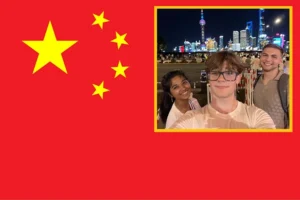
UWM Chinese program students Owen Czubin, Emmanuel Weber, and Hidayah Osman spent three weeks over the summer learning about emerging technologies and experiencing Chinese culture at the Shanghai University of Finance and Economics.
For the students, it was a dream come true to study and travel in China. For their instructor, Senior Teaching Faculty Lu Yin, it was equally rewarding to see them go. Yin discovered the Shanghai program, which covered tuition and housing, and went a step further by successfully applying for UWM grant funding to cover the students’ round-trip airfare.
“I thought, okay, they don’t have to worry about the money,” Yin said. “And then if they go to China, they’ll be immersed in the language environment. It will help them continue learning Chinese.”
The program’s curriculum focused on new and emerging technologies and China’s role in their development. The first week focused on new energy vehicles, the second on artificial intelligence and the digital economy, and the final week on entrepreneurship and innovation in Shanghai. Each day featured lectures, site visits, or cultural workshops, culminating in a final project presentation
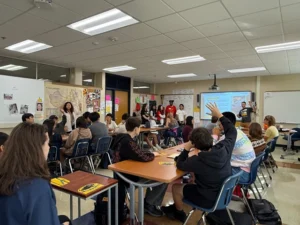
The experience proved transformative. After returning to the United States, the students shared their insights with peers in UWM’s Chinese classes and visited Brookfield East High school, where they gave a presentation titled “Tasty, Techy, and Green: Exploring China with UWM Students.”
Their talk sparked lively interest among the high school audience, with many students expressing enthusiasm for learning Chinese and exploring study-abroad opportunities in China. Yin reflected, “This underscores UWM’s dedication to building partnerships with local schools while inspiring future generations to engage with world languages and global perspectives.”
Emmanuel Weber
“Manny” Weber is of Puerto Rican descent, and he’s long seen China as a strategic partner for Latin American and the Caribbean. That’s why he decided to add a Chinese minor alongside his major in supply chain management. But Weber wasn’t satisfied with what he knew of China based purely on Western media. So, he decided to experience the country for himself.
“China is a totally different place than you would expect from what you hear in western popular culture,” Weber said. “China is really at the center of what is happening in the new multi-polar world system.”
He particularly enjoyed the topics explored during the week-long courses. China, he learned, boasts the world’s largest electric vehicle market, and has diversified its energy portfolios to meet the needs of the AI data centers the country is constructing, an area that the United States is still struggling to reconcile.
“This is a pretty cool opportunity to me as a business student because these are exactly the industries that I find so fascinating. I learned a lot about the internal dynamics of the new electric vehicle market, and I learned a lot about how AI is being used,” Weber said. “China is the source of the most advanced manufacturing technology. What is happening in China should be of vital importance to everybody in the world.”
He hopes to take this experience, his Chinese language skills, and his business acumen and apply it in a career working in international business or trade between Latin America or North America and China.
Owen Czubin
Owen Czubin is double-majoring in computer science and Chinese. While he found the classes on EVs and AI interesting, he was more interested in using the trip to strengthen his Chinese language skills and learn about Chinese culture.
Czubin enjoyed touring not only Shanghai alongside Weber and Osman, but also Beijing, Hangzhou City, Suzhou City, and Mount Huangshan. Each locale was beautiful; in his presentation, Czubin shared that Suzhou has often been called the “Venice of the East” because of its classical gardens and canals, and marveled at the beauty of Huangshan, which is also known as the Yellow Mountain.
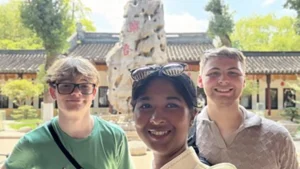
“There’s a lot of ancient pine trees and beautiful scenery up there. Beyond the mountains, there are a lot of ancient villages surrounding it … (some of which) are UNESCO world heritage villages,” Czubin said. “It was, I think, the most beautiful place we went.”
Visiting Beijing and seeing famous sites like the Temple of Heaven, the Great Wall, Tiananmen Square, and the Forbidden Palace was also exciting. In each new place, Czubin got to practice his language skills a little more.
“Communication was really tough at first … but as we got along, I got better at using the (translation) apps and such. The hotel and restaurant, security and retail staff, everybody is really patient and helpful,” Czubin observed during his presentation. “I got better at listening and better at speaking quickly. It felt like a really important threshold in my Chinese learning.”
Hidayah Osman
Architecture major and Chinese minor student Hidayah Osman had an especially exciting summer. In addition to participating in the Shanghai program, she was selected by the judging committee of the 2025 Midwest College Chinese Speech Contest to represent the U.S. Midwest at the 24th Chinese Bridge Competition, an international competition that brings together top foreign college students to demonstrate their mastery of the Chinese language.
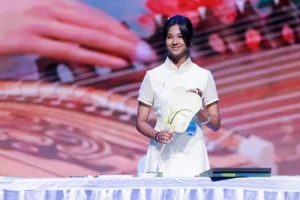
Competing against 155 top contestants from 133 countries and regions, Osman earned an Award of Excellence, which granted her a semester of Chinese language study in China. Her accomplishment highlights both the strength of UWM’s Chinese language program and the university’s growing global presence. Osman expressed heartfelt gratitude to her teacher, Lu Yin, for her dedicated mentorship and support.
In addition to competing, Osman joined other participants for three weeks of cultural exploration in Beijing and cities across Fujian Province. In her presentation to her classmates after her return, she shared highlights from her journey, from the Forbidden City in Beijing to the breathtaking Mount Wuyi and Nine-Bend river in Fujian. Osman also attended the World Robot Conference and toured a “dark factory,” a highly automated facility where robots operate with little to no lighting. She experienced China’s high-speed trains, learned about tea customs and performing arts, and enjoyed Kungfu demonstrations and other cultural activities.
Yin could not be prouder of her students.
“Everybody should know that our students did a very good job,” said Yin. “We have excellent students at the advanced level who now represent UWM on the world stage.”
By Sarah Vickery, College of Letters & Science