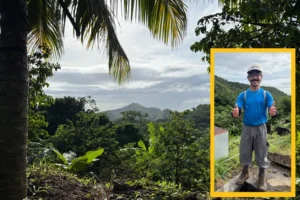
Jaeden Carrasquillo can’t stop smiling.
Even when he is battling razor grass (“It hurts! You get a lot of scratches”), hiking treacherous terrain (“It was basically ‘Man vs. Wild’”), or flushing a frog’s stomach (“It’s about as crazy as it sounds”), Carrasquillo is having the time of his life.
Of course, it helps that he’s doing it all in the tropical island paradise of Grenada.
Carrasquillo, a conservation & environmental science (CES) major, is one of three UWM students participating in UW-Milwaukee and Wisconsin Lutheran College’s Grenada SURF-TURF program, along with biological sciences major Mackenzie Dasek and geography and CES double-major Kaitlyn Lund. UWM PhD student Billie Harrison, who accompanied the students on the trip, has partnered with Wisconsin Lutheran College for reef research initiatives in 2008, but this current collaboration between UWM, WLC, and conservationists in Grenada is meant to build US scientists’ international research capacity by training undergraduate students in field research and conservation practices.
The program was funded by an International Research Experiences for Students (IRES) grant from the National Science Foundation and overseen by UWM Biology Professor Emily Latch. That funding covered everything – airfare, lodging, transportation, research equipment, and even scuba gear.
“I want to highlight how important this program is to UWM,” Carrasquillo said. “I would not have dreamed of doing something like this because it didn’t seem possible for me. But having this program at UWM and … getting the NSF grant to pay for everything is the only reason I have been able to get my foot in the research door.”
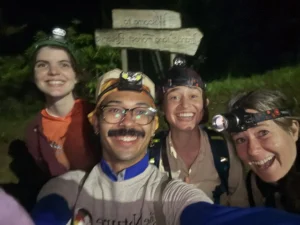
The group left for their adventure in May and will return in early July.
Getting started
Carrasquillo is a Milwaukee native, so UWM has always been close – “geographically and emotionally,” he joked. He was drawn to environmental science because he wants to help preserve the planet for future generations. When he entered UWM, declaring a CES major was an obvious choice.
And when Latch and Harrison visited one of Carrasquillo’s biology classes last fall to recruit applicants for the SURF-TURF program, that was an obvious choice too.
“I was like, I need to make sure I can go,” he said. “(When I got my confirmation), I couldn’t stop smiling for 20 minutes because I was in awe. I truly can’t describe how good I felt in that moment.”
To prepare for the trip, the students took a class over the spring semester to learn about the ecology and culture of Grenada, as well as the research practices they would need on the island.
Research in Grenada
Each student crafted their own research project to explore during the trip. The Wisconsin Lutheran students are studying marine life, but the UWM students are more interested in the terrestrial.
“We were all helping each other with our projects and making sure everybody got the data they needed,” Carrasquillo said. “It’s been really interesting to see how all of our projects work together.”
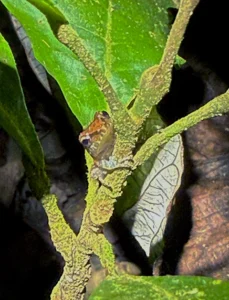
For instance, Lund is examining the environmental features, such as soil pH, humidity, and canopy coverage, to study the habitat of the Grenada frog. Dasek is studying which insects are in the frog’s preferred diet. That’s where the amphibian stomach-flushing comes in.
“I get to hold a frog, and (Dasek) basically puts a syringe in their mouth. It’s a couple of cc’s of water into their digestive system and then out, and then we get to see their frog vomit and see the things they eat,” Carrasquillo explained. “It’s pretty weird at first, but now I’m like, ‘Oh, look at the wing of the mosquito in there!’”
Their research supports the work of Harrison, who has been studying the Grenada frog for years. For such a small animal, it’s facing some big threats.
“The Grenada frog is found only on the island of Grenada. Like many island species, it faces a high risk of extinction due to its small range, shrinking habitat, sensitivity to environmental changes, and limited conservation support,” Harrison explained. “Our team is working to understand where these frogs live; how they’re affected by threats like disease, habitat loss, climate change, and invasive species; and to gather essential data about their populations.
“We are very fortunate to have students like Jaeden Carrasquillo working hard to gather data needed to guide local conservation efforts and help protect this unique species for the future.”
For Carrasquillo’s project, he wants to see whether there was more biodiversity in areas protected by the government versus areas without federal protection. So, he visited multiple sites in different forests, selected 30-meter transects, and counted and catalogued all the vegetation he could see: Razor grass, massive broadleaves, heliconia, ferns, and more.
He’s still processing the data, but so far, it looks as though there is greater plant diversity in federally protected areas. Carrasquillo hopes his results can help the Grenadian government make more informed decisions about its land use and conservation methods. It would be a nice payoff, considering the hard work the students put in to collect their data.
“We were very off the beaten path. We did some crazy hikes,” Carrasquillo said with a laugh. “The terrain is very steep. There is so much thick vegetation, and you can tell that literally no one has been there before.”
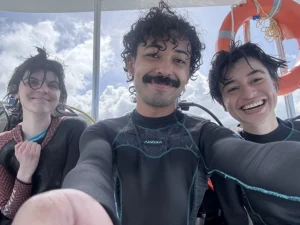
In addition, the UWM students assisted the Wisconsin Lutheran team with their fish and coral surveys during scuba trips off Grenada’s coast.
What he’s bringing back
Being in Grenada is an amazing experience, Carrasquillo said. He’s learned so much, not just about Grenadian ecosystems and frogs, but also about how to write a research proposal, conduct field work, and analyze statistical data. He learned about the welcoming culture of Grenada’s people, who offered their knowledge about the terrain and wildlife that gave the students new insight into their work.
Carrasquillo also learned skills that he wants to use in service of his hometown. “In my research (in Grenada), I wanted to replicate something I could do down here very similarly in urban environments, especially in Milwaukee,” he said.
When he does, you can be sure he’s doing it with a smile.
By Sarah Vickery, College of Letters & Science