¿Cómo puedo ayudar? How can I help?
Allison Libbey’s Spanish students asked that question a lot this semester.
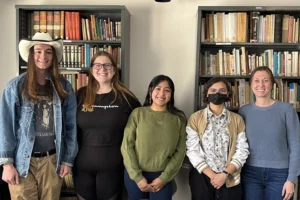
Libbey, a senior teaching faculty member in UWM’s Spanish Programt, is the creator of the special topics course “Spanish 391: Using Spanish in Our Community.” It’s a new service-learning course designed to help students hone their conversational language skills by assisting nonprofits in the Milwaukee area.
“Many students feel like Spanish is something they do in class only, and they don’t have the opportunity to do anything with Spanish outside of class … so I created this course to address that,” said Libbey.
Students started their education in the classroom by exploring topics like Latinx Heritage Month, immigration in Wisconsin, and the job and education outlook for Milwaukee’s Latino residents. Outside of class, they completed 20 service hours over the semester and turned in video reflections (delivered in Spanish, of course) about their experience.
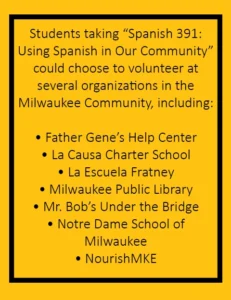
Libbey worked with UWM’s Center for Student Experience & Talent to partner with seven organizations around the Milwaukee area in need of Spanish-speaking helpers. Students could pick where they wanted to volunteer based on their interests and schedules.
The course, offered for the first time this fall, was a success.
“It’s been one of my favorite Spanish classes I’ve ever taken because it’s been so practical,” said student Helena Kohlhoff. “The conversations we’ve had have been eye-opening. We get to hear from a lot of different people with a lot of different perspectives.”
Thanks to their experiences in Spanish 391, students walked away with three important lessons:
1. How to get comfortable speaking Spanish
The course’s focus on conversation helped grow the students’ language skills.
“Having a class like this, where (the learning) is all based on actual communication, has given me a lot more confidence in being able to talk to someone in Spanish and maintain my side of the conversation,” said Jack Uslabar, a creative writing major who is minoring in Spanish. He volunteered at NourishMKE where he helped guests navigate the food pantry.
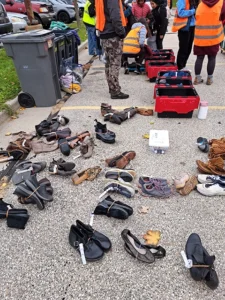
It took Uslabar a few weeks to get the hang of things. It helped that he found a mentor in Norma, a NourishMKE volunteer who also spoke Spanish. “(Speaking) came with experience, and also hearing what Norma says at each station, so I can pick up on what certain things are called,” Uslabar said. “For instance, I would know that these vegetables are green beans, but I wouldn’t know the word in Spanish. Then someone would point to them and say it, and I’d pick that term up and use it in the future.”
Kohlhoff, a medical laboratory science major working toward a certificate in Spanish for healthcare professionals, and Spanish major Eden Skoug quickly became well-versed in phrases like “¿Qué talla necesita?” What size do you need? Or “¿Alguien te está ayudando?” Is anyone helping you?
Both worked with Mr. Bob’s Under the Bridge, an organization that provides clothing, shoes, and other supplies and services to unhoused people in Milwaukee.
“We’re constantly switching languages. You can be talking to an English speaker one second, a Spanish speaker the next second, and an ASL (American Sign Language) user another second,” Skoug said. They’re not kidding; Skoug also takes ASL lessons at UWM and had to put their signing skills to use as a volunteer in addition to their Spanish.
2. How to prepare for their future careers
Jennifer Ortiz is majoring in early-childhood education with a minor in Spanish and is also working towards certifications in ESL and bilingual education. She’s a native Spanish speaker, so she was a perfect fit to volunteer at Notre Dame School of Milwaukee, one of three bilingual schools in the city that asked Libbey for volunteers.
“There are some kids there that don’t speak as much Spanish, and I wanted to help them be more involved in the classroom and simplify the language so they are able to connect more with the students who may only speak Spanish,” said Ortiz.
Not only was she able to help others develop their language skills and fine-tune her own, but she also gained insights that she can use in her education major.
“The teacher I worked with asked me to come back next semester,” Ortiz said. “(I) might even do my student teaching there, because I loved making all of those connections with the students and the staff.”
For Skoug, working with Mr. Bob’s Under the Bridge has given them a taste of what their future career might be like.
“The work that I’m hoping to do is similar to the work that I’m doing at Mr. Bob’s. I want to be able to use Spanish to serve the community as maybe a translator or interpreter. I like being able to create connections among Spanish-speaking and English-speaking communities,” they said.
3. How to support their community
When her students turned in their video reflections, Libbey noticed a pattern.
“Empathy and compassion – those were two words that I heard over and over,” she said. “(Students are) not just thinking about their own little bubble anymore. (They’re) thinking about the wider community.”
Ortiz said she gained a new respect for teachers after watching her mentors at Notre Dame School juggle large classes while still being responsive to individual student needs. “It really made me realize that we need more Spanish teachers, or even Spanish assistants, anyone that can speak Spanish and help out in the schools, because it gets very overwhelming,” she said.
Skoug said they learned a lot about Milwaukee’s unhoused population and how those individuals seem to fall through the cracks. For instance, several of the people served by Mr. Bob’s Under the Bridge died during last summer’s flooding, but little attention was paid to their loss. “That’s why it’s so important that Mr. Bob’s is creating connections with that community, and making sure those people are not forgotten,” Skoug added.
For Kohlhoff, volunteering helped them realize that being able to understand one another is an essential part of building community.
“The amount of joy that people have when you can converse with them in their native language and be able to help them is something that reminds me why I’m doing what I’m doing,” they said.
Class has ended, but Libbey says that several of her students plan to continue volunteering with their chosen organizations. They’ve found the answer to the question, ¿Cómo puedo ayudar?
By Sarah Vickery, College of Letters & Science