These stories are part of the “Always Dream Bigger” series, written to celebrate the inauguration of UW-Milwaukee Chancellor Thomas Gibson.
Gibson’s own path in life exceeded his earliest expectations, and he encourages students to seek out new opportunities. The UWM students and alumni in these stories share what it means to them to Always Dream Bigger at UWM.
Recent UWM physics grad sees the value of persistence
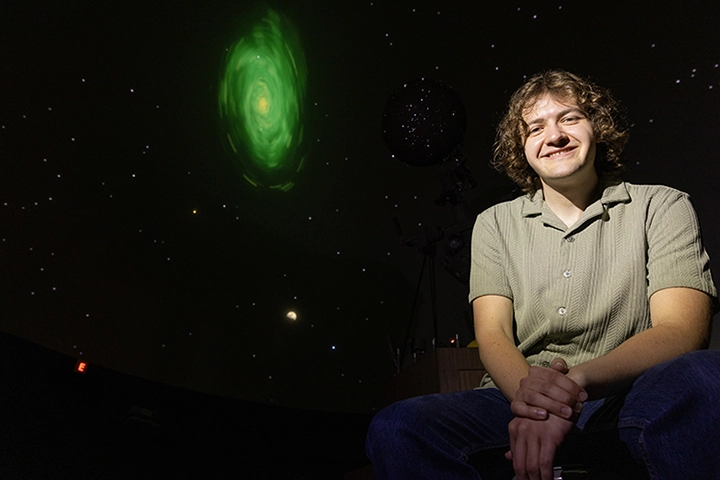
Nick Nelson began college as a mechanical engineering major. But just weeks into his freshman year, he realized he was much more interested in physics, a major that his engineering-focused school didn’t offer. He began researching other universities, and UW-Milwaukee immediately caught his eye.
“I saw that UWM has a fantastic physics program, and I knew I liked the campus and the area around it,” Nelson said. He also was reassured by the wide range of majors at UWM. “I knew that if for whatever reason physics didn’t work out, I’d be able to find something eventually that clicked for me.”
Physics did in fact click for him. Nelson especially enjoyed his courses with Philip Chang, a physics professor who specializes in theoretical astrophysics and cosmology. Intrigued by the possibilities of undergraduate research, Nelson asked Chang if he could work with him on a research project. The professor asked him to come back in a year or two, explaining that he typically supervises students who are more advanced in their coursework, an advantage for theoretical and computational research.
A few months later, Nelson attended a meeting for physics majors and faculty, where Chang mentioned students’ future careers. “He told us that to be successful in physics and astronomy, one of the main things you need is persistence,” Nelson recounted. “Right after that meeting, I went up to him and said, ‘You said we need to be persistent. Are you sure I can’t research with you?’”
Read the full story on UWM Report.
UWM helps student grow her love of science – and her confidence
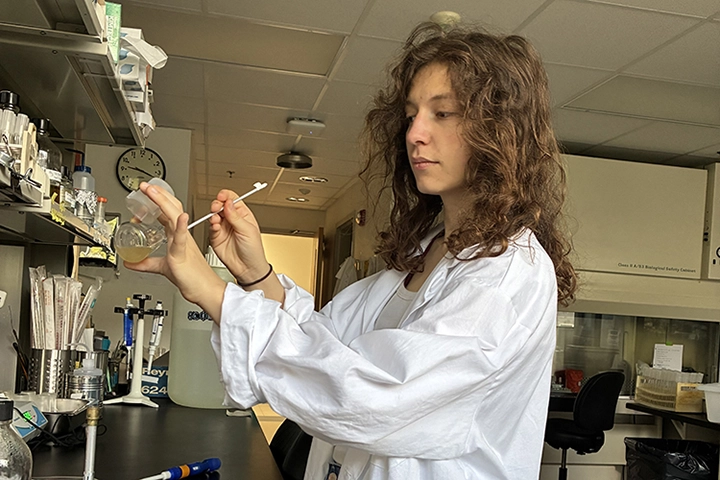
After she graduated from UW-Milwaukee in May, Ally Ruffino moved to the Washington area to take a fellowship conducting research at the National Institutes of Health.
She recently was riding the Metro train around the city when she had a realization about this new phase of her life. “I was sitting there thinking, ‘Oh, younger me would be really impressed,” she said.
Back in high school, Ruffino discovered that she loved science and completed an independent research project on bacteriophage, a virus type that infects and replicates inside bacteria.
So she was especially excited to arrive at UWM for college and meet Alita Burmeister, assistant professor of biological sciences, who conducts research on phage.
“I thought I knew a lot about phage, but I didn’t know anything,” said Ruffino, who grew up in St. Louis. “I looked at her and thought, ‘I want to be this person!’”
Read the full story on UWM Report.
Undergraduate research gives student new career possibilities
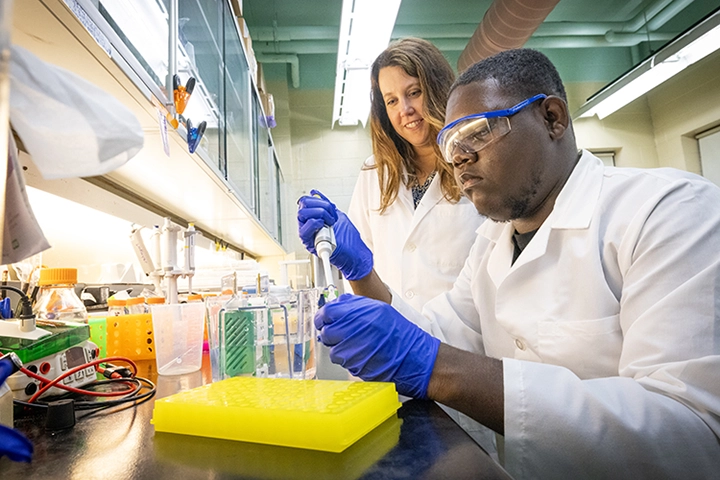
Back when Jehiel Smith was in middle school, the movies “Hidden Figures” and “Black Panther” celebrated Black people with expertise in STEM fields. “Those movies were big for my age group and my culture,” he said. But as much as he admired those characters, their knowledge felt out of reach.
He considered working in healthcare, perhaps as a doctor. He spent his teenage years as his mother’s primary caregiver, helping her cope with multiple chronic conditions. Those experiences led him to earn his nursing assistant certification at age 17, which allowed him to work at a nursing facility in his neighborhood in Greenfield.
During high school, Smith also met the founders of Pipeline to Practice, a Milwaukee nonprofit that supports American descendants of slavery in their efforts to become doctors. When cofounder Dr. Delicia Randle-Izard learned about Smith’s experience working with older adults, she encouraged him to attend UW-Milwaukee and apply to its Success Through Aging Research program. Funded by the National Institute on Aging, the program gives UWM undergraduate students funding, academic support and the chance to work on mentored research projects related to aging.
Smith was initially hesitant. “I thought, ‘There’s no way I’m going to do well in research,’” he said. “I just want to help people feel better.”
Read the full story on UWM Report.
By Erin O’Donnell, Marketing & Communications