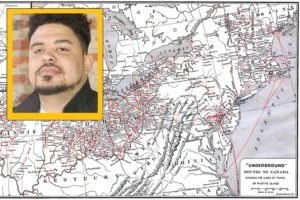
The Underground Railroad was a network of safehouses and secret routes that ferried fugitive slaves from the south to safety in the northern U.S. and Canada in the years leading up to America’s Civil War. Some of those routes ran right through Wisconsin.
A new PBS documentary, “Wisconsin’s Underground Railroad,” details the state’s role in this secretive operation and the stories of the courageous men and women who traveled the Railroad to pursue their freedom. The documentary features none other than UWM Associate Lecturer Robert “Biko” Baker, who teaches in the Department of African & African Diaspora Studies.
Baker sat down to talk about the documentary and the incredible stories he was able to tell.
What an exciting project to be part of! How did you come to be part of the PBS documentary?
Brian Ewig, the filmmaker for PBS, emailed in late spring and asked if I wanted to be involved. I said, absolutely! It sounds like a great topic.
The Underground Railroad isn’t necessarily my subject matter expertise. But I’ve studied this time period because I got a PhD in history, so I have to sometimes own that. I also asked them to have my back by talking to Clayborn Benson, who was a UWM student, and is the head of the Wisconsin Black Historical Society. I saw it as a tag-team effort.
Mr. Benson is like a human AI when it comes to Black American history. It’s incredible. Mr. Benson illuminated the passageway from Waukesha to Burlington, Wisconsin, and how there is an informal network to Racine. He uncovers the whole context and backdrop to places in southeastern Wisconsin, and why it was a hotbed. He’s such an important part of our community.
What does this documentary cover?
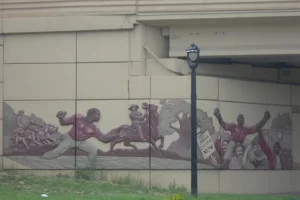
It covers the history of Wisconsin’s Black Underground Railroad. It takes a look through the lens of two stories. There was Caroline Quarles, who was the first Black American to come through Wisconsin on the Underground Railroad. The one that we know best, I think, is Joshua Glover, because his image is all throughout the city and landmarks and signs.
It covers those stories and then investigates how, perhaps, people in Wisconsin were a lot more involved in this than people ever imagined. It’s a really well-done piece of history. I’m proud of it.
What is Caroline Quarles’ story?
Caroline Quarles is – I hate to use these words, but from that time, she’s 1/8th Black so she’s an ‘octoroon.’ She’s part of a family where her grandfather is her owner. On July 4, 1843, she gets up and leaves Missouri, and by way of boat and ferry, gets to Milwaukee. When she gets to Milwaukee, Samuel Brown – who owned (the land) where Venus Gardens is now on 17th and Fond du Lac and Johnson’s Park – harbors her and takes her to Waukesha, Wisconsin. Eventually she finds her way to Canda.
Twenty years after her time in Canada, she writes back to her abolitionist friends: ‘Thanks, sir.’ So as a historian, we have these documents to track (her journey). So that’s really cool.
It’s very cool, because as I understand it, there are not many written records from folks who were part of the Underground Railroad.
You’re not leaving records, you know what I mean? You’re on the run! … But the thing is, we’ll never know. One of the people who was on the mercantile side of the Underground Railroad wrote a letter in the 1890s and said that they had harbored over 100 people.
We don’t really know what happened, but there’s evidence right here in front of us. You can walk up and down Brown Street on Milwaukee’s north side and know that there was a guy who put it on the line to support a woman of color.
Was there anything that surprised you during your research for this part?
The thing that was eye-opening to me, when I was studying this, is the extent to which people like Sherman Booth – if you go to Eastside, there’s Booth Street, and he’s one of the founders of the Republican party – how far they were willing to go to challenge the federal government.
The government enacts the Fugitive Slave Act (in 1850), which allows people to come into Wisconsin and find slaves. Sherman Booth resists to the point where he gets put in jail! They actually come up with a Supreme Court case called Abelman v. Booth, which says that resisting a Supreme Court or federal ruling is illegal. They were putting their lives on the line for Black people, which I didn’t know. Wow, what a powerful story here in Wisconsin.
Sherman Booth helped Joshua Glover escape, correct?
Joshua Glover gets here in 1852, I believe. He goes to Racine. For two years, he’s a mill worker in Racine. And then his owner finds out that he’s in Wisconsin. They come with the posse to get him. They take him to Milwaukee, and these folks in Racine line up with Sherman Booth, and they get on a ferry from Racine and go to Milwaukee and break this Glover out jail. Then they take him to Waukesha, and they get him out of the country.
Is there any evidence of places in Milwaukee or Wisconsin that were used to hide people? Crawl spaces, hidden rooms, that sort of thing like we learned about in elementary school?
(The filmmaker) had a lead at this church, First Presbyterian in Racine. They have this basement that has these crawl spaces, and they’re finding hats, shoes, materials that are indicating that they might be slave materials. They have a record saying that at least one slave has been sent to Canada. My sense is, once you start opening this door, other doors open. As a historian, we wonder, what else can we find? What other materials did people hide or cover up so they couldn’t get caught?
What do you hope that people understand when they watch the documentary?
One, I’m excited that we can tell Black history at a time like this, and I want people to value that.
The second thing is, I want people to see that Black history is not just Black history. It’s American history. It’s tied to all of our stories. It’s tied to all of our outcomes. At a time when history is polemical, I would love for us to cherish this.
The third thing is, I think we need to go deeper into these stories, whether that’s assigning stuff at the curriculum level or the elementary level, or even trying to find an investor to invest in this as a narrative film. We have to keep telling the story.
By Sarah Vickery, College of Letters & Science