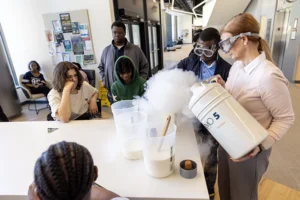
A vat of sugar, cream, egg whites, and vanilla sat on the table in front of a hungry group of eighth graders. There was one ingredient left to add to turn it all into ice cream: Liquid nitrogen.
“You have to get (nitrogen) really, really cold to make it liquid,” Chemistry & Biochemistry Professor Kristen Murphy explained, mist billowing as she poured a canister of the liquid nitrogen into the mix to flash-freeze the cream. Her audience did enjoy the chemistry lesson, but they enjoyed their sweet treat more.
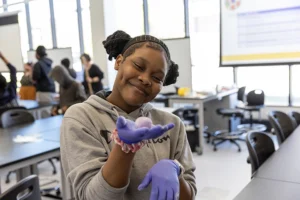
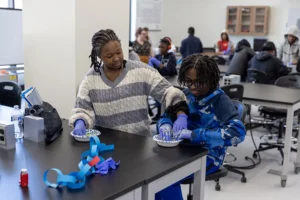
The Hartford Avenue University School eighth grade science classes visited the UWM Chemistry Building in May to do some hands-on experimentation and learn about the possibilities open to them in STEM fields. Guided by Murphy, Associate Professor Anja Blecking, and several graduate students, the budding scientists learned about chemical polymers by creating their own bouncy balls and slime and rounded out the visit with ice cream.
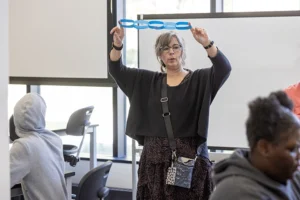
The visit was everything Hartford Avenue University School science teacher Drew Wallsworth hoped it would be.
“The (students) got to learn about the different careers that are in chemistry … as well as the different majors that are here at UWM. They got to see what an actual college science lab looks like, versus our middle school science lab,” Wallsworth said. “They were really excited.”
That was exactly the point. The visit was part of a reimagination of UWM’s Science Bag, and the program will be expanding to teach even more students about the wonders of STEM in the coming months.
A reimagined Science Bag
For decades, the Science Bag lecture series invited the Milwaukee community to visit campus every Friday evening and be treated to family-friendly talk on whatever topic the presenting UWM scientist had chosen for the month. But Science Bag had to take a hiatus during the COVID-19 pandemic and its audience never rebounded.
And, said Suzanne Boyd, the old lecture format wasn’t working anymore.
“Students want and need and expect something more interactive,” she said. “You have to engage the audience and have them be active in their learning.”
So, Boyd and her colleagues decided to pivot. Boyd, the Associate Dean of Natural Sciences and an associate professor in the Mathematical Sciences Department, assembled a committee of faculty members from across the natural sciences departments to reimagine Science Bag. Their goal was to modernize the program while staying true to Science Bag’s fundamental mission: Making STEM fun and accessible to the community.
They decided to ask for faculty volunteers to develop a series of presentations that they could take on the road – “almost like a magic show,” Boyd said. “You’re explaining (a scientific concept), you do a fun demonstration, some volunteers from the audience come up and do (an activity with you).”
The best audience, they decided, would be middle schoolers. Over the past year, Boyd and other faculty members reached out to middle schools around the Milwaukee area and offered their services. Biological sciences professors Gerlinde Höebel and Rafael Rodríguez Sevilla readied their tanks of tree frogs and treehopper insects for demonstrations at UWM’s Saturday Academy. Mathematical Sciences senior teaching faculty Bart Adrian, who is a former meteorologist for Fox 6, delivered a talk about weather, forecasting, and climate change at the science fair of the Hmong American Peace Academy. At Glendale River Hills Middle School, Physics Professor Ionel Popa helped the students build their own large models of proteins found in the body.
Of course, UWM has some world-class facilities that stand ready to receive students as well. The Hartford Avenue school group was the first to visit UWM for a science demonstration.
“We’ve already been able to interact with hundreds of students just this year,” Boyd said. “We made it convenient for them and interactive and exciting, leveraging our expertise and their interests, and I’m really pleased with how this is the beginning.”
Science accessible for all
Back in the UWM Chemistry Building, the Hartford Avenue eighth graders ate their ice cream and watched as Murphy and several graduate students dipped flowers and balloons into the leftover liquid nitrogen and shattered them like glass against the tables.
The guests enjoyed the show and the hands-on activities.
“When I first came here, I was kind of nervous,” confessed eighth-grader Zamaria Brown. “But everything here is really nice. I like science. It’s my favorite subject.”
Murphy hopes that Brown and her classmates learned not only about polymers and liquid nitrogen, but also about the opportunities available to them in the science field. Many young people believe that science is only for engineers or doctors, said Murphy, but there are myriad possibilities for careers in STEM.
“It’s really fun to have conversations with our younger students and be able to have them start to think about that at a very early age,” Murphy added.
The reimagined Science Bag will continue this year, bringing more science to students – and perhaps more ice cream as well.
By Sarah Vickery, College of Letters & Science