Geosciences Updates
Come join UWM Geosciences for exploration and excitement at this year’s Darwin Day!
When: Feb. 14 from 10 a.m.-3 p.m.
Where: Lapham Hall
Darwin Day is a public outreach event celebrating the life and times of one of the most brilliant and influential Victorian naturalists, Charles R. Darwin. Darwin was an avid geologist and biologist who most famously developed the theory of natural selection—one of the driving mechanisms behind biological evolution—published in his seminal work: On the Origin of Species. Today, this theory forms the foundation for many of our natural sciences. Darwin Day is a national celebration of Darwin’s scientific legacy typically held on (or near) his birthday.
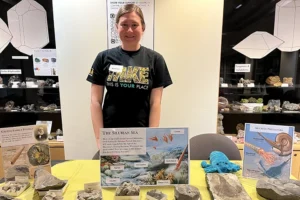
This event is free and open to guests of all ages. Many wonderful geological and biological specimens will be available to observe, with volunteers on hand to explain their fascinating histories. Learning tables will focus on the natural history of Wisconsin and the contributions of the Thomas A. Greene to our understanding of local geology, with many rare and beautiful samples on display in the Greene Geological Museum. Other activities will be available throughout the day, including scientific lectures presented by UWM scientists and guest speakers, coloring and crafts for young kids, and free planetarium shows. See the activities list and schedule of events below for more information.
Greene Geological Museum:
Our small but mighty museum of rocks, minerals, and fossils will be open for guests to tour throughout the event. The Greene Geological Museum houses specimens collected by the prolific collector and namesake, Thomas A. Greene, throughout the mid-to-late 19th century from both Wisconsin and other locales. Many of the mineralogical specimens on display are one-of-a-kind, and originate from localities no longer accessible to modern geologists! The Museum is also highly valuable for paleontological research, and houses the single best collection of marine Silurian invertebrate fossils in North America. If you have never had the opportunity to visit the Museum, now is a great time!

Learning Tables:
See and learn about your own Wisconsin natural heritage! Numerous tables will be set up throughout the first floor of Lapham Hall displaying a wide assortment of specimens including rocks, minerals, fossils, and even animals! Volunteers—our very own UWM students and staff—will be available all day to teach you about these fascinating objects, their importance to the natural sciences, and their value to our local communities.
Lectures:
Three lectures will be presented throughout the day by UWM scientists and guest speakers. Lectures will cover topics related to Wisconsin geology, biology, and Milwaukee history. These lectures will be short, digestible, and accessible to a general audience. Our keynote lecture will discuss modern Antarctic exploration and the natural sciences of Antarctica!
Student Research Showcase:
UWM is a leading national research institution, and our students will make sure you don’t forget it! Stop by our student research showcase table throughout the day to learn what our very own geoscience and biological science graduate students are working on. Students will cycle in throughout the day, come by a few times and check out the groundbreaking research going on here at UWM!
Thomas A. Greene’s Glowing Cavern:
These minerals really glow! Come see our most impressive fluorescent minerals literally glow in the dark. A small, guided space will be available all day to experience minerals in a way few people ever do,
Children’s Activities Tables:
For parents, activities will be available their young children. This includes coloring, arts and crafts, and even an interactive sandbox. Remember, you’re never too young to start learning!
Touch Tables:
See, touch, and discover! Stop by and explore an array of fascinating specimens and models, all safe to touch. Experience natural history with all of your senses!
University Advancement Updates
Panthers Connect Career Mentoring Program
Spring 2026 Session | Feb. 9 – May 11, 2026
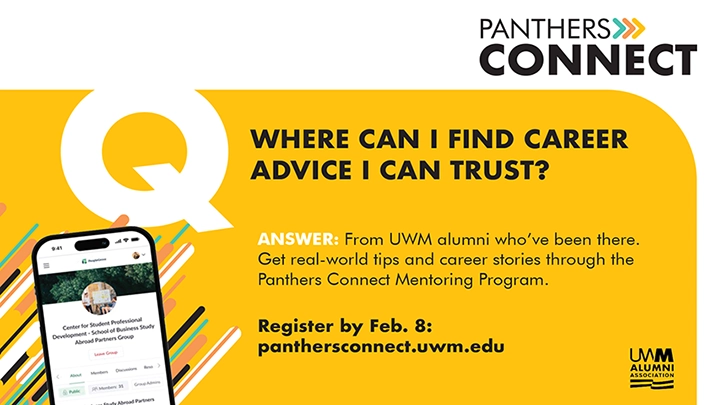
Ready to take the next step toward your career goals? The Panthers Connect Career Mentoring Program pairs you with experienced UWM alumni who are eager to share advice, insights and real-world perspective. Whether you’re exploring career paths, building your network or preparing for internships and full-time roles, this program is designed to help you grow with confidence.
There’s no application deadline — you can join anytime during the semester. However, to be matched for the first round on Feb. 9, be sure to submit your application by Feb. 8, 2026.
Take advantage of the power of the Panther network and start building meaningful connections today.
Learn more and apply at www.panthersconnect.uwm.edu
Questions? Contact Abby Rojas at strozins@uwm.edu or 414-229-6116