Morgan Foster knows she’s working against a lot of skepticism when it comes to the humanities.
“Humanities have been under attack for so long. We know that there are barriers facing students in those majors,” she said. “Students love their English class, they love history, they love women’s & gender studies, but they ask, how do I do this for a living and support myself?”
Foster wants to help answer that question. She is the undergraduate advisor and program coordinator of UWM’s Women’s & Gender Studies (WGS) program, and she’s also the instructor for UWM’s “Internship in Women’s & Gender Studies” course. It’s a unique class that not only helps WGS students find an internship, but also encourages students to take the concepts they learn in their classes – concepts like intersectionality, queer history, connected systems, etc. – and apply them to the working world. The class also teaches skills like building a résumé, creating a LinkedIn profile, conducting yourself as a professional, and more.
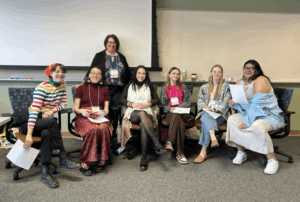
Her students love the class and how it prepares them for their internships and future careers. In April, they had a chance to share their experiences with a wider audience. Undergraduates Angelina Cheng, Audrey Creary-De La Cruz, Brynna Fennie, Ducky Griesemer, Cordiellia Hosler, and Aurora Martinez were invited to the annual Women’s & Gender Studies Consortium Conference at UW-Madison. The conference brings together WGS students from across the Universities of Wisconsin to network and engage with their peers.
The UWM contingent’s panel, “Embodying Feminist Practice Through Experiential Learning,” discussed pedagogical practices of the WGS internship course and how students applied their knowledge from the classroom to the workplace.
“This conference is big. There are people from all over the country who attend,” Foster said. “The students did such a fantastic job. They spoke about how to turn the theoretical concepts to the practical.”
“We were asked questions about our experience in our internship, our women’s & gender studies coursework, how we applied it to our internship, and how we think our internship is going to help us in the future,” added Angelina Cheng, one of the undergraduate students who attended the conference.
Cheng, who is double majoring in WGS and psychology and also pursuing a certificate in LGBTQ studies, completed her internship last fall at Courage MKE, a licensed group home in Milwaukee’s foster care system especially designed for queer children and teens. Cheng learned about the group home while doing research for a different class. When the opportunity arose, she was excited to apply for an internship at the organization.
For fifteen hours a week, in exchange for course credit, a small stipend, and the chance to help others, Cheng worked at Courage MKE. She cleaned the facilities, helped prepare meals, organized closets, and spoke with the youths at the home about the challenges they faced.
“Which is difficult to do with teenagers, because they don’t want to open up about a lot of those things,” Cheng said. “So whenever they felt like it, (we would) talk about, what does your identity mean to you? We talked about Pride Month. We talked about how they were doing emotionally.”
It was the perfect opportunity to apply her classroom theoretical concepts in a practical way.
That’s exactly what Foster hopes all of her students will be able to experience in their respective internships. She also hopes that more students will take the internship course so they can find their own avenues to fulfilling careers.
“(Students see that) maybe there are jobs for me that don’t require me being a professor or getting a PhD. Maybe I could run a resource center. Maybe I could do nonprofit programming. I can get a major in women’s & gender studies and have jobs and careers I never thought about,” Foster added.
Cheng has already begun making plans. After she graduates this May, she plans to attend graduate school for her Master of Social Work so she can continue helping others.
She recommends that other WGS students take the internship course so they can get a foot in the door to their chosen careers. Foster, too, would love to see more students enroll so that she can continue to turn skepticism about the humanities into enthusiasm.
By Sarah Vickery, College of Letters & Science