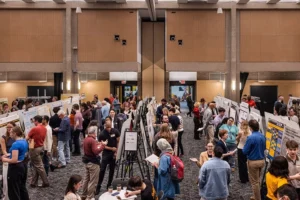
Student research is a vital component of UW-Milwaukee’s prestigious R1 Research Institution status, and the best place to see it on display is at UWM’s annual Undergraduate Research Symposium. At this year’s symposium on April 24, more than 300 students from across campus gathered to share their discoveries, including many from the College of Letters & Science.
Below, meet three young researchers whose work spans the different disciplines of Letters & Science.
Natural Sciences: Leila Goodrum, “Ladies’ Choice: Characterizing a Novel Female Signal in Enchenopa Treehoppers”
In the animal kingdom, people tend to think of animal behavior as wild, dominating, and even brutal.
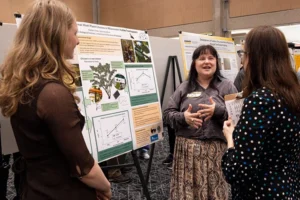
But when it comes to mating, one animal species is downright courteous, said Leila Goodrum. A nontraditional student who returned to college at age 26, Goodrum is a biology and conservation & environmental science major studying treehoppers under the guidance of her mentor, Biological Sciences Professor Rafael Rodríguez Sevilla.
Also known as the species Enchenopa binotata, treehoppers live on nannyberry trees. They communicate by sending vibrations through the stem of the plant that other treehoppers can feel with their feet. These small vibrations do make sounds. When a male treehopper sounds out a mating call through the stem of his plant, a female treehopper can choose to duet with him if she likes his song. The pair “sings” together until the male locates the female to mate.
Goodrum and her fellow researchers can listen in on those duets using a laser vibrometer, which detects the plant’s small vibrations and converts them into sound. Researchers have been using this method to study mating calls for years.
But recently, a graduate student in the lab discovered a new sound that no researcher had noticed before. Before the male finds the female treehopper, and before she lifts her abdomen to indicate she is ready to mate, the female emits a small vibrational signal.
“It’s really faint, but it turns out it’s there in a lot of our recordings. And every time we hear this signal, it’s immediately followed by a male mating attempt,” said Goodrum. “We think that this is a signal that the female sends to tell the male that he can try to mate. … If he doesn’t receive the ‘advancing’ signal and he attempts to mate, she will never raise her abdomen. Females are not into males who are going for it without getting the ‘go-ahead.’
“It’s really interesting, because that’s an additional stage of female choice and female agency in the system,” she noted.
Now, Goodrum is helping study this new signal to understand how the treehoppers’ mating behavior evolved. Being “courteous” is not a learned behavior; it seems to be instinct, she said. The researchers will test their theories by playing the ‘advancing signal’ to the male treehopper to learn more about this mating behavior.
This research is important because “we tend to think of mating in the animal world as kind of brutal,” said Goodrum. “But it does seem like there’s increasing evidence that there are a lot of these kinds of ‘courteous’ systems that are evolving or that have evolved, and that has major implications for how mate choice affects its own evolution.”
Goodrum presented her work at the Undergraduate Research Symposium and garnered an Outstanding Presentation Award for her second year in a row.
Social Sciences: Ra’Shida Rockette, “Can You Read This for Me: Adapting Mental Health Learning Materials to Make Them Accessible to Adult Latinx Immigrants”
Ra’Shida “Sadie” Rockette already had a bachelor’s degree and worked in special education when she decided to return to UWM for a second undergraduate degree. Working in special ed classrooms had inspired her to get involved in research to find new ways to benefit her students.
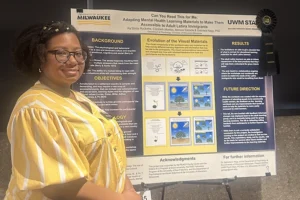
But when she began research at UWM, Rockette discovered she wanted to explore more than special education. She got involved in programs like Success Through Aging Research (STAR) and eventually found herself working in Assistant Professor Gabriela Nagy’s lab in the Department of Psychological & Brain Sciences – first as a volunteer, then as a paid student researcher.
Even so, Rockette never expected to hear her name called when the Outstanding Presentation Award winners were announced at the UWM Undergraduate Research Symposium.
“I was just so shocked. It was really lovely because … I was able to invite my family and my partner to (the symposium), and they saw me win a ribbon for this hard research that they have seen me put in long hours for,” Rockette said with a smile. “It was very encouraging for them to see me excel.”
Rockette is assisting with a research project focused on community mental health among Milwaukee’s Latinx population. Latinx people often face mental health stressors that are different from those of the general U.S. population. Not only do they have typical worries like bills, work, and health, but they often face feelings of cultural isolation or loss, especially among immigrant families.
Rockette helped to identify volunteer community mental health workers drawn from Milwaukee’s southside neighborhoods, where many Latinx people have settled. She and other researchers in Nagy’s lab compiled a booklet of mental health resources and coping techniques, which they shared with the volunteers in hopes that they would bring the educational strategies back to their communities.
The booklet, written by Nagy, contained material “that were very strong, positive interventions and things that were going to be culturally relevant and appropriate,” said Rockette. That included things like a glossary of difficult words and terms, guides to mental health resources, poetry, and even graphics that Rockette designed herself.
For her research, Rockette solicited feedback from the volunteers to find the parts of the booklet that were most useful. What contents needed to be kept, revised, or scrapped? What material was most helpful for the health workers navigating life’s stressors?
Based on that research, Rockette and Nagy will be able to refine the booklet to better serve the mental health needs of leaders in Milwaukee’s Latinx community. In fact, Rockette said, the booklet has already helped.
Now, “when people approach them, (the mental health workers) are equipped to handle those problems and be able to help navigate those people to resources that are out in the community, and to be able to just walk with them about their issues, to make it easier and more accessible,” she said.
Humanities: Sam Maurer, “From Foreign to Familiar: Name Changes and Social Pressure in Milwaukee’s Immigrant History”
Student research doesn’t have to take place in a lab or clinic. Some of the most valuable research happens right in the classroom.
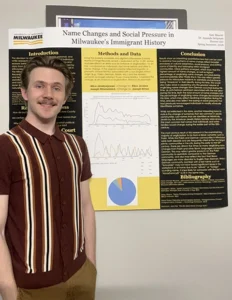
That’s how it was for Sam Maurer, a student in UWM’s accelerated urban studies and Master of Urban Planning program. The research project he presented at the symposium began as an assignment in his “History of Milwaukee” class, taught by History Professor Amanda Seligman.
During a class visit to the UWM Archives with Abigail Nye, Maurer was introduced to an online archive of name changes recorded at the Milwaukee County Courthouse between 1871 and 1977. He noticed that many people were anglicizing their ethnic surnames. That made him curious: Who was changing their name and why? That question served as the basis for a class research project that he eventually presented at the symposium.
It took weeks, but eventually, Maurer scoured all 11,591 recorded name changes and analyzed the data.
“The most notable trend was that the Polish community changed their name more than any other group, even though, in Milwaukee, there were more Germans than there were Polish people,” he said.
In fact, people with Polish surnames anglicized their names five times as often as people with German surnames. It made sense, said Maurer. Milwaukee is a city that was settled primarily by German immigrants. Someone with a Polish last name might try to anglicize it to hide their background to avoid discrimination or get by day-to-day in a city where they might be considered an outsider.
And it wasn’t just Polish immigrants who faced discrimination: “This was in primary documents most seen in people with identifiably Jewish names. The most common names that people would change from were ‘Cohen’ and ‘Goldberg’ and ‘Goldstein’ and ‘Epstein,’” Maurer said.
There was another spike in name changes after 1945. This time, it was primarily people with German last names, because it was not popular to seem too German at the end of World War II. Anglicizing their last names helped people feel more American.
But that trend began to reverse in the 1970s.
“People started to change their Americanized last names back to their ethnic last names,” said Maurer. “It seemed that the children, grandchildren, and great-grandchildren of Milwaukee’s original immigrants wanted to reconnect with their family heritage.”
During his research, Maurer looked for his own family name in the records, but since his ancestors were relatively recent immigrants to the city, he didn’t find anything. But he did find that he enjoys research and sharing his ideas at the symposium.
“It was the most rewarding part by far. It made the entire process worthwhile,” Maurer said.
By Sarah Vickery, College of Letters & Science