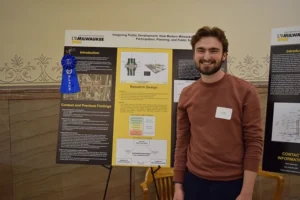
Five years ago, UW-Milwaukee debuted its accelerated bachelor’s and master’s degree program in Urban Studies and Urban Planning. Now, in a few short weeks, the first graduates of the program will walk across the stage at UWM Panther Arena and accept their diplomas.
“I had not been considering doing a graduate program when I came to UWM. That wasn’t something that was in my plan,” said Liam Farin. “When I saw that this was an opportunity, that I would be able to shave off a year? It suddenly became something that felt more possible.”
Farin and his fellow graduate students Isabella Lemieux and Avarie Daly are set to become the first three graduates of the accelerated degree program.
The program allows students to major in urban studies and earn their bachelor’s degree and then continue on to earn their master’s in urban planning (in the School of Architecture & Urban Planning), all in five years instead of six. The programs are closely linked; urban studies asks students to examine topics like economics, race, geography, and history of cities, while the urban planning program prepares them for careers in city planning and public policy.
Given the interdisciplinary and complementary nature of both programs, it just made sense to create a combined, accelerated dual-degree pathway, said Jamie Harris, the associate program director of the Urban Studies Program.
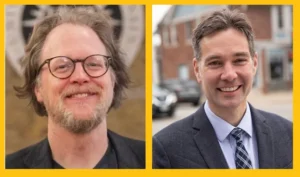
“I think the reason this is such a good pairing between urban studies and urban planning is that it allows students to develop this really broad, liberal arts background in urban history and urban geography and urban sociology,” Harris said. “Having this broad array of lenses and disciplines and methodologies to address what are complex urban issues and urban developments will make them much better planners.”
“The students who enter our Master of Urban Planning program after three years in urban studies are very well prepared,” said Robert Schneider, co-chair of the Department of Urban Planning. “They make important contributions to their client project teams, bringing a broad perspective on urban challenges and excellent research skills. We are thrilled to have the first three accelerated program students graduating and starting their professional careers.”
A quicker degree
The program is designed to have students complete their bachelor’s degree in three years and their master’s in two. Some of the urban studies major credits can count toward the graduate degree, and some of the graduate classes fulfill requirements for the urban studies major, so the students can shave a year off their schooling.
It is a tight schedule. Students need to decide to start on this pathway during their first year of college so that they can fit in all their required courses. Luckily, said Farin, UWM’s faculty and academic advisors make it easy to plan your schedule. And though the requirements are strict, there is still flexibility within the program for students to tailor their classes to their particular interests.
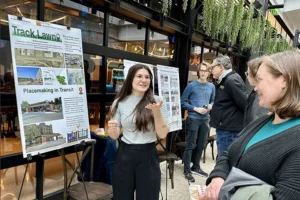
For example, Lemieux decided to specialize in transportation planning. She particularly enjoyed honing her skills in her Planning Policy Analysis class last semester. It gave her an opportunity to apply the theories she had learned over the course of her college career in a practical way by asking her and her classmates to act as consultants for Milwaukee community projects.
“The first project was working with a transportation coalition, and I work with that coalition now. I’m seeing the ideas that we gave them being put to work,” Lemieux said.
Farin, who describes his interests as “broad,” has taken a more general approach. He wants to use his degrees to address community engagement, housing policy, and transportation.
Their rigorous schedule and classes kept them busy, but, said Farin, there was still plenty of time to enjoy college life. Farin worked with UWM Outdoor Pursuits in between his classes, while Lemieux joined the Bowling Club and Rock Climbing Club. When they achieved graduate student status, both worked as teaching assistants.
After they graduate, Lemieux plans to continue her job with the Milwaukee County Transit System and will look for more opportunities to grow her career in the transportation sector. Farin is in the process of applying for jobs, but wherever he ends up, he’ll start his work after a backpacking trip to celebrate his graduation.
Some words of advice
It takes a particularly motivated student to be able to complete the five-year degree program. Harris is looking for students who relish an academic challenge and are comfortable with rigorous coursework. There are currently about 10 students at various stages of working on their accelerated degree, he said.
Farin advises that if any first-year student even thinks they’re interested in the accelerated degree program, they should get started at once.
“If at some point you decide it’s not right for you, that’s okay,” he said. “But I think that, along the way, you’ll meet a lot of really amazing faculty mentors who are there to help you out and answer questions you have.”
Those mentors are invaluable resources, added Lemieux.
“Learn how to advocate for yourself and learn who to go to and be able to communicate any issues, which is a skill that is important to learn in adulthood in general,” she said.
In turn, Harris has some advice for the soon-to-be graduates: “You know how important it is to be able to engage in these issues and communities and improve a lot of Milwaukee’s metropolitan area,” he said. “It’s important to be a good listener. Learning how to be a good collaborator is a process.”
It’s a good thing that Farin, Lemieux, and their cohorts have learned how to do just that in the accelerated degree program.
By Sarah Vickery, College of Letters & Science