Book and art lovers, there is exciting news ahead: Two faculty members in UWM’s Art History Department have new books set to release this spring.
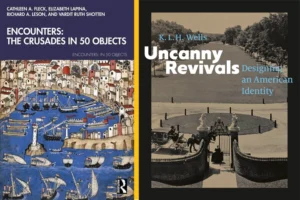
Associate Professor Richard Leson is the co-author of Encounters: The Crusades in 50 Objects, a book for general audiences that explores the Holy Wars through the lens of artifacts like illuminated manuscripts, fragments of castles, and even drinking cups.
Associate Professor Kay Wells’ new book is titled Uncanny Revivals: Designing an American Identity and argues that key pieces of 20th century American art cultivated a national identity that portrayed society as affluent and white – leaving many people out of the country’s cultural narrative.
Each sat down to talk about their work ahead of their book’s release.
Encounters: The Crusades in 50 Objects
The Crusades were a series of violent conflicts that took place over the course of the twelfth and thirteenth centuries. European rulers and Popes sent armies to recapture Jerusalem—the city they regarded as the center of the world—from Muslim control. Both the Crusaders and those they regarded as their enemies – the Jewish and Muslim peoples living in the “Holy Land” – left behind artifacts that form the basis of Leson’s new book.
Richard Leson is a Medieval art historian with expertise in Crusade studies. The book, a joint venture between several historians and archaeologists, covers a mix of “known” objects and artifacts that have never been published before. Each entry provides in-depth analysis about what the object can tell us about the time period.
“It’s fascinating to think about these objects, not only in terms of their function and their symbolic significance, but also just their material qualities, and what it would have taken to make these objects at that time,” Leson said. “It leads us to an image of the Middle Ages which is more global, more cosmopolitan than we typically allow for in the popular imagination. That, I think, is something that comes through in many of the entries in the book.”
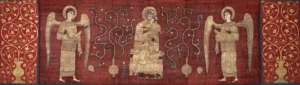
For instance, one entry looks at a piece of embroidery purchased by a crusader named Otto de Grandson from Savoy. The piece was made using embroidery techniques from Cyprus, and someone later extended the piece with panels made using an embroidery technique from England.
As people read the book, Leson hopes that they look beyond the historical accounts of the Crusades and think about the ordinary people who used these objects as part of their daily lives.
“Life in those places conquered by the crusaders wasn’t violent every single day, and people of all different creeds and colors lived together and tried to make do as best they could. There was an awful lot in the way of cultural, linguistic, material, and visual exchange,” he said.
One of Leson’s favorite pieces in the book is one he’s written about extensively: A cup excavated from the ruins of a church in Syria in 1980. The inside of its basin is engraved with 11 different heraldic shields.
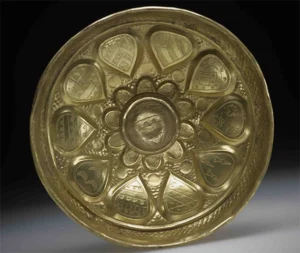
“You would drink, and then these shields would appear beneath the wine,” Leson said. “But the point of these cups is that you don’t just drink it alone. You pass it around. … The cup is acting as a kind of agent to solidify the relations and commitments that these various actors have made to one another. It’s that kind of object and that kind of dynamism that we wanted to capture in this book.”
This book may capture the interest of academics and students, but it’s important for everyone to understand the cultural legacy of the Crusades, since that impact still resonates today. U.S. Secretary of War Pete Hegseth recently referred to America’s campaign in Iran as a “holy war,” for example, and many people use iconography from the Crusades to illustrate their political leanings. Leson hopes that his book will help people understand that the Crusades were more than the romanticized medieval battles depicted in Hollywood blockbusters, and that relations between Christians and non-Christians were more nuanced and complex.
“What these objects individually demonstrate on a granular level are connections between different human beings made under circumstances far from ideal, circumstances that came about because of prejudices and greed and religious zealotry,” he said. “But in many cases, these objects illustrate possibilities of community, coexistence, and even understanding.”
Encounters: The Crusades in 50 Objects will be available for pre-order later in April and will be released in May.
Uncanny Revivals: Designing an American Identity
What do Colonial Williamsburg, the Index of American Design, and the Thorne Miniature Rooms have in common?

“I argue that they all achieved this uncanny feeling of revival, of really making people feel like they could reach out and touch history,” said Kay Wells. “(They don’t) encourage viewers to think of the politics of recounting history, and instead encourage people to experience history as an aesthetic kind of enjoyment. … That, in turns, helps naturalize the ideologies that that version of history is presenting.”
Wells’ book focuses on American art in the 1930s and 40s. During this time, she said, designers constructed Colonial Williamsburg as a living history village where visitors could explore their nation’s founding by talking with costumed interpreters and touring replicas of buildings. During the Great Depression, the government’s Works Progress Administration commissioned works for the Index of American Design, a collection of thousands of watercolor paintings of American folk objects. Narcissa Niblack Thorne created her miniature rooms in the 1930s as a visual history of interior design.
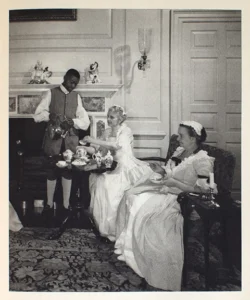
In each case, Wells argues in her book, the artists and patrons were deliberately cultivating an image of American culture and history. And in most cases, she noted, that image was one of white, middle-class prosperity. People of color were often marginalized or left out of the narrative altogether, while “real” white Americans embraced their proud history.
For example, “In the case of Colonial Williamsburg, there’s so much emphasis on showing the hierarchy between white people and Black people. White people are very visible in historic costumes, playing the role of aristocrats,” Wells noted. “Black people are also very visible in historic costumes, but playing the roles of enslaved people. Showing that hierarchy as historically long-standing is a way to help naturalize that same hierarchy in the Jim Crow South.”
And art from this time period wasn’t just about race; it was also about class. Take the Thorne miniature rooms, for example. These tiny dioramas depict rooms from family homes and domestic scenes, but the scenes depict an upper-class lifestyle.
“They’re really putting their elite lifestyles on display through these rooms, but making them accessible to a mass audience. They were wildly popular,” Wells said. “It’s asking people to look at these rooms and imagine them as something they could live in or aspire to live in, but also to imagine them as something that their ancestors lived in. There’s an invented tradition of ‘gracious living.’”
Wells gives many other examples throughout her book of how early 20th century American art crafted messages of belonging for a certain subset of Americans while ignoring others, and she hopes that her readers gain an understanding of the hidden, sometimes sneaky messages conveyed through art.
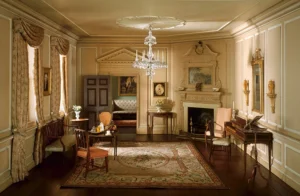
“These modes of oppression and hierarchies of power can manifest in many different ways. We need to understand not just how they came about or why they happen, but why they’re so effective,” she argued.
Learning those lessons is critical so that people can understand the political messages being conveyed in today’s art. Who is included? Who is left out? What kind of narrative is being written about our cultural identity?
Uncanny Revivals: Designing an American Identity is available for preorder and will be released on April 28.
By Sarah Vickery, College of Letters & Science