New research by Philip Chang suggests that there is a dark matter sub-halo lurking in our cosmic neighborhood.
Chang, a professor in UWM’s Department of Physics & Astrophysics, is the co-author of a recent paper titled, “Constraints on a dark matter sub-halo near the Sun from pulsar timing.” In it, he and his collaborators constrain the existence of a halo of dark matter about 3,000 light-years from our solar system. The paper has already garnered some attention and was recently covered in an article published by New Scientist and featured on science YouTuber Sabine Hossenfelder’s channel.
Understanding dark matter
What is dark matter, exactly?
“Good question,” said Chang. “The nature of dark matter is something that we don’t understand. People are really, really working hard trying to get some idea of what it is, but the experiments that have been done to this point have more or less all shown that it is even more elusive than we have previously thought.”
The unscientific explanation is that dark matter is ‘stuff’ (“That’s about how well we define it,” Chang joked) that we can’t see or detect through conventional means.
“In fact, the majority of the universe is made up of this extra ‘stuff’ that people can’t see, touch, feel, or basically detect,” he said. “But we do know its effects through gravity.”
For instance, scientists can tell by examining the rotation of stars around galaxies, and by examining the orbits of galaxies in clusters, that there must be more mass than what they have detected to hold these galaxies and clusters together.
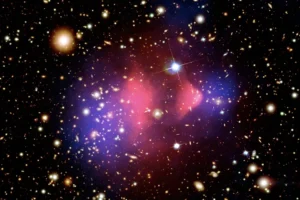
this composite image maps matter in the galaxy cluster 1E 0657-556, also known as the “Bullet Cluster.” Hot gas detected by the Chandra observatory in X-rays is seen as two pink clumps in the image and contains most of the “normal,” or baryonic, matter in the two clusters. A visible-light image from Magellan telescopes in Chile and the Hubble Space Telescope shows the galaxies in orange and white. The blue areas in this image depict where astronomers calculated that most of the mass in the clusters must be. Most of the matter in the clusters (blue) is clearly separate from the normal matter (pink), giving direct evidence that nearly all of the matter in the clusters is dark.
X-ray: NASA/CXC/M.Markevitch et al.; Optical: NASA/STScI; Magellan/U.Arizona/D.Clowe et al.; Lensing Map: NASA/STScI; ESO WFI; Magellan/U.Arizona/D.Clowe et al.
Another piece of evidence of dark matter is the structure of the universe itself, Chang said. Scientists have mapped a “cosmic web” connecting galaxies. Given what we know of the initial conditions of the universe, there must be more matter than what we can observe to produce that cosmic web.
The universe is ‘clumpy,’ Chang added. The stuff in the universe, from galaxies on down, tends to try and clump together. The theory, he said, is that dark matter also tends to clump together, in clumps that can be as small as the mass of Earth, or many times bigger than galaxies. When dark matter clumps together, it’s called a halo, and within that halo, there can be sub-halos.
A new method
To find this particular dark matter sub-halo, Chang and his colleagues turned to pulsars. Pulsars are rapidly-spinning neutron stars that emit regular bursts of radio waves – so regular, said Chang, “you can literally set your atomic clocks with it. Pulsars are the most precise clocks in the universe.”
But if these pulsars experience any sort of accelerated motion – like if they were being pulled on by a gravitational field – the timing of their pulses can change. In fact, scientists at NANOGrav, of which UWM is a part, have been timing pulsars to look for evidence of gravitational waves.
In 2021, Chang and his collaborators theorized that they could use binary pulsars, where one star orbits its companion, to weigh the galaxy. They were, in essence, using one clock to time the pulses of another clock. They accounted for all known effects, like the pulsars’ acceleration and movement, to find the last variable, the matter density of the surrounding galaxy.
“And because we can basically figure out how much gas there was, how many stars there were, we were able to put a constraint on the dark matter mass density of our galaxy,” Chang said.
The method worked. Now they had to test it in more places. So, Chang and his colleagues mapped out some pulsars and began looking for fluctuations in their measured accelerations. “We found a few of these pulsars in a particular region of the sky that suggests there’s some extra thing ‘pulling’ on them,” Chang said. “What could be that extra thing? Well, in order to fit this acceleration (that we measured), we need an extra piece of matter, which is about 10^7 solar masses of ‘stuff’ right in this area of the sky.”
They examined the area surrounding the pulsars. There were no molecular clouds. It couldn’t be a cluster of stars because the scientists would have seen their light. So, either there’s a rare primordial black hole in the area, or, as Chang and his team theorized, there is a dark matter sub-halo.
A cosmic neighbor
Chang and his team were excited that their method worked, and also a little bemused.
“The main thing that was surprising about it was that it was so close, about one kiloparsec away,” said Chang. That’s about 3,000 light-years away, or 17.6 quadrillion miles – practically in our cosmic block, given the sheer size of the universe.
The size of the probable sub-halo and its proximity means that the door is open for scientists to build on Chang’s research. For instance, some researchers have been looking for evidence of dark matter by searching for evidence of gamma ray annihilation, when particles of dark matter bump into other particles and release energy as a result. Now, they have a new direction in which to look.
“This (research) is an indirect probe of our understanding of the origin of the universe,” said Chang. “It’s an exploration of the limits of our knowledge.”
By Sarah Vickery, College of Letters & Science