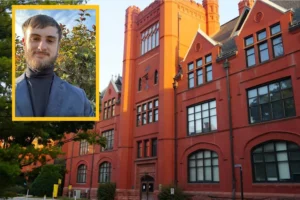
Did you know that there is a boarded-up observatory hidden on the top floor of Merrill Hall? Or that the façade of Johnston Hall is decorated with carvings of dragons, mermaids, and the faces of former deans of Downer College?
There’s a trove of hidden secrets and forgotten history in UWM’s buildings, and this past year, Cael Byrne made it his mission to uncover them.
Byrne is a recent graduate of UWM’s Journalism, Advertising, & Media Studies program. Inspired by On Milwaukee’s “Urban Spelunking” columns by Bobby Tanzilo, Byrne created “UWM Urban Spelunking,” a docuseries published on the UWM Post website that explores some of the historic buildings on the UW-Milwaukee campus. The project was a labor of love for Byrne, who is a Milwaukee native.
“I’ve always been interested in historic buildings. When I came to UWM, I didn’t realize that they had so many on their campus,” Byrne said. “When I started the project, I didn’t realize it would be this big of a scope, where we were covering 20 different buildings on campus, but I’m glad that I got to cover that many.”
Exploring and writing
The project started with a healthy curiosity. While he was a student, Byrne and a friend explored the dark corners of the campus buildings where they had their classes. It was fun, and Byrne wanted to learn more. Plus, as the editor of the UWM Post during his senior year, he had a platform to publish his findings.
So, instead of merely urban exploring, Byrne began urban spelunking.
“Urban spelunking is basically exploring a building that has historic context to it. It could be an abandoned building, or it could be a building that’s still in use. It’s just usually an older building,” Byrne explained. It is not trespassing, to be clear: Byrne obtained permission from UWM officials before he started his work.
The goal was simple: Like Tanzilo’s columns, Byrne wanted to highlight the architectural features of the buildings and find out their histories. At one point, he said, “pretty much every building on campus was a contender (to be profiled). It just came down to if I could find people who knew the history and were willing to give me a tour or be on camera.”
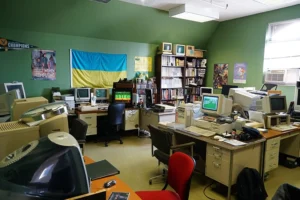
Eventually, he whittled it down to some of UWM’s more esoteric and unexpected holdings, including the Center for Nursing History in Cunningham Hall; the Retrocomputing Lab in Holton Hall; the Office of Sustainability at the University Services and Research Building; and the Downer College Buildings, like Merrill, Johnston, and Garland halls, among others. (UW-Milwaukee occupies the site of the former Downer College, a women’s college established in 1851 that merged with Lawrence College in Appleton in 1964.)
Byrne talked with campus leaders about these offices and facilities to create documentaries about each locale. He climbed forgotten staircases and traipsed through boarded-up attics, camera in hand to shoot footage. He wrote the script for each episode, recorded the dialogue himself, and pieced his films together on UWM Library computers.
To find the material for his scripts, Byrne consulted the Milwaukee and Wisconsin historical societies. He spent hours scouring the UWM Archives to find the images featured in his documentaries and blueprints of the buildings. The archives on the Downer College buildings alone took up around 200 boxes.
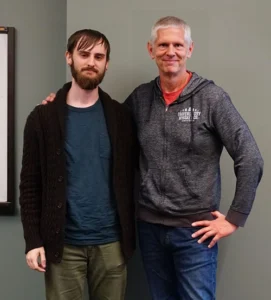
“The people (at the Archives) are amazing. They have so much content there to go through. Even I didn’t get through all of it. I tried my best,” Byrne said ruefully.
He had a source of inspiration to keep him going, though: Halfway through the project, Byrne had an opportunity to interview Tanzilo himself.
“Getting to interview him, so far, is the highlight of my career, because he’s like a local celebrity and I’ve been reading his stories for forever,” Byrne said.
Sharing his work
As of December 2025, the “UWM Urban Spelunking” project is complete. Now, Byrne wants to share what he learned about campus’ beautiful, historical buildings. He’s in the process of applying to show his docuseries in the Milwaukee Film Festival, and he plans to hold a premiere on campus as well.
Eventually, he would love to make this sort of work his career. He found that he enjoys learning and sharing the histories of historic buildings, and he hopes he can help others appreciate them as well.
“For people in Milwaukee, I just hope that they realize how many historic buildings we have in Milwaukee specifically,” Byrne said. “I hope that UWM students pay attention more to the buildings that they’re going to class in. If you just look around a little bit within the archives or within the building, you’ll find things that you never expected. I certainly did.”
By Sarah Vickery, College of Letters & Science