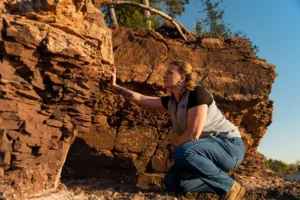
You might think Antarctica is the most remote place someone’s career might take them. UWM alum Libby Ives traversed Antarctica’s ice landscapes to study glacial sediments laid down more than 300 million years ago, but years later, she found herself even farther afield — literally, if not scientifically — when she applied her sedimentary skills to analyzing Martian landscapes for NASA.
By studying ancient landscapes, her work offers valuable insights about a planet’s environment — past, present and future. But the Waukesha, Wisconsin native didn’t always know geology was her path.
“I knew I wanted to do science, and I knew I wanted to be outside a lot,” Ives said. She discovered her passion for geosciences as an undergraduate at Northern Michigan University, where she was drawn in by the interdisciplinary nature of the field. “You get to use your physics, biology and chemistry knowledge, and you get to put it all together to tell the story of the Earth and how things came to be.”
Read the full story on UWM Report.
By Anna Funk, Marketing & Communications