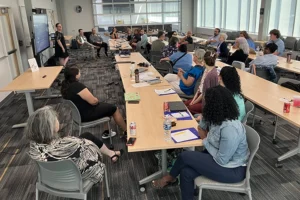
On July 7-9, UWM’s Center for Latin American & Caribbean Studies welcomed 25 educators to campus for the program’s annual Summer Teacher Institute, supported in part by a National Resource Center Title VI grant from the U.S. Department of Education. Representing grades kindergarten through college and many disciplines, educators from across Wisconsin and eight other states quickly jumped into collaborations, taking in expert presentations and buzzing in small group discussion on this year’s topic of “Childhood and Youth in Latin America.”
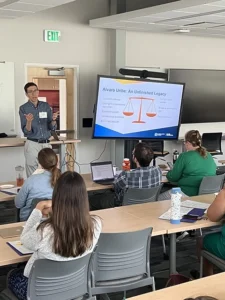
Each of the three days was anchored by a faculty expert who shared their research: Professor Gabriel Velez (Marquette University, Educational Policy and Leadership) on Colombia’s history of violence and first-of-its-kind peace curriculum; Professor Jessica Taft (University of California Santa Cruz, Latin American and Latino Studies) on Latin America’s rich tradition of youth activism; and Professor Erin Hogan (University of Maryland Baltimore County, Spanish) on children in Latin American films.
Participants also learned from leading professionals who support children’s well-being and amplify their stories: photojournalist Misha Vallejo Prut, who shared reporting on solar power and school infrastructure in Ecuador’s Amazon; the Pulitzer Center for Crisis Reporting, which offers many free resources for K-16 educators; Julie Kline, co-founder of the Américas Award, which recognizes excellent children’s and young adult literature that portrays Latin America, the Caribbean, or Latinos in the United States; María Morfín, whose nonprofit La Jugarreta facilitates children’s democratic participation in their communities across Mexico; and Carlos Hagerman and Jorge Villalobos, whose animated documentary Home is Somewhere Else depicts the varied migration stories of three Mexican-American youth.
For first-time institute participant Aaron Kaio, who teaches high school social studies in Madison, the three-day professional development program helped him reconsider existing classroom units and provided new resources for a Latin American studies class he’ll be teaching for the first time this fall.
For UWM’s Center for Latin American & Caribbean Studies, that is a sure sign the event was a success. Their goal is helping educators bring more Latin American content to their classrooms – in Milwaukee, Wauwatosa, Madison, La Crosse, and beyond – and preparing students to be informed and empowered global citizens.
For more details on the summer institute, visit the Center for Latin American & Caribbean Studies’ website.
By Monica VonBladel, Center for Latin American & Caribbean Studies