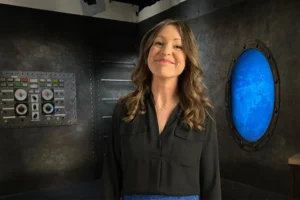
UWM Associate Professor of Anthropology Ashley Lemke has had a busy year. Last summer, she appeared as an expert on the History Channel’s new show “Mysteries Unearthed,” hosted by Danny Trejo. This summer, she was a consultant for the immersive, interactive exhibit “Mysteries from the Deep: Exploring Underwater Archaeology,” created by the company Flying Fish, which builds traveling museum exhibitions.
And in May, her new Great Course became available for streaming.
The Great Courses are an extensive collection of video series covering an array of academic subjects, from “Homemade Holiday Breads” to “Understanding Cognitive Bias” to “The Many Hidden Worlds of Quantum Mechanics”. The videos are written and narrated by experts in their fields – including Lemke, who was invited to become a host for a 12-episode series titled “Underwater Water Archaeology: Mysteries of the Deep.”
Lemke recently sat down to talk about making a Great Course and the fascinating stories she uncovered as she wrote and recorded the series.
How did you get tapped to create a Great Course?
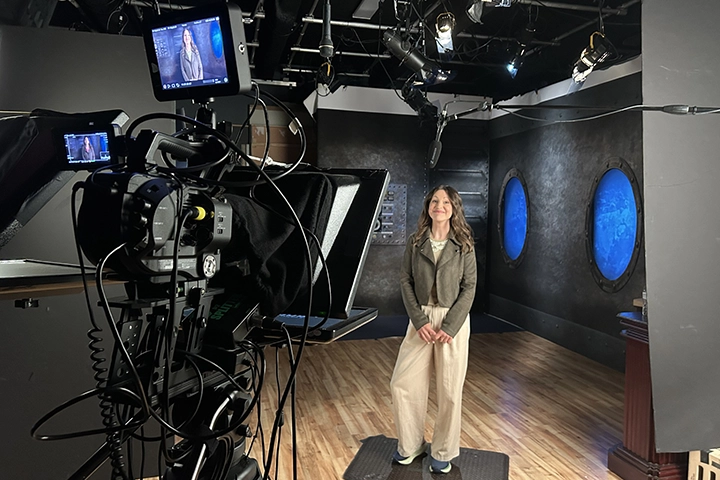
I got an email out of the blue (from a talent recruiter of The Great Courses) that said, “Hey, we’re going to do a course about underwater archeology, and we want to talk to you about it.” I thought that it was going to be a documentary with many people talking about underwater archeology and their research. They asked if I could write a script and they would fly me out (to the recording studios near Washington, D.C.) to record part of the pilot.
I had literally no idea what I got myself into. They flew me out there and said, “Okay, we’re going to pick you up tomorrow for the audition.” I was so surprised! It was an audition to be the host of the whole course. I did tape a pilot episode that was 30 minutes, and I wrote the whole script for it. And then I got the part.
You didn’t just get the part; you were asked to write scripts for twelve 30-minute episodes. How did you decide what to cover?
The producers and I went back and forth because they wanted the series to be all about shipwrecks and I don’t specialize in shipwrecks! (Lemke researches ancient hunter-gatherer villages submerged in the Great Lakes.) I teach an underwater archeology class at UWM, so I based a lot of the Great Course on that class. In my class, I had pirate week, and then shipwreck week, and then there was ice age hunters, etc., and I did those topics in the course, too. It was a challenge because no one person can be an expert in everything. For example, there’s a whole episode on World War II, and I’ve never studied (that era) in detail.
The course includes some amazing visuals of underwater archaeology. How did you get the images to accompany your scripts?
The Great Courses content developers asked me for names and emails of my colleagues in the underwater archaeology field and relied on my network to (find images and footage). I think people were happy to see their work highlighted and I was so excited to showcase my colleagues!
For example, in the pirate episode, I talk about Port Royal. Everybody’s heard of Port Royal because of the “Pirates of the Caribbean” movies, but Port Royal is a real place, and it really did sink into the ocean. Texas A&M University has excavated parts of Port Royal. I had never seen any of that footage, but the producers reached out to the archaeologist, Donnie Hamilton, and he gave us underwater video from Port Royal from the archeologists that were excavating. And it’s the coolest stuff ever.
Have you heard any feedback about your series?
When you’re a professor, you know who signs up for your classes. But literally anybody anywhere can watch this! People have reached out from all over the world to say that they’ve watched and that they really like the episodes. And I think that’s the coolest. I’m really honored by it.
Do you have a favorite episode?
I kind of like all of them! I’ll say the episodes about Viking ships and settlements, or the World War II episode. Those are stories that, for a while, felt like they weren’t really like mine to tell because it’s not the specific research that I do, but it was fun and enlightening for me to get to highlight my colleagues. I know a lot of people that research World War II “conflict archeology”. It was intriguing to get into the details of those stories.
Were there any interesting stories you uncovered during your research for the series that made it into an episode?
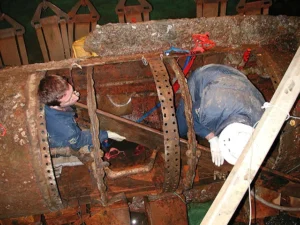
During the Civil War, the Confederate army had a submarine, and it was the first successful combat submarine in the world. It was called the Hunley. It was the first submarine that successfully sank an enemy ship, but the submarine also sank. Scientists have hypothesized about what caused the loss of the Hunley and it’s likely the shock wave from the torpedo killed the crew and sank the vessel.
Since its discovery underwater the submarine has been raised, conserved, and researched. The archaeologists found the Hunley’s crew’s remains preserved in the submarine.
They found a gold coin in the pocket of the Hunley’s captain, and it was bent in kind of a “C” shape. He had fought in one of the Civil War battles on land. He was shot and the coin in his pocket stopped the bullet and saved his life and they found that coin on his person in the submarine. Engraved on it, it says, “My life preserver.” But it’s so tragic, because he died with it in his pocket out at sea.
Now that you’re done with it, would you ever want to make another Great Course?
I think probably everybody feels this way after a massive project – you’re like, I’m never going to do that again! And now it’s only been a couple months but I’d love to do another one. It was challenging but I can’t think of a better way to share archaeology!
By Sarah Vickery, College of Letters & Science