WUWM Radio got quite a present for its 60th birthday.
The station was recently accepted into the American Archive for Public Broadcasting in collaboration with GBH Boston and the Library of Congress, ensuring that its decades of content will be preserved for the decades to come.
The American Archive’s mission is to “preserve for posterity the most significant public television and radio programs of the past 60 years,” according to the repository’s website. WUWM will be the first public radio station from Milwaukee to have its material included in the archive.
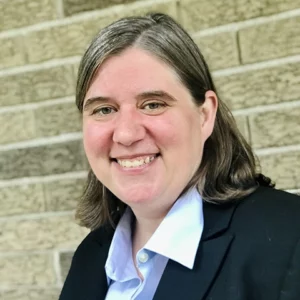
“The first thing it means is we’re part of any research that you do now. If somebody goes to the Library of Congress and searches all of these things, we’ll come up in that search, and they’ll be able to hear that audio,” said Ele Ellis, WUWM’s Vice President of Content and Programming. “The second thing is, it means that there are a lot of voices of Milwaukee in the Library of Congress.”
Ellis learned about the American Archive at an industry conference several years ago. She knew immediately that she wanted to get WUWM Radio accepted, and not just for the prestige.
“Of course we wanted to be in the Library of Congress. That’s super cool! But for us, the big piece is we’ve been trying to figure out how to save this audio for a while,” Ellis said. “Every piece of media until you get to digital media … is degradable. When you think about WUWM turning 60, those reel-to-reel tapes (of broadcasts), those first ones, are 59 years old. The idea that they’re going to last forever is impossible.”
Not only will the Archive make WUWM’s media available to the general public, but its employees will also digitize and send a hard drive of the broadcasts back to the station. With that in hand, WUWM will have preserved media like the Dahmer trial and interviews with most every mayor in Milwaukee’s history over the past 60 years.
“All of the voices that were on WUWM in Milwaukee will be saved. I just think that’s amazing,” said Ellis.
Many helping hands
But before the Archive can digitize WUWM’s broadcasts, it needs the recorded material.
There was just one problem.
“All of the (broadcasts from) before we were putting things online, it’s in different places. It’s some on reel-to-reel, some on cassette, some on CD. It’s just everywhere, and it’s not searchable,” said Ellis.
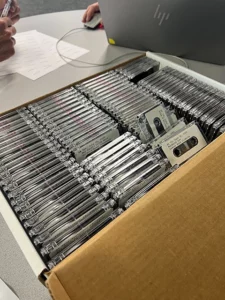
There were reel-to-reels of news broadcasts from the 1980s and ‘90s piled in the news studio. A glass cabinet full of CDs of old “Lake Effect” shows sat in the conference room, while Ellis’ office was packed with CDs of other broadcasts and cassette tapes were piled in another production studio. Other material was scattered around the station. Sixty years’ worth of broadcasts get stored wherever there is room.
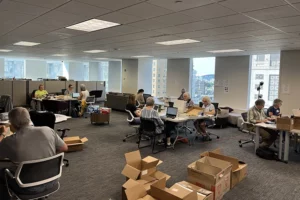
Ellis needed help, not only to sort and package the material, but also to record its metadata – the broadcast date and time, the host, any guests, and so on. So, she put out a call for volunteers in hopes that WUWM listeners might want to get involved.
“I thought we’d get 10 or 15 people. I was hoping for 20,” Ellis recalled. “We got, over the course of two days, 100 people. They would bring their own laptop and come and enter data for us.”
A young electrician came straight from his job still in his work gear; several couples made a date of it. One participant was an archivist herself and had written a dissertation about public broadcast archiving.
As for volunteer Allison Mayenschein, “I was looking for different opportunities to keep me busy and help out. I am a huge supporter of the radio station, so I was there and I catalogued the Lake Effect show.”
Mayenschein, who happens to be a UWM journalism graduate, began listening to WUWM Radio in 2009 and has been tuning in ever since. She was excited to assist – and not just because the station gave the volunteers lunch, a t-shirt, and a tour of the station. The materials she worked with contained recordings from shows in the 2000s and in the 1980s.
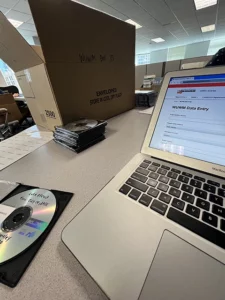
“There were a couple (of shows) that I remember listening to. One was the County Transit System strike. I was going to school at UWM and I took the bus every single day, so that affected my life greatly,” Mayenschein said. “Coming across that recording was like coming across an old memory I had forgotten about.”
Thanks to Mayenschein and the other volunteers, WUWM Radio was able to record metadata for and pack up most all of its collection. The contents will be shipped to the American Archive for Public Broadcasting by the end of January, and Ellis hopes that WUWM’s broadcasts will be archived, online, and searchable by the end of 2025.
Celebrating 60 years
WUWM, which operates under the umbrella of the College of Letters & Science, was founded in 1964 by Ruane Hill, a faculty member at UWM who served as the first chair of the mass communication department. The UW Board of Regents appointed Hill to create a public radio station at UW-Milwaukee in 1963, and he served as the station’s general manager for more than a decade before retiring.
In November, WUWM delivered a slew of media surrounding the presidential election, including an online and printed voter guide and animations on how to vote. The station is also celebrating its 60th birthday in style. In September, WUWM kicked off its Many Voices, One Frequency: 60 Years of Public Service campaign, a six-month-long period of special events, programming, and fundraising. To start things out, station manager David Lee threw the first pitch at a Brewers game in September. The station also hosted a special retrospective with long-time, now-retired, WUWM host Bob Reitman.
More birthday events are planned for the coming months, and the station’s election coverage will continue with a second season of the podcast “Swing State of the Union,” which Ellis says will coincide with the state Supreme Court election in April.
After all, now that WUWM’s past is safely archived, it’s time to look to its future.
By Sarah Vickery, College of Letters & Science