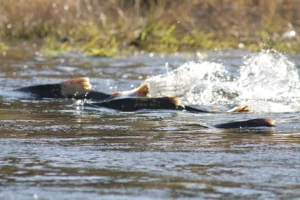
In the Pacific northwest, salmon is king. The animals are a staple of Washington State’s economy, and they’re culturally and economically important to the state’s tribes as well. That’s not to mention their vital role in the ecosystem.
So, when you’re trying to restore and preserve riparian (river adjacent) forests and wetlands in Washington, you need someone who really knows her fish – someone like UWM alumna Chemine Jackels.
“My son’s friends will go fishing and they’ll ask me what a specific kind of fish is,” Jackels said with a smile. “I’m also a Girl Scout leader, and we go out at low tide, and I teach (my troop). They know that I’m an aquatic biologist.”
That’s one of the reasons that she’s so good at her job as a marine habitat restoration specialist with NOAA.
“I absolutely love it,” Jackels said of her work. “I always had a passion for the environment, and I knew that I wanted to work with threatened and endangered species and make a difference in their recovery.”
Habitat restoration
Most people think of the National Oceanic and Atmospheric Administration as the group that tracks hurricanes, but NOAA does much more than monitor severe weather. The organization also has a branch called NOAA Fisheries. They oversee management of commercial fisheries, but “they also have jurisdiction over federal endangered species that are marine-based, or in the case of salmon, marine and freshwater,” explained Jackels.
Work is busier than ever, thanks to the Bipartisan Infrastructure Law and the Inflation Reduction Act. These federal actions allocated millions of dollars to NOAA, which has used that money to award grants to local governments, nonprofits, and tribes interested in improving community resilience and habitat for fish.
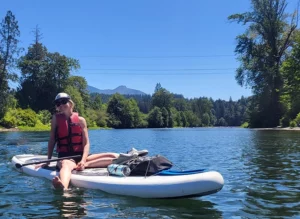
As an ERT-contract NOAA restoration specialist, Jackels helps guide those groups through the permitting process, offers input on their project design, and makes sure that they meet their project milestones. She also helps them comply with federal laws, including the National Environmental Policy Act, the Endangered Species Act, and the National Historic Preservation Act. That’s not to mention her work with the Washington Tribes, which are an important partner in restoration work.
Usually, projects fall into one of two categories: Fish passage and hydrologic restoration. Fish passage means improving routes for salmon to travel by removing a dam, for example, or widening culverts for migratory fish species. Hydrologic restoration involves reconnecting a river with its floodplain. That might mean removing a levee so that the river can form side channels and open more areas for fish to forage for food.
But it’s not just the fish that benefit.
Environmental connections
While salmon are important to the people living in the region, they’re essential for the ecosystem. Healthy salmon runs are a good indicator of water quality. In addition, most salmon die after they spawn in freshwater, and their carcasses provide all sorts of beneficial marine nutrients to rivers and streams.
And of course, salmon are an essential food source.
“We have critically endangered Southern Resident killer whales here that eat primarily salmon, specifically Chinook salmon, and there are not enough,” Jackels said. “So, the whales are starving. Their population declines every year. They cannot keep calves alive.”
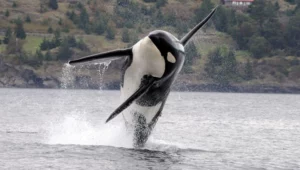
You may recall news stories from 2018 about one of the Southern Resident orcas, known as J35, who carried her dead newborn calf on her head for over 1,000 miles. The same whale recently gave birth to another calf, which sadly was confirmed dead on New Year’s Day. J35 has started the same grieving process of carrying this dead calf around, just like she did in 2018.
Producing calves is a huge energetic (and emotional) investment for these highly intelligent, social whales. J35 needs plenty of food so she can produce the milk her calves need to thrive.
“So, we really need to boost the salmon population to feed them, and particularly the Chinook salmon,” said Jackels.
That means the fish need more places to spawn, eat, and grow before beginning their journey to the open ocean. Salmon spend most of their lives in the saltwater ocean, but they return yearly to freshwater rivers and streams to lay their eggs. Over time, many of those spawning and rearing grounds have been lost, due to human development and modifications to rivers and their adjacent habitat.
That’s why habitat restoration is so vital. The community projects that Jackels oversees will open up new waterways and spawning and rearing grounds. Jackels smiles as she recalls one project she worked on while she was employed with the U.S. Army Corps of Engineers. Her group was relocating a stream from a channelized road-side ditch to a meandered channel through a forested wetland.
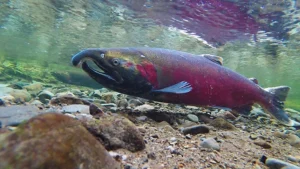
“(The salmon) were waiting there (to use the new stream). We see that a lot; there’s a general sort of mantra that if you build the habitat, they will come. I’ve personally witnessed that.”
These days, Jackels is consulting on a few restoration projects. One project in southwestern Washington will completely remove a culvert that impedes fish access to high quality, forested stream habitat; for another, she is monitoring habitat changes in an area where a dam was removed.
A fishy start
It’s always been Jackels’ dream to work with threatened and endangered species, but she learned to love fish while she was working on her bachelor’s and master’s degrees in biology at UWM.
“What really hooked me into aquatic biology or fish biology was taking (associate professor) Tim Ehlinger’s class,” she recalled. “He taught a class on ecology. … I ended up getting a job in his lab working in the summer doing stream and fish surveys. That’s where I really started to find my niche.”
After graduation, a UWM professor helped Jackels procure a research appointment at the University of Washington. Later, she worked with the Army Corps of Engineers in Washington, assisting with Endangered Species Act and Clean Water Act compliance, before joining NOAA as a contract employee.
Her job is fulfilling, though often at the mercy of federal policy and congressional budgets. Even so, Jackels is heartened by the sheer number of people interested in habitat restoration. “The demand is really high,” she said with a smile. “It gives me hope that there are so many possibilities out there. I’ve met a lot of incredible, passionate people who care about the environment and salmon recovery.”
By Sarah Vickery, College of Letters & Science