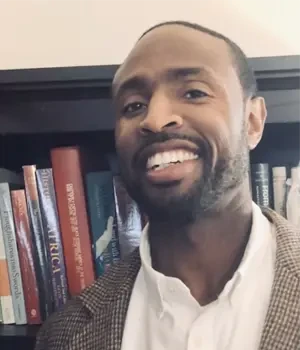
The University of Wisconsin-Milwaukee History Department welcomes Assistant Professor Dr. Marcus Allen, whose work brings new depth to the study of African American history through an economic lens.
Dr. Allen’s path to UWM reflects more than a decade of persistence, movement, and scholarly growth. Over the course of his career, he has served as a lecturer, adjunct instructor, visiting professor, and postdoctoral scholar, gaining experience across institutions and refining both his research and teaching. Most recently, he held appointments at the National Humanities Center in North Carolina and Case Western Reserve University, where he continued to develop his work in African American history.
At the center of Dr. Allen’s scholarship is his ongoing book project, which examines Black depositors in a white-owned savings bank in Baltimore between 1850 and 1900. Drawing from savings account records, personal inventories, and wills, he reconstructs the financial and material lives of African Americans during the antebellum and postbellum periods. His research offers a more expansive understanding of the 19th century, one that moves beyond narratives focused solely on hardship to also highlight financial strategy, resilience, and economic agency within Black communities.
“There’s a lot of history that still needs to be uncovered,” Dr. Allen explains. “We have to be careful about drawing strong conclusions, because there may be history out there that changes how we understand things.” This perspective shapes his approach to both research and teaching, emphasizing the importance of continued discovery and critical inquiry.
Dr. Allen’s work also extends beyond academic spaces. He was recently featured on Black Nouveau, where he discussed his research on Black economic life and the importance of uncovering overlooked histories. In the interview, he highlights how examining financial records and everyday economic decisions can reshape our understanding of the past and reveal stories that have long gone unrecognized.
His interest in Black financial history began during his undergraduate studies, when he first encountered the story of the Freedman’s Savings and Trust Bank and the significant losses experienced by many Black depositors after its collapse. That moment sparked a lasting curiosity about Black economic institutions and the historical narratives that have been overlooked or underexplored. What began as a single question has grown into a sustained research agenda focused on understanding how Black communities navigated economic life in the 19th century.
In the classroom, Dr. Allen brings the same level of passion and curiosity to his teaching. He is committed to creating an encouraging environment where students feel empowered to challenge themselves and think critically. Whether teaching Black American history or broader historical themes, his goal is to help students see new possibilities in both their academic work and their personal growth. As he puts it, he aims “to encourage people to try to do things they think they can’t do.”
Dr. Allen was also drawn to UWM by the opportunity to join a department engaged in meaningful historical work and by the chance to contribute to a new academic community. As he settles into Milwaukee, he is especially interested in learning more about the city’s history, what he describes as rich, layered, and often underrecognized. He looks forward to exploring those stories and incorporating them into his teaching and research over time.
Beyond his academic work, Dr. Allen enjoys running and cooking, mentioning specifically eating kale and lime juice straight up, raises a few eyebrows.
As he begins his time at UWM, Dr. Allen brings with him not only a strong research agenda, but also a commitment to uncovering overlooked histories and expanding how the past is understood. His work serves as a reminder that history is not fixed; it is continually being discovered, questioned, and reinterpreted.