Nathan Connolly Delivers 6th Annual McGaffey Lecture on Family History and Capitalism
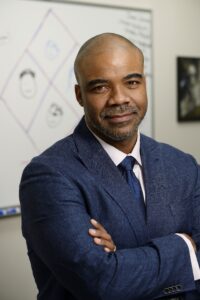
On April 2, we had the privilege of hosting the 6th annual McGaffey Lecture with speaker Nathan Connolly of Johns Hopkins University. The lecture, “Letters from the Ancestors: Family History and our Capitalist Future.” Draws from four generations of family archives, Connolly explores how Caribbean family histories reveal the lived realities of racialized capitalism, economic precarity and structural inequality.
At the heart of the lecture was Connolly’s great-grandfather, William “Smiley” Connolly, a multilingual Caribbean intellectual. writer and activist whose life unfolded across the British Empire and the United States in the early twentieth century. Although widely respected in community and intellectual circle, Smiley Connolly never held a formal academic position, noting how many Black scholars and thinkers existed historically outside traditional institutions. By tracing Smiley’s life through scattered documents, letters, and family stories, Connolly demonstrates how personal archives can help to explain larger histories of colonialism, migration and economic struggle.
Connolly described the process of reconstructing these histories as working through what he calls a “demented archive” a mix of official documents, fragmented letters, oral histories and family memories shaped by illness, migration and generational storytelling. These materials, he argued, reveal how families navigate systems that often deny them stability or recognition.
As Connolly explained during the lecture:
“What we need is not men who will make the world safe for democracy, but men who will make the world unsafe for autocracy.”
The lecture highlighted several key themes, including how family archives can help us understand the development of racial capitalism, the ways working-class families navigated racism and financial instability and how family narrative, particularly those surrounding women, can obscure the structural causes of economic hardship. Connolly challenged audiences to rethink how inherited stories shape our understanding of responsibility, success and failure within capitalist systems.
“Letters from the Ancestors” invited attendees to reflect on how personal histories intersect with larger political and economic structures. By connecting his family’s experiences in the Caribbean and the United States to contemporary inequalities, Connolly encouraged listeners to consider how we engage with institutions today and how the stories we tell about our past influence the futures we imagine.
Inside UWM’s Retrocomputing Lab: Where Students Experience the Digital Past Firsthand
Students in HIST 399: “How the Computer Became Universal” are not just learning about the history of computing; they are experiencing it.
During a recent class session, students visited the University of Wisconsin–Milwaukee’s Retrocomputing Lab, located in Holton Hall 402. The lab, created and maintained by technology historian and professor Thomas Haigh, offers a special hands-on opportunity to explore the machines, software and materials that shape the digital world.
The Retrocomputing Lab is one of only four of its kind in the United States, and the only one operated within a history department, making it a unique resource for both teaching and research.
A Lab Built for Experience, Not Just Observation
Unlike a traditional museum, the Retrocomputing Lab is designed as a working collection of everyday machines. Students don’t just look at the past, they interact with it. The lab includes around 20 fully functional computer systems, along with printers, storage devices, manuals and software spanning from the late 1970s through the early 2000s.
Much of the collection comes from Haigh’s personal archive, combined with donations, university surplus, and carefully selected additions. This approach reflects the lab’s central goal: not to collect rare or exotic artifacts, but to recreate what it actually felt like to use computers in different eras.
Why Hands-On History Matters
As highlighted in a recent feature by Fast Company, one of the biggest challenges in teaching the history of computing is that today’s students have no lived experience with older technologies.
For many undergraduates, devices like the Apple II, early IBM PCs, or even floppy disks were already obsolete before they were born.
Haigh created the Retrocomputing Lab in part to bridge that gap. By giving students the chance to load programs from disks, navigate early operating systems, or play vintage games, the lab makes abstract history tangible.
As the article explains, this kind of experience cannot be fully replicated through emulators or modern devices. The physical interaction, the keyboards, the delays, and the trial-and-error process are essential to understanding how computing actually worked.
Inside the Classroom: HIST 399

In HIST 399, students examine how computers evolved from niche tools into universal technologies. The Retrocomputing Lab plays a central role in that process.
During the recent class visit, students explored early personal computing systems such as the Altair 8800, TRS-80 Model I and Apple II, machines that introduced programming, gaming and personal productivity into everyday life.
They also examined a mechanical teletype terminal, which printed computer responses onto paper, offering insight into how people interacted with computers before modern screens and interfaces.
Through these experiences, students gain a clearer understanding of both the technical limitations and the cultural expectations surrounding early computing.
Looking Back to Understand the Future
The Retrocomputing Lab is not only about preserving the past, but also about helping students think critically about the future of technology.
As the Fast Company article notes, modern computing increasingly relies on cloud services, online infrastructure, and constantly updated software. This raises important questions about what aspects of today’s technology will be preserved, and what may be lost.
By contrast, many of the systems in the Retrocomputing Lab are fully self-contained, allowing them to be restored, studied and experienced decades later.
The lab also reflects a growing interest among students in tangible, understandable, and not constantly connected technology, a contrast to today’s always-online digital environment.
A Resource for the UWM Community
The Retrocomputing Lab is open to members of the UWM community by appointment or during scheduled open house sessions. Students interested in technology history, restoration work, or hands-on experimentation are encouraged to get involved.
As the lab continues to grow, it remains a unique space where past and present intersect, allowing students to understand not just how computers work but how they became essential to everyday life.
UWM’s RetroLab Welcomes Doors Open Milwaukee
Part nostalgic digital playground, part digital and technological history lesson, UWM’s Retrolab in Holton Hall 402 is one of just four such retro computing labs in the entire country. Its collection of some 50 vintage computers dates back to the 1970s – from PCs and Apple Macintosh machines to legends like the Apple II, Atari 2600 and Commodore 64. Complete with productivity and entertainment software, it serves as a valuable, hands-on teaching experience for UWM students.
Visitor Experience
Step into the Retrolab and back into the computer gaming world of days gone by. Visitors will get a few minutes to play their favorite old-school games on their original machines and explore the lab’s fully functioning catalog of computers. You’ll also meet the UWM history professor who created the space, preserves the machines and made it what it is today.
Check it out at https://historicmilwaukee.org/doors-open/buildings/uwm-history-department-retro-computing-lab/