
Every two years, UW-Milwaukee School of Architecture & Urban Planning awards internationally recognized design professionals who bring fresh, innovative and effective thinking to the field of urban design. Urban Edge Award recipients engage with the school through studios, seminars, symposia and other events co-organized with a SARUP faculty member.
Origin

The Urban Edge Award was created in 2006. Modeled after the successful Marcus Prize and supported by the Wisconsin Preservation Fund and the law firm of Reinhart Boerner Van Deuren, the Urban Edge Award recognizes excellence in urban design and the ability of individuals to create major, positive change within the public realm. Funding for the Urban Edge Award totals $50,000.
Since its inception, the Urban Edge Award has welcomed designers from around the world to Milwaukee, inspiring student designers through immersive learning opportunities and hands-on experiences.
Milwaukee Urbanism Defined by Global Scholars
Since its inception, the Urban Edge Award has welcomed architects, landscape architects, urbanists, and designers from around the world to Milwaukee, directly impacting the city through projects, studios, seminars, symposia and other events.
2025 Urban Edge Award
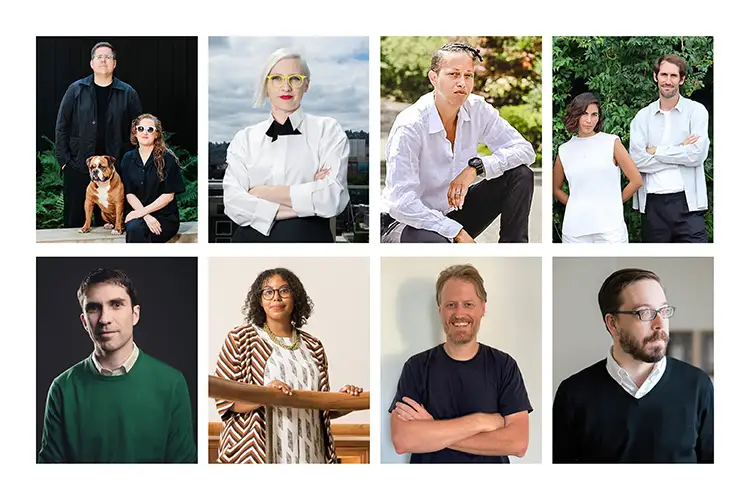
Ashley Bigham and Erik Herrmann, Jennifer Bonner, Mitch McEwen, Laura Salazar-Altobelli and Pablo Sequero, Paul Andersen, Adrienne Brown, Jonathan Tate, Jesus Vassallo
Led by Assistant Professor Sam Schuermann
The 2025 Urban Edge Award supported On Housing, the single-family lot and the American City, a multi-day symposium and accompanying exhibition exploring housing in the American city, one of the most pressing issues of our time. The event brought together nationally recognized architects and theorists to engage with students and faculty through lectures, panels and workshops.
Participants and audiences discussed the legacy and status of domestic architecture today, particularly through the lens of the single-family typology and with a variety of socio-political complexity.
The Urban Edge Award also supported a spring seminar in which students worked closely with symposium content to develop an edited publication that documents and extends the symposium’s ideas.
Past Urban Edge Awards




Midwest Modernism
Daniel Barber, Ann Lui and Michelangelo Sabatino | 2023 Urban Edge Award
Taught by Associate Professor Whitney Moon
The 2023 Urban Edge Seminar served as a research platform for a forthcoming book and exhibition on the work of Milwaukee-based architects Willis & Lillian Leenhouts, to be co-curated by Whitney Moon and Monica Obniski. The seminar looked at how modernist housing became popular and widespread in the Midwest from the 1930s to the 1970s. Along with weekly class sessions, the course included three public lectures and hands-on workshops: 1) Modern, Midwestern, and Modest in Milwaukee, 2) The Social City, and 3) Environmental Activism and Architecture. Scholars Daniel Barber, Ann Lui and Michelangelo Sabatino shared their knowledge about Midwestern modernism and worked closely with students to help them research, write and design four themed Architectural Field Guides.
Milwaukee as a Carbon Neutral and Water-Centric EcoCity + Inner Harbor Freshwater Campus
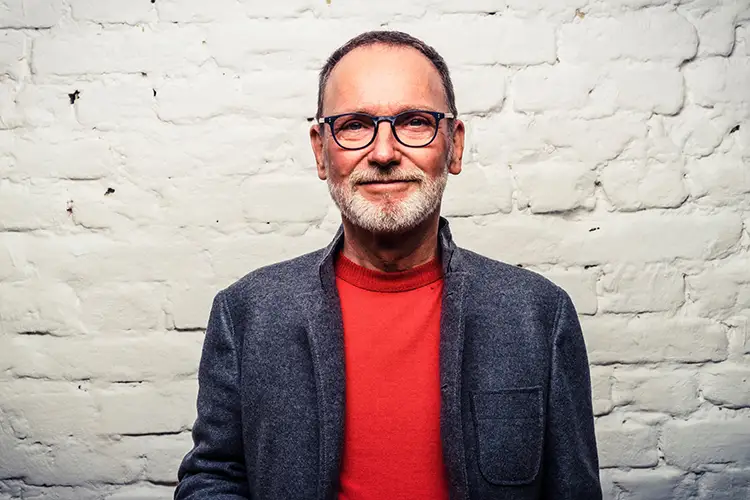
Herbert Dreiseitl | 2019 Urban Edge Award
Co-taught by Professor James Wasley
Designer Herbert Dreiseitl co-taught the 2019 Urban Edge Seminar called “Milwaukee as a Carbon Neutral and Water-Centric EcoCity.” Students explored how to design a more sustainable future for Milwaukee, starting at the large watershed level and working down to individual public spaces. Professor Dreiseitl, known worldwide for his “fluid thinking” approach and major international projects, guided students through this vision. Dreiseitl joined the class virtually from Germany every other week. His input helped students connect global ideas to Milwaukee’s water, energy, and infrastructure systems as they imagined a greener, post-carbon city.
Herbert Dreiseitl | 2011 Urban Edge Award
Co-taught by Associate Professor James Wasley
German artist and landscape architect Herbert Dreiseitl, known for using water as a central theme in his designs, co-taught a design studio as a result of the 2011 Urban Edge Award. The studio challenged students to imagine future plans for a “harbor campus” combining university research and industrial innovation. The goal was to show how economic development and environmental sustainability could work together. Students focused especially on how water could be managed in ways that help restore the environment, making ecologically smart design a key part of Milwaukee’s future along the harbor.
From Waste to Wonder—Working with What Remains
Fionn Byrne, Walter Hood, Joyce Hwang, Olakean Jeyifous, Catie Newell and Sergio Lopez-Pineiro | 2017 Urban Edge Award
Co-taught by Assistant Professor Nikole Bouchard
The 2017 Urban Edge Award invited six design professionals to conduct three design workshops with SARUP students. The goal of the three design workshops was to create a variety of design projects that addressed selected urban sites, situations and social inequities that are specific to Milwaukee but similar to scenarios in post-industrial cities throughout America. Each design workshop had a unique theme, site and cast of characters. Seminar students developed design projects at a variety of scales that explored issues of urban vacancy, adaptive reuse and productive landscapes. Students used the power of design to re-imagine a Milwaukee where cultural, social, economic and environmental issues are foregrounded and fortified.
Rethinking the Urban Edge
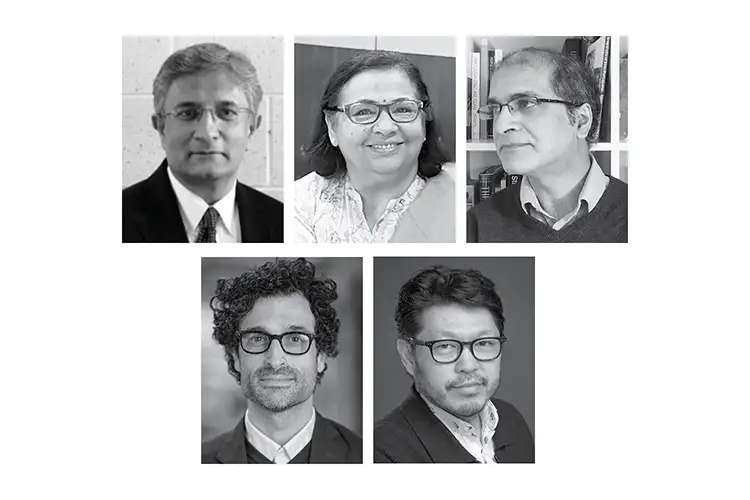
Ameen Farooq, Sangeeta Bagga Mehta, Vinayak Bharne, Antonio Furgiuele, Dongsei Kim | 2015 Urban Edge Award
Co-taught by Associate Professor Manu Sobti
The Urban Edge Studio in 2015 conducted by Associate Professor Manu Sobti built upon earlier studies that examined interventions at Chandigarh’s city center, which combined visions of French architect Le Corbusier’s unbuilt Post and Telegraph Building with relevant scenarios of commercial and institutional expansion in Chandigarh. Two action areas, Badheri and Kansal, were selected and employed to provoke discussions on urban and rural edges. The studio culminated in a symposium and exhibition.
Evolutionary Infrastructure: Practice and Projection
Michael Manfredi and Marion Weiss | 2013 Urban Edge Award
Co-taught by Assistant Professor Karl Wallick
The 2013 Urban Edge Award brought Michael Manfredi and Marion Weiss of WEISS/MANFREDI to curate and lead a symposium titled “Evolutionary Infrastructure / Evolving Practices,” bringing together architects, artists, ecologists, engineers and theorists. Expanding the definition of infrastructure to address an escalating set of design challenges that are at once cultural, architectural and environmental, the symposium included a series of cross-disciplinary talks and discussions.
2009 Urban Edge Studio
Elizabeth Diller, Diller Scofidio + Renfro | 2009 Urban Edge Award
Co-taught by Associate Professor Mo Zell
In 2009, the second Urban Edge Award was presented to Elizabeth Diller, principal of Diller Scofidio + Renfro (DS+R) and Professor of Architecture at Princeton University. Her practice is an interdisciplinary practice at the crossroads of architecture, the visual arts and the performing arts. The 2009 Urban Edge Award supported a studio co-taught by Ms. Diller. In an effort to expand the definition of architecture, the seminar used DS+R’s temporary installations as inspiration for students to research, design and propose a series of installation projects throughout Milwaukee.
2007 Urban Edge Studio
Julie Bargmann, DIRT Studio | 2007 Urban Edge Award
Co-taught by Associate Professor Manu Sobti
The first Urban Edge Award was given in 2007 to Julie Bargmann, founder of DIRT Studio in Charlottesville, Virginia. Her work focuses on transforming polluted, abandoned industrial sites into healthy, usable spaces by combining ecology and design. She partnered with UWM Associate Professor Manu Sobti to lead the first Urban Edge Studio. Together, they encouraged students to explore Milwaukee’s aging cityscape through its layers of history and culture. A week-long “DIRT Charrette” and design competition gave students from multiple studios hands-on experience with new ways to study, map and reimagine urban spaces.