Urban Studies Majors Honors/Senior Thesis
Jack R. Rongstad, A History of Mitchell Park in Three Eras: 1890-2021
Full text: dc.uwm.edu/honorsthesis/1/
Abstract
This thesis examines the history of Mitchell Park—and the various iterations of the conservatory it now hosts—across three distinct periods of urban development. Located in Milwaukee, WI, the County-operated institution consists of three conoidal-domes, measuring 140 feet across by 85 feet high (7 stories), each structure protects an acre of soil within; one dome hosting desert flora, a second filled with tropical vegetation, and a third mixed-use ‘show-dome’ able to host rotating exhibitions. The massive civic structures were constructed over nine years, from 1958-1967, as a testament to the industrial might of the growing harbor city. Through a blend of primary and secondary sources, this thesis seeks to provide a more complex and detailed history of Mitchell Park than currently exists. The few historical writings that do exist, do not focus on Mitchell Park exclusively and tend to condense its long history into a one-to-two-page summary. By excavating the past, this thesis identifies and analyzes the social and cultural forces informing park design and development in Milwaukee. More broadly, a close examination of the history of Mitchell Park shows how place can be used as a lens to understand urban change through three distinct eras: Golden Age Milwaukee (1880-1930), Postwar Milwaukee (1945-1972), and Neoliberal Milwaukee (1972-ongoing), and in turn, how each era influenced park design and development. Acting as a symbolic representation of Milwaukee’s history and a manifestation of its identity, the story of Mitchell Park is also broadly reflective of the wider urbanization process in the United States. In attempting to trace the mechanisms that shape the city, this thesis explores the history of urban development, and the complex nature of power within the city, through the collection, and juxtaposition, of both primary and secondary sources.
Urban Studies 150 Service Learning Projects and Neighborhood Research
Spring, 2025 – Walnut Hill Community Garden.
Urban Studies Capstone Seminar Research Projects
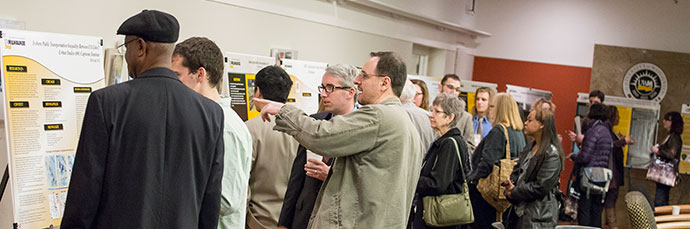
Each spring semester students complete their senior capstone seminar course (Urb Std 600: Capstone Seminar in Urban Studies) as part of the last required course in the Urban Studies major. Capstone students over the course of the semester develop an original research project that demonstrates mastery of several Urban Studies learning goals. Since 2016, student research projects have focused on the Milwaukee area and address topics within the housing and community development subfields (e.g. gentrification, eviction, homelessness, public housing, fair housing, affordable housing, urban redevelopment, neighborhood/community development/change, urban agriculture, economic development/BIDs, transit, etc.). Research projects can have a contemporary or historical focus, and employ a variety of methodologies, from GIS to archival and ethnographic approaches. Capstone students present a poster of their research project at the annual Urban Studies Student Research Forum and produce a high quality, article-length paper.
Past Capstone Research Projects
2026
- Haylan Blanchard, From Private to Public: The Creation of The Milwaukee County Transit System in 1975
- Charlie Engling, Transit Justice and the Politics of Development: The Case of Milwaukee’s Connect 2 BRT
- Henry Hopton, Shared Urban Greenway and Uneven Change: Land Use and Redevelopment Along Milwaukee’s Beerline Trail in Riverwest and Harambee
- Michael Jensen, Raze or Revive?: Analyzing Demolition as Urban Policy after the 2008 Housing Crash in Milwaukee
- Sam Maurer, When AI Becomes Your Neighbor: Support and Contestation in the Development of Hyperscale Data Centers in Southeast Wisconsin
- Anna Perez, Homeownership Disparities in Milwaukee: The Role of Community Organizations and Housing Policy in the Effort to Purchase Homes for Marginalized Residents.
- Alair Posard, Flood Control or Social Control? Governance, Equity, and Community Power along Milwaukee’s Kinnickinnic River
- Nathan Powley, Patterns of Development: A Comparative Study of Milwaukee’s 56, 67, and 71 Tax Incremental Districts (TIDs)
- Alexandria Vborny, Beyond Demolition: Lasting Imprints of the Park West Freeway in Milwaukee
- Amelia Walker, Prevention, Protection, and Intervention: Comparing Youth Programs in Milwaukee
2025
- Rachel Antonson, Placemaking and Community Identity: Revitalization and Transformation in Milwaukee’s Bronzeville Neighborhood
- Tyler Grant, Chronic Nuisance as Social Control: Chronic Nuisance Ordinances in Metropolitan Milwaukee
- Henry Maes, A Place to Both Live and Be: Housing with Community Space
- Caitlin Monahan, The Prevalence of Change: House Flipping as a Gentrification Mechanism in Milwaukee
- Anna Perez, Home Buying Coaches and Housing Policy: How Communities are Working to Rectify Homeownership Disparities in Milwaukee
- Owen Saiia, Placemaking in Milwaukee’s Inner Harbor District
- Miranda Wickre, From Public Park to Silent City: The Rise, Fall, and Rebirth of Recreation in Forest Home Cemetery
- Makiah Zeznanski, Under the Bridge, Out in the Open: Green Infrastructure and Social Cohesion in Milwaukee’s Swing Park
2024
- Avarie Daly, Twenty-First Century Manufacturing and Brownfield Redevelopment: Evidence from Century City in Milwaukee
- Liam Farin, Imagining a New City Partnership: How Modern Milwaukee Navigates Citizen Participation, Planning, and Public Safety
- Georg Frisch III, High Opportunity Housing: Metro Milwaukee’s Newest Voucher Experiment
- AJ Krambeer, Remaking Downtown: An Analysis of the 2040 Downtown Milwaukee Revitalization Plan
- Isabella Lemieux, When the State Won’t Play: Making the Case for the Revitalization of the KRM Commuter Rail Without a Regional Rail Authority
- Susan McClung, Making a Case for Safety: An Analysis of the Brady Street Pedestrian Plan
- Aidan Sodemann, Transit-Oriented Development in 3 Milwaukee Projects: Moving Milwaukee Forward?
- Isabella Wineke, Shades of Green: A Spatial Analysis of Tree Canopy Disparities in Milwaukee’s Urban Landscape
2023
- Rakeem Brown, Exploring the Role of Local Governance: An Analysis of Sherman Park, Bay View, and Murray Hill Neighborhood Associations’ Roles in Facilitating Neighborhood Democracy;
- Nate Hemze, “Freeways Without Futures”: A Comparison of Two Milwaukee Projects to Change the City;
- Natalie Hernandez, Considering an Area’s Cultural History and Identity in Business Improvement Districts: Milwaukee, Wisconsin’s Cesare E. Chavez Drive;
- Ryan Lawrence, Reckless Driving in Milwaukee: The Response from Leaders, Advocates, and Media;
- Neena Lewis, Monopoly Landlordism: The Tenant Experience with Berrada Properties Management Inc;
- Eli Norlander, LLC Takeover: The Financialzation of Milwaukee’s Rental Markets
- Ann Seigfreid, Community Empowerment Theories Applied to Milwaukee Improvement Districts;
- Hunter Turpin, “It Got Off the Track”: Discourses Around Milwaukee’s Chapter 220 Program.”