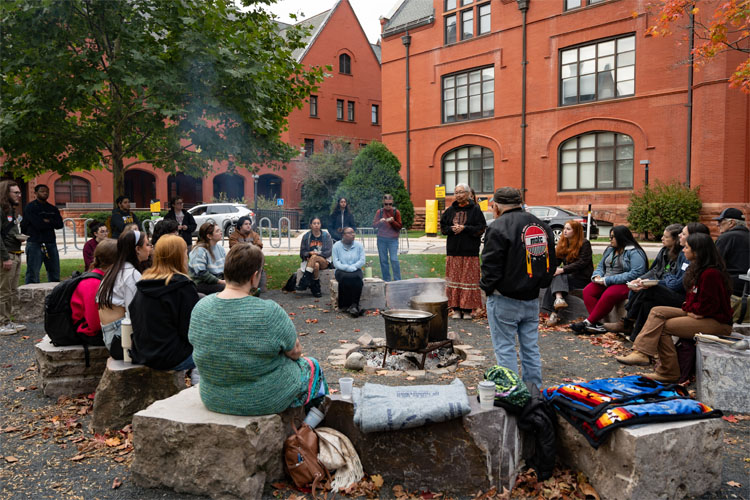
They are Learning from Each Other Symposium

The Development of Indigenous-Centered Land Restoration and Policy

Thursday, October 16 | 10:00 AM – 7:00 PM
UWM’s Union Wisconsin Rooms | Free Admission (RSVP required for lunch)
Sponsored by: EQI, MMSD, Daybreak Fund

Join us for a full-day symposium exploring Indigenous-centered approaches to land restoration and policy development. This gathering brings together scholars, students, and community leaders to share knowledge, stories, and strategies rooted in Indigenous environmental systems and relationships to land.

Through presentations, panels, and shared meals—including soup at the Fire Circle—participants will engage in meaningful dialogue about the intersections of land, language, and policy. The day will culminate in a keynote address by Dr. Dawn Martin-Hill, a leading voice in Indigenous knowledge and environmental advocacy.

Schedule Overview

TimePresenter(s)Presenting
10:00–10:15 AMEQI StaffIntroductions and Opening
10:15–11:00 AMDr. Sharity Bassett, EQI & WGS and Breann Clark, EQI"Shared Knowledge, Shared Responsibility"
11:00–12:00 PM Kristin Schultheis, MMSD TBD
12:00–1:00 PM[Break]Lunch (Registration required)
1:00–2:00 PMMichael Zimmerman, Ojibwe Language Instructor & Potawatomi Language Consultant"Land and Language: A bridge to understanding worldview"
2:00–3:00 PMDr. Mark Freeland, EQI"Starting Places Matter: Building Ecological Resilience Through Engagement with Indigenous Thought"
3:00–4:00 PMStudent Panel "Reflections on Land Stewardship Internship"
4:00–5:30 PM[Break]Soup at the Fire Circle
5:30–7:00 PMKeynote: Dr. Dawn Martin-Hill“Reimagining Environmental Science with the Haudenosaunee of Six Nations”

Keynote Presenter:

Dawn Martin Hill, Emeritus, Indigenous Studies Department, McMaster University 

Dawn Martin-Hill Receives OU International Water Prize — OhneganosDawn is Mohawk and resides at Six Nations of the Grand River with her family. She was the first Indigenous cultural anthropologist in Canada and continues to break barriers in education and research. She founded the Indigenous Studies Program at McMaster University as a Master’s graduate student. Recently her work has had global policy influence,  Ohneganos research report has been officially entered into the Parliament Record for FN Water Bill C-61 and  United Nations Framework Convention on Climate Change  drew from Kayaní:yo (a good path)—Warrior Science Ohneganos—Indigenous ecological knowledge in its 2024 strategy paper Technical guidance and training materials to support the implementation of the UAE Framework for Global Climate Resilience to support its call for more incorporation of Indigenous knowledge and improved environmental health services in Indigenous communities. Her current research is applied in and by community ecological knowledge. Indigenous mapping, climate change modelling, digital learning platforms, film, art to increase capacity in water monitoring and management. She holds numerous research grants, (NSF and SSHRC) Global Climate Change Center, Indigenous lead, Climate Adaptation and Resilience Strategies (CLARS), GWF Co-Creation of Indigenous Water Quality Tools (Canada First Research Excellence Fund) and Traditional Ecological Knowledge, Training & Co-Creation of Mixed Method Tools, (Canada First Research Excellence Fund).  She led numerous community research grants in partnership with Six Nations Polytechnic. She is also a member of, Canada of the UNESCO Hydrology Committee, and a CIHR- IIPH board member. She has numerous peer reviewed publications and informal community publications housed at www.ohneganos.com and the Royal Society Library. Her research has gained international acclaim such as the water science award from the U of Oklahoma, and Ohneganos podcast water is life won the David Suzuki People’s Choice Award. Recently she was honoured by MIRI renaming community scholar award after her. She is currently producing a virtual reality Skyworld to disseminate her teams research findings. She is currently collaborating with SNP to establish a TEK Haudenosaunee Research Institute to sustain training, monitoring and community research. 

Keynote: Reimagining Environmental Science with the Haudenosaunee of Six Nations 

From the perspective of the traditional Haudenosaunee, we speak in terms of responsibilities with respect to water, not in terms of water rights. From time immemorial, we have held the view that the “law of the land” is not man-made law, but a greater natural law, the Great Law of Peace ….the root words for “rain” in Mohawk means expensive, or precious or holy. Culturally, we would not abuse this resource (King, 2007, p. 452). 

Ohneganos Ohnegahdę:gyo (Ohneganos) led by advisors’ community knowledge holders, working with leading experts in IK methodology working alongside western-trained scientists to co-create a holistic model of water research; braiding of Indigenous and western sciences. The overarching aim of our project is to holistically address cross-cutting and interconnected issues to create a ‘double dividend’ that builds capacity and improves resilience of the Six Nations community. Many Indigenous communities in Canada are experiencing severe water and health crises caused by climate change and colonialism but are also uniquely positioned to contribute to the solutions to these problems by accessing Indigenous Knowledge (IK). IK pedagogy acknowledges diverse ways of knowing and respects the pluralism of knowledge. Described by Daes (1994), IK is “…a complete knowledge system with its own concepts of epistemology, philosophy, and scientific and logical validity…[which] can only be fully learned or understood by means of the pedagogy traditionally employed by [the] peoples themselves…” (p. 2-3). Further, Marlene Brant Castellano (2000) adds, “..knowledge derives from multiple sources, including traditional teachings, empirical observation, and revelation (p.23)…and is said to be personal, oral, experiential, holistic, and conveyed in narrative or metaphorical language (p. 25)”. The philosophical foundation of IK prioritizes local geographies and relationships with the ecosystem over thousands of years. Ohneganos has co-created science, technology and tools by braiding two ways of knowing to co-create and enhance innovative, sustainable, smart environmental management and training within communities that draws upon both IK and WS. IK is increasingly recognized as a valuable source for adaptation and resilience-building in the face of impending environmental change and water insecurity – locally, regionally in Canada, as well as globally (UNFCCC, 2016; Nakashima et al., 2018; IPBES, 2019). The Government of Canada’s Federal Budget for 2017 underscored the priority of integrating IK in the country’s pathway for sustainable growth to “…build a better understanding of climate change and to guide adaptation measures; enhance Indigenous community resilience through infrastructure planning…” (Government of Canada, 2017, p. 129). 

Guest Speakers:

Kristin Schultheis, MMSD

Presentation: Letting Go and Challenging the Paradigm

Kristin Schultheis’ life work is dedicated to building community wide expertise and partnerships for the care of our natural lands. With her background in soil science and hydrogeology, Kristin advances innovative practices to support urban and rural communities’ land management efforts by bringing together diverse teams of people and stakeholders. She works for the Milwaukee Metropolitan Sewerage District as a Senior Project Planner, manages the Working Soils® and Greenseams® floodwater management programs, facilitates the Milwaukee River Watershed Conservation Partnership, and serves on the board of River Alliance of Wisconsin. Beyond work, Kristin finds ways to immerse herself in Wisconsin’s expansive ecology while trying not to turn every outdoor excursion into a science lesson for her two kids.

Dr. Mark Freeland, EQI

Presentation: Starting Places Matter: Building Ecological Resilience Through Engagement with Indigenous Thought

profile photo

Mark Freeland Director of the Electa Quinney Institute and Associate Professor of Anthropology

Boozhoo! Makwa indoodem. Bahweting nindonjibaa.Mark Freeland is Bear Clan and a member of the Bahweting community in Northern Michigan (Sault Ste. Marie Tribe Chippewa). He received a Master of Divinity from the Iliff School of Theology and a PhD in Religious and Theological Studies from the Iliff School of Theology and the University of Denver joint doctoral program. His research critically identifies the role of Indigenous worldview as an integral component of cultural and linguistic translations. His book, Aazheyaadizi: Worldview, Language and the Logics of Decolonization, provides a theoretical grounding for understanding the problematic role that religion continues to play within Indigenous communities and calls for a deeper involvement of the logics of worldview in the regeneration of Indigenous lifeways and protection of our relationships to our environment.While receiving his Master and Doctoral degrees in Denver, he worked as a council member of the Four Winds American Indian Council, an urban community center in downtown Denver. There he participated in a range of civic, educational and ceremonial duties.He is coming most recently from South Dakota State University where he was the Co-coordinator of the American Indian and Indigenous Studies Program, which provided the academic component for the Wokini Initiative, a program to redistribute land grant funding to support Indigenous students.

Aside from EQI, Dr. Freeland has authored Aazheyaadizi: Worldview, Language, and the Logics of DecolonizationAazheyaadizi rethinks decolonization by developing a theory of worldview to shed light on the issues around translating Indigenous languages in and out of colonial languages.

Dr. Sharity Bassett, EQI & WGS and Breann Clark, EQI

Presentation: Shared Knowledge, Shared Responsibility

Image previewSharity L. Bassett is Assistant Professor of Women’s and Gender Studies and Executive Manager of the Electa Quinney Institute for American Indian Education (EQI) at the University of Wisconsin–Milwaukee. She earned her PhD in Global Gender Studies from the State University of New York at Buffalo and has collaborated with Haudenosaunee communities since 2011.
Her book, Haudenosaunee Women Lacrosse Players: Making Meaning through Rematriation (Michigan State University Press, 2024), examines Indigenous women’s lacrosse and the theory of rematriation. At EQI, she created and directs the Indigenous Kinship & Responsibility Scholarship—which supports undergraduate research across disciplines—as well as the Indigenous Felt Knowledge Festival and Artist in Residency program.
She is currently a Fellow for the Center for 21st Century Studies, where she is developing a multivocal and collaborative autofiction project that began in summer 2025 with EQI/MMSD interns and a workshop series at Ring Lake Ranch in Wyoming. Her research explores a methodological innovation that integrates Indigenous worldviews with three key components: (1) co-laboring across difference through intergenerational stories, (2) fiction as a means of building empathy, and (3) autofiction as a way to articulate why and how we work across difference. This approach revises concepts of the self to recognize other-than-human relatives as active participants in the process of working across difference, with the goal of creating connected futures through engagement with difficult stories, empathy, and transformative dialogue.

Michael Zimmerman, Ojibwe Language Instructor & Potawatomi Language Consultant

Presentation: Land and Language: A bridge to understanding worldview

Michael Zimmerman Jr. is a citizen of the Pokagon Band of Potawatomi Indians of Michigan and Indiana and has been teacher of Ojibwe, Potawatomi, and Odawa languages for the better part of the past 15 years. He currently teaches for the Grand Portage Band of Lake Superior Chippewa in Minnesota. He specializes in cross-language comparison, historical text interpretation, as well as etymology within Algonquian languages.