About the Fire Circle
The Electa Quinney Institute Fire Circle is a gathering space located outside Merrill Hall at UWM. The space supports learning, reflection, ceremony, cultural programming, and community engagement.
In October 2021, the Fire Circle was enhanced with the installation of the Grandfather Stones, designed by Oneida architect Chris Cornelius of Studio:Indigenous. The stones honor Indigenous ancestors who centered their cultures on the sustainable stewardship of land, water, and all living things.
Dedicated on October 26, 2021, the installation provided a space for connection and gathering during the COVID-19 pandemic. Community members welcomed the Grandfather Stones through song and drumming. Today, the Fire Circle continues to host classes, cultural events, and educational programs throughout the year.

The Meaning of the Grandfather Stones
The inscription at the site reminds visitors of Indigenous relationships to place and stewardship:
These stones who stand here remind us of Indigenous ancestors who centered their cultures on the sustainable stewardship of land, water and all life. The circle continues from the first sunrise on earth to the next moonrise. The map on the firestone marks a moment in time when Menominee, Ho-Chunk and Potawatomi villages guarded the confluence of the Menomonee, Kinnickinnic and Milwaukee rivers along the shoreline of Michigaming, the Great Freshwater Sea.
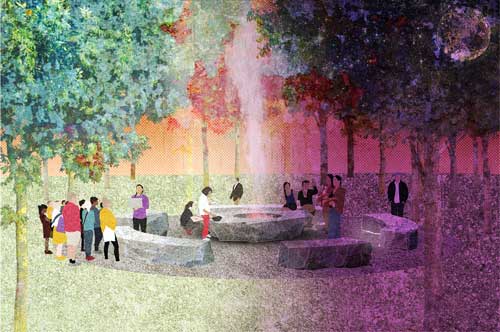
Here is an early illustration of the design created by Chris Cornelius.
Reserving the Fire Circle
Faculty and staff can reserve the Fire Circle through the ROAR reservation system. Students and community members and organizations interested in using the Fire Circle should contact Dr. Mark Freeland to discuss availability, appropriate use of the space, and event planning considerations.
A Place for Community
The Fire Circle reflects UWM’s commitment to Indigenous visibility, belonging, and education. It serves as a welcoming space where Native and non-Native community members can gather, learn, and engage with the histories, cultures, and contemporary experiences of Tribal Nations.
Acknowledgments
The Electa Quinney Institute gratefully acknowledges the generosity of Bader Philanthropies, whose support made the Grandfather Stones installation possible.