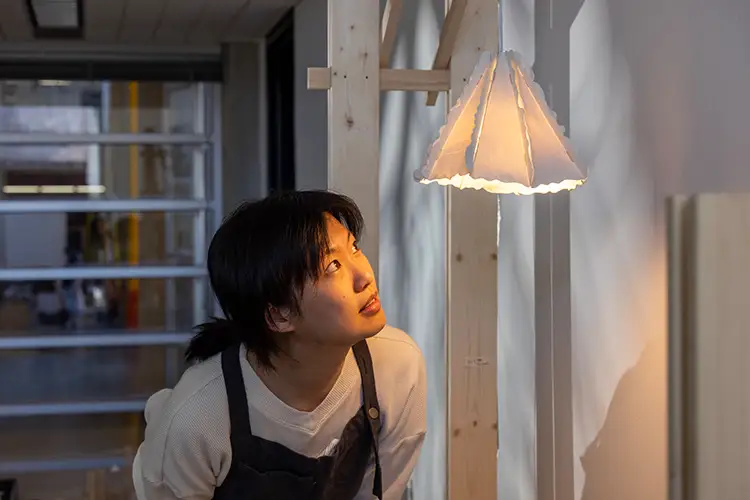
During her final semester as a Fitzhugh Scott Faculty Fellow at the UWM School of Architecture & Urban Planning, Iris Xiaoxue Ma is transforming the Jim Shields Gallery into an active site of material research.
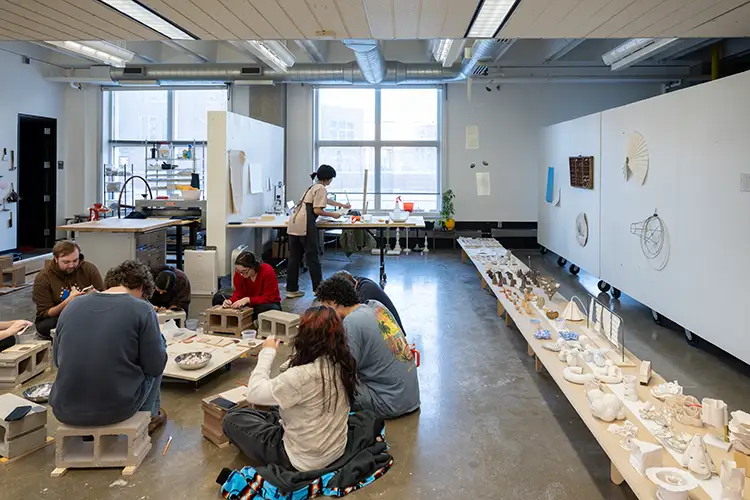
Rather than presenting a static exhibition, Ma has reconfigured the gallery as a working ceramic studio and Earth Material Resource Center, where she foregrounds material testing, spatial limits, and slow decision-making.
“Craft is an inherently slow process,” Ma said. “My way of working involves extended periods of hesitation, testing, and reconsideration.”
Process as a shared resource
Instead of treating that indecision as something to resolve privately, she makes it visible, allowing the process to unfold within the gallery itself.
“By opening up the process and allowing it to be interrupted or disturbed,” she explained, “I make visible how decisions accumulate, shift, or fail under constraint and pressure.”
For Ma, the physical boundaries of the gallery are not incidental. “Limits of space shape how choices are made and revised over time,” she said. This semester, she thinks of her work “primarily as curating a set of conditions, tools, and materials, rather than producing discrete artifacts.”
The result is a space that operates less as a finished display and more as a laboratory for architectural thinking.
What excites Ma most about this approach is the possibility of turning process into a shared resource.
“By making my methods, tests, and material experiments visible, the work becomes something others can learn from, adapt, or question, rather than something sealed off as a finished result,” she said. “Accessibility, for me, means allowing people to see uncertainty as part of making.”
Working with untamed materials
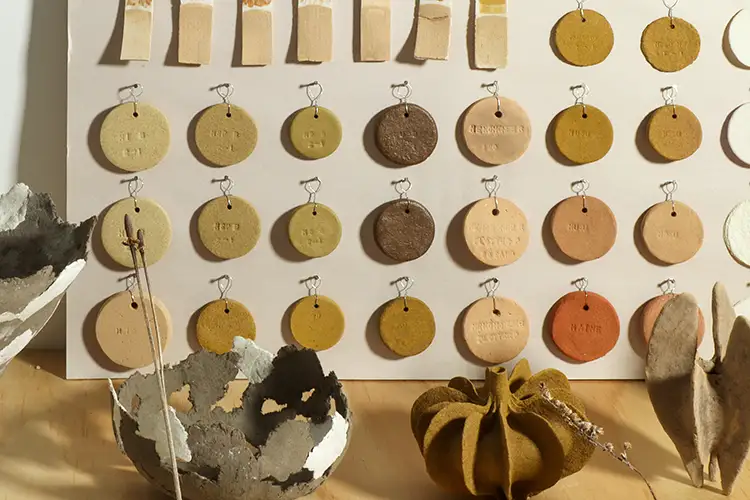
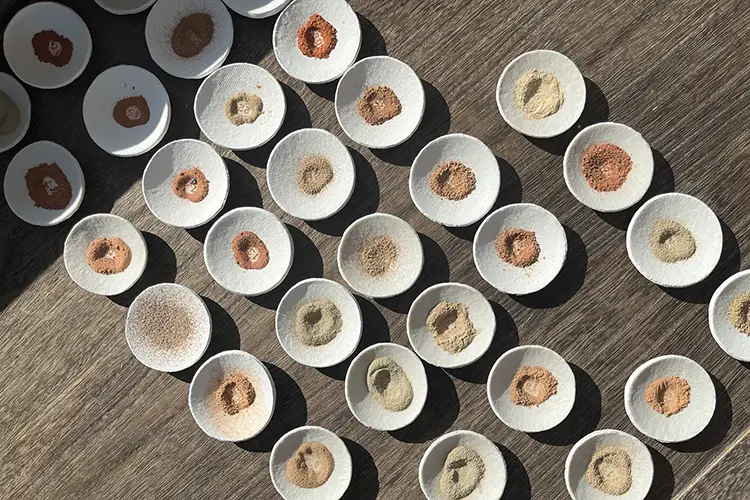
That uncertainty is embedded in Ma’s material practice. She works with foraged local clay, paper porcelain, and recycled organic aggregates, materials that are deliberately fragile and responsive.
“I often say I choose these materials because they are free,” she said, “not in the sense of costing nothing, but in the sense of being untamed.” She describes them as “feral materials that misbehave, vary from batch to batch, and offer no guaranteed results.”
Rather than attempting to impose control, Ma frames her work as a negotiation. “Instead of asking, ‘How can I control this material?’” she said, “I ask, ‘What kind of relationship can I build with it?’”
Because these materials are locally sourced and variable, they “carry local and temporal specificity” and “resist the idea of universal, standardized solutions.” That resistance, she added, “offers an element of surprise, which is important to me.”
Material practice and architectural thinking
Ma sees clear parallels between this material practice and architectural thinking.
“Architecture often privileges control, efficiency, measurement, and repeatability,” she said. Her interests, by contrast, “lean toward fragility, uncertainty, and instability—qualities architecture typically seeks to constrain or minimize.” The intersection, she noted, “is less about utility and more about perspective.”
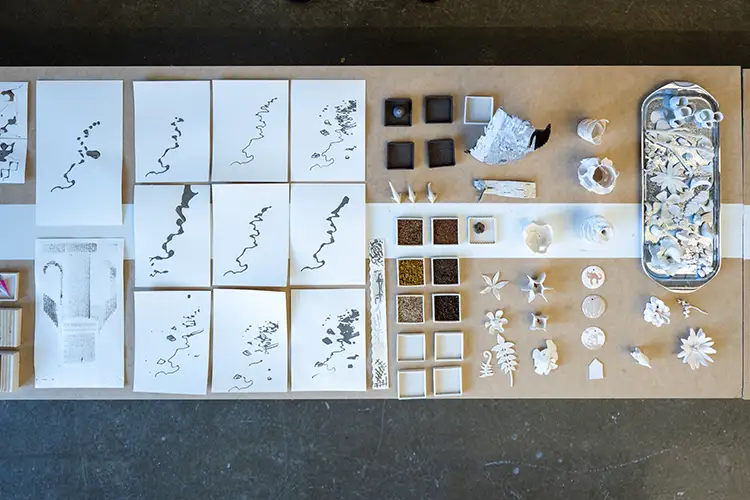
Within the gallery, that perspective is evident in how materials, tests, and structures are displayed. Research artifacts are carefully arranged, emphasizing care and intentionality rather than spectacle.
A culmination but not the end
As Ma nears the end of her two-year fellowship, the exhibition serves as a culmination without closure.
“My thinking has shifted from seeking resolution to sustaining inquiry,” she said. Earlier in the fellowship, she was “preoccupied with making a coherent ‘thing,’” but over time learned “to value open-ended investigation and to resist the pressure to arrive at fixed outcomes.”
The decision to transform the gallery into an Earth Material Resource Center reflects that shift. It is, Ma said, “not as a final display of knowledge, but as a platform for shared exploration and ongoing inquiry.”
An evolving space for engagement
Over the spring semester, the space will continue to change as she works in it, offering workshops and walk-in hours for students interested in hands-on material experiments.
“If the space does anything,” Ma said, “I hope it recalibrates attention toward slowness, material origins, and the care embedded in objects and spaces.”
Visitors are invited to return, observe changes, and witness making as it happens.
“We rarely witness how things come into being,” she added. “I hope visitors sense that making is not only about outcomes, but about relationships between time, matter, and care.”
Story by Oliver J. Johnson