- bil@uwm.edu
- 414-977-7774
- Architecture & Urban Planning 497
- He / Him
Directory Categories
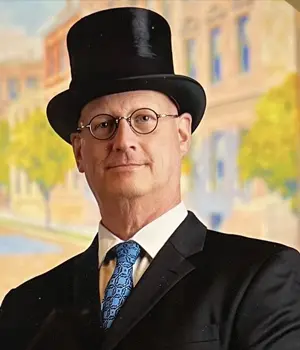
William Kenneth Krueger
- Instrument Shop Manager, Architecture
- Building Chair, School of Architecture & Urban Planning
- Academic Fabrication Technology Coordinator, School of Architecture & Urban Planning
Education
- Master of Architecture, Historic Preservation, UW-Milwaukee
- BS, Architecture, UW-Milwaukee
Biography
Documentation has been central to my life’s work. I began with traditional methods—sketches, tape measures, pencil, and paper—and progressed into advanced digital technologies such as Light Detection and Ranging (LiDAR), photogrammetry, and high-resolution spatial data capture. My pursuit of knowledge is a daily practice. Rapid advancements in laser scanning hardware and software require continual education, adaptation, and refinement of both technical and pedagogical approaches.
LiDAR scanning represents a zero-contact, non-invasive method of capturing the visible environment at a specific moment in time. The resulting datasets enable the production of precise 2D and 3D interpretive drawings and digital models suitable for archival, analytical, and design purposes. These files serve not only as documentation, but as tools for conservation, research, and replication. Through 3D printing and digital fabrication technologies, scanned environments, buildings, landscapes, and cultural artifacts—can be recreated virtually or physically at any scale. This capacity to preserve and reinterpret architectural heritage motivates my desire to pursue advanced research and contribute meaningfully to the field.
My professional career at the University of Wisconsin–Milwaukee (UWM), within the School of Architecture & Urban Planning (SARUP), has been devoted to architectural heritage and its preservation through documentation and analysis.
My work encompasses:
- Building documentation and measured drawing
- Perpetuation and stewardship of archived data
- Advanced laser scanning and LiDAR capture
- Drone-based spatial recording
- Building history research
- Building envelope assessment
- Advocacy for endangered structures
- Historic material restoration
- Adaptive reuse design proposals
- National and international academic study programs
These experiences reflect both the breadth and depth of my engagement with architectural heritage. My interests lie at the intersection of technology, preservation, and pedagogy—specifically how emerging documentation technologies can transform the way we record, interpret, teach, and protect the built-environment.
While my expertise in architectural heritage is broad, my most distinctive specialization is laser scanning. With over 20 years of hands-on experience, my knowledge in this area is uncommon within SARUP and has positioned me as a resource beyond my home institution.
Universities and institutions that have collaborated with or consulted me include:
- University of Maryland
- Cornell University
- University of Reading
- Southwestern University
- Ludwig Maximilian University of Munich
- Hermitage Museum
- University of Ballarat Australia
In addition to these collaborations, I have directed and participated in international academic studies in Australia, Japan, Germany, England, and Italy, working with students, professors, and professionals in heritage documentation and digital capture methodologies.
My career reflects sustained dedication to architectural heritage documentation, technological innovation, and collaborative scholarship to synthesize decades of professional experience into rigorous academic research, contribute new knowledge to the field of digital heritage preservation, and mentor future architects and preservationists in the responsible use of emerging technologies.
Links