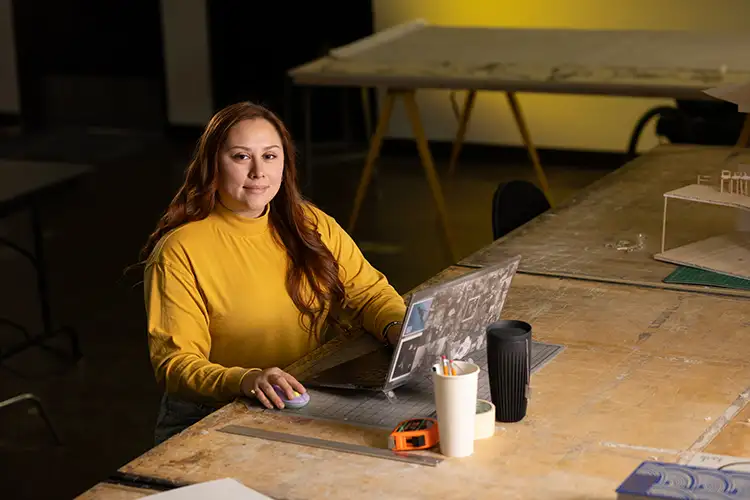
Architecture has always been an area of interest for UWM master’s student Dulce Carreno, but in high school, she didn’t consider it a viable option. Instead, after graduating from her Las Vegas high school, Carreno served in the U.S. Air Force for six years, preparing and maintaining aircraft for military use.
Her military journey was borne out of necessity — to help her pay for a college degree — but in hindsight, Carreno says her military service ultimately charted her course to architecture and urban planning.
“In the military, I saw the real-world difference I was making through my job,” she said. “I knew I wanted to pursue a career that allowed me to impact people’s lives.”
Today, Carreno is enrolled in UWM’s joint Master of Architecture and Urban Planning degree program, where she is learning how to build strong communities. The dual degree allows students to pursue two related professional degrees at once and complete them both in less time than it would take to earn them separately.
A surprising foundation
During her military service, Carreno worked full-time and earned a bachelor’s degree in marketing from Southern New Hampshire University. After graduating in 2022, she briefly worked in the digital marketing field before realizing it wasn’t the right fit for her.
“Even though marketing can be fulfilling, I didn’t feel the same level of impact as I did in the military,” she said.
As Carreno was considering what she might explore next, she learned about UW-Milwaukee from her boyfriend, who grew up in the Milwaukee area. The coordinated MArch and MUP degree program was uniquely appealing, because it offered courses that would prepare her to design buildings and create communities that support people’s well-being and health.
Committed to community
Carreno, who is Mexican-American, understands firsthand the systemic issues affecting people of color and other marginalized groups. The first in her family to pursue a master’s degree, Carreno sees her background as an asset.
“With a more diverse workforce, we can better meet the needs of different communities,” she said. For example, architects of color may have specific ideas about what resources and spaces communities of color need to thrive.
After graduation, Carreno hopes to work as an architect designing community-focused buildings such as libraries and K-12 schools. Her long-term dream is to use her skills to work in disaster zones and help communities as they rebuild.
For now, Carreno’s commitment to community shines through in her role as co-president of the student chapter of the National Organization of Minority Architects. The chapter leads architecture firm tours and helps students establish direct connections in the field before they graduate.
“Even one professional connection can help someone get an internship or even a job,” Carreno said.
More architects and urban planners from diverse backgrounds means urban spaces and communities that serve and address the needs of everyone — not just a few. Carreno is glad to be a part of the effort, saying, “I truly feel most fulfilled when I’m helping people and communities thrive.”
Story by Ashley Abramson | Explore more in Make New Waves