For architecture professor Adam Thibodeaux, buildings are never just physical structures. They are records of human behavior shaped not only by original design intent, but by the improvised, often invisible adaptations made by people who relied on them most.
Through an ongoing research initiative known as Ghost Lab, Thibodeaux and his students engage buildings with forgotten histories of use by marginalized communities. The work asks a fundamental question that sits uneasily within conventional preservation practice: how do we assign value to architecture when significant traces within were never meant to be permanent, visible, or celebrated?
“At its core, it’s a bit of an activist project,” Thibodeaux said. “But less focused on advocating for preserving specific buildings than for alternative ways of assigning value that fall outside institutionalized preservation practice.”
Challenging preservation’s blind spots
Ghost Lab grew out of a disconnect Thibodeaux observed between ongoing conversations around heritage value and the regulatory frameworks that govern preservation in the United States.
While there is increasing recognition that buildings used by marginalized groups carry historical significance, preservation standards, he says, continue to privilege material authenticity tied to an architect’s original intent or a narrowly defined “period of historical significance.”
That framework often conflicts with how marginalized communities historically engage architecture.
“Without the material, financial, or sociopolitical resources to build from scratch, marginalized groups frequently occupy and appropriate spaces not built for them,” Thibodeaux said. “Changing use, alongside a frequent need for discretion, typically results in ad-hoc manipulations of a building that—when read through existing regulating documents—are cited as offenses to a building’s material and historical value.”
The paradox, he explained, is that efforts meant to preserve buildings with heritage value for marginalized communities often require stripping away the very adaptations that made those spaces usable and safe.
Ghost Lab operates within that tension.
Reading the “ghosts” in architecture
Rather than advocating for the literal preservation of every physical trace, Thibodeaux focuses on making the human narratives behind those traces legible to the public before they are inevitably erased.
Within the Ghost Lab framework, Thibodeaux refers to these ephemeral traces as “ghosts.”
“We recognize that most of the elements we highlight are going to be stripped away,” he said. “Their legacy is charged by their eventual negation.”
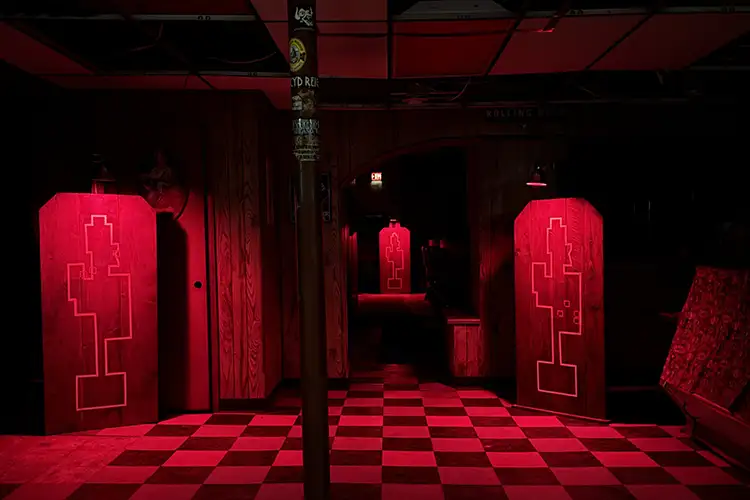
Ghost Lab treats that inevitability as an opportunity. Through on-site installations and exhibitions, students connect physical remnants to the human needs that produced them. A boarded window, for example, becomes a way to understand privacy and discretion within a specific historical context.
“Our interventions allow people to consider why an original window was boarded up for part of its life,” Thibodeaux said. “We celebrate a future where the window can be restored to reconnect the building’s interior to the outside world but want the public to understand why that wasn’t always desirable.”
From archives to on-site research
Most Ghost Lab sites were identified through the Wisconsin LGBTQ History Project, where Thibodeaux serves as a Community Advisor. While archival records provide essential context, Ghost Lab moves beyond documentation by embedding human narratives directly into architectural space.
“It’s easiest to communicate human value through human stories,” Thibodeaux said. “And most of architectural practice is about representing space to the public.”
That approach is carried forward through student-led, on-site research supported by the UWM Office of Research, including Support for Undergraduate Research Fellow (SURF) grants and an Advancing Research and Creativity (ARC) Grant.
Students are involved at every stage of a project, from early research to installation and public engagement.
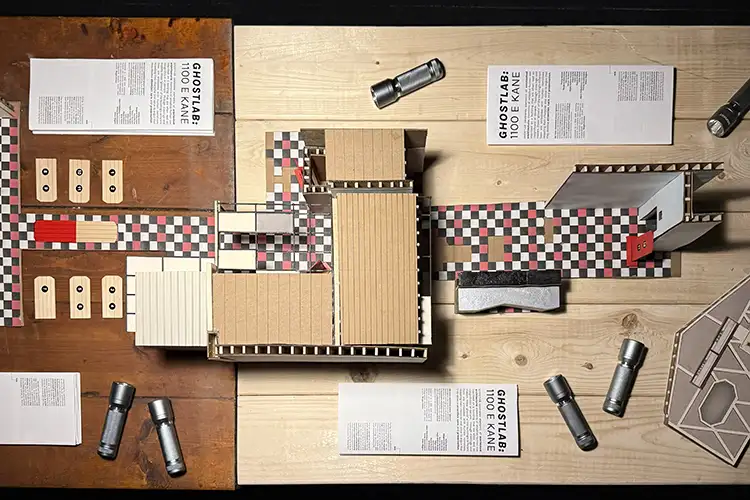
One recent Ghost Lab project focused on a building at 1100 E. Kane Place. Initial SURF-supported research by Morgan Greene (BArch 2026) unfolded over multiple semesters and led to a larger ARC-funded installation developed and installed by eleven additional students in an elective studio course taught by Thibodeaux.
“The ARC Grant allowed us to lease the building for the semester and engage it in a way that wouldn’t have been possible otherwise,” he said.
Public memory activated
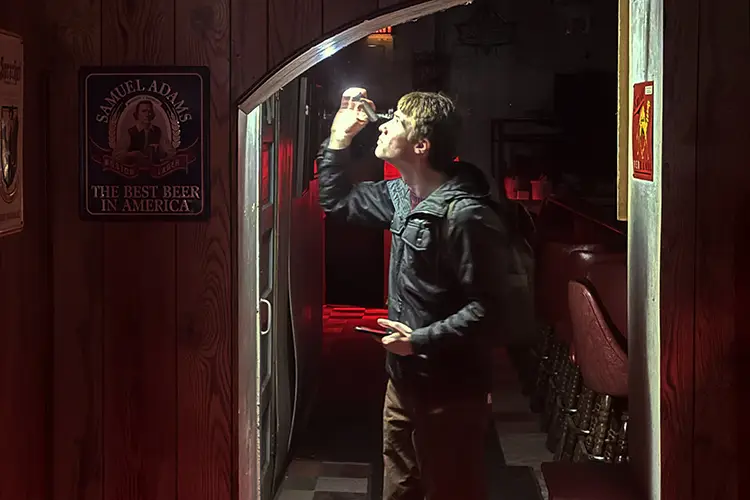
Community response has reinforced the project’s core premise. Visitors encountering the Kane Place exhibition often arrived with their own memories and stories prompted not by what remained, but by what was gone.
“When people re-enter these buildings, they often have more stories about what is no longer physically present than what currently is,” Thibodeaux said. “It supports the idea that negation inevitably enhances memory.”
For Thibodeaux, those moments affirm the value of slowing the erasure process long enough to acknowledge what came before.
“It feels special to allow the public to celebrate these ghosts before they are laid to rest.”
Looking ahead
A second ARC-supported Ghost Lab exhibition is planned for June, engaging another building with a forgotten history of marginalized use. As with previous projects, the site and form will be shaped by access, student research, and community collaboration.
In the short term, Thibodeaux hopes the work encourages people to pause before dismissing buildings that appear too altered—or too “deviant”—to save. In the long term, the ambition is broader.
“We can only hope that once enough folks on the ground start to look at buildings differently, shifts in value judgment might make their way up the chain,” he said.
That could inform new standards of regulation in preservation practice.
“It’s a lofty goal,” he added. “But the first step is getting in the door before the wrecking ball does.”
Story by Oliver J. Johnson