General Lab Equipment Set up
When Setting up your laboratory equipment remember to follow a few safety guidelines:
- Read and follow the expected Manufacturer guidelines for installation, safety, equipment guarding and use.
- Read the Manufacturer information (books /guides) prior to purchase, set up and use.
- Use the equipment as designed (guarding, locking devices). Otherwise it is not the equipment appropriate for your task.
Before you purchase and install the equipment, know the equipment needs.
- Electrical
- Does the lab have the right electrical outlets for the equipment needs (i.e.: 240V vs 120V)?
- Do you have enough electrical outlets to satisfy the equipment plug ins?
- Do you have enough electrical available in your current lab or do you need to have facilities install more electrical sockets?
- Space
- is there enough room around the equipment in order to use it properly
- Will the equipment inhibit workflow or activity pathways?
- Ventilation
- Does the laboratory have the equipment ventilation needs available and in place before installation.
- Learn about the safety needs when using the equipment. (guarding, ventilation, PPE)
- Understand how to apply safety practices to your process.
Make sure your more hazardous pieces of equipment have a Standard Operating Procedure (SOP) written for its use and training your lab staff. Everyone who uses the equipment must be trained on the equipment and that training must be documented. Store the SOP with your laboratory safety documents in a easy to locate place and it is available at all times for all laboratory personnel to easily access.
- Exclude unnecessary personnel from the laser area during alignment.
- Whenever possible, use low-power visible lasers for path simulation of higher-power visible or invisible laser.
- Wear laser protective eyewear during alignment. Use special alignment eyewear when circumstances (e.g. wavelength, power, etc.) permit their use.
- When aligning invisible (e.g. UV, IR) beams, use beam display devices such as image converter viewers or phospor cards to locate beams.
- Perform alignment tasks using high-power lasers at the lowest power level.
- Use a shutter or beam block to block high-power beams at their source except when actually needed during the alignment process.
- Use a laser-rated beam block to terminate high-power beams downstream of the optics being aligned.
- Use beam blocks or laser protective barriers in conditions where alignment beams could stray into areas with uninvolved personnel.
- Place beam blocks behind optics (e.g.: turning mirrors) to terminate beams that might miss mirrors during alignment.
- Locate and block all stray reflections before proceeding to the next optical component or section.
- Be sure all beams and reflections are properly terminated before high-power operation.
- Post appropriate area warning signs during alignment procedures where laser are normally Class 1 (enclosed).
- Alignments should be done only by those individuals who have received laser safety training.
No one should use an autoclave unless they have received recent instruction in autoclave procedure or are working under the direct supervision of an experienced autoclave worker.
Accidents are most likely to occur during the final operations of opening and unloading the autoclave, if they are to happen. When the pressure gauge reaches zero, wait one or two minutes before opening the autoclave. It is dangerous to begin opening the autoclave before the pressure gauge reaches zero. Long-sleeved, heat-resistant gloves should be worn- do not use if wet or have holes in them. Other protective equipment that should be worn to prevent being splashed by hot liquids are rubber apron and safety goggles, glasses, or faceshield.
Steam (Sterilizing) Autoclaves
The major hazards are:
- Burns resulting from physical contact with the structure of the autoclave.
- Steam burns arising from contact with steam issuing from the apparatus.
- Explosive breakage of glass vessels during opening and unloading.
- Burns arising from careless handling of vessels containing boiling liquids.
Top-Loading Autoclaves
Beware of residual steam in the apparatus. Remove the lid cautiously keeping the body as far away from the apparatus as possible. Do not lean over the autoclave to examine the contents.
Front-Loading Autoclaves
- It is wise to stand so that as the door is opened it shields your body from the contents of the autoclave.
- Open the door slowly to allow steam to escape.
- Watch your feet! Sometimes boiling liquid accumulates in the autoclave and runs out as the door opens. Wear rubber boots.
- Remember glassware may have cracked during autoclaving.
Occasionally, the Department of University Safety & Assurances is asked to approve the purchase of ductless fume hoods for use in labs. The hoods are designed to remove hazardous fumes and vapors from the work area as the exhausted air passes through an absorbent, such as activated charcoal.
The system’s appeal is largely economic because it does not require the expensive ductwork that traditional hoods need to exhaust fumes to the outside. However, in practice these hoods require constant attention and often do not provide adequate face velocity. In many cases, the filter is designed for specific chemicals and will not protect against the variety of chemicals used in a typical university laboratory.
Ductless fume hoods are plagued with the problems associated with “breakthrough” and with desorption of vapors from the absorbent. The user will also face expenses to replace charcoal filters and to dispose of the expended filters, which may be classified as hazardous waste. Estimated cost of filter disposal will be about $100 each. Therefore, depending upon the amount of use, annual maintenance costs to the owner could exceed several hundred dollars.
We do not believe that the hoods provide reliable protection against chemical exposure, and we think they may, in fact, give workers a false sense of security. Therefore, we strongly recommend against and, except in extremely rare circumstances, will not approve the use of ductless fume hoods. Moreover, we do not provide inspection or certification for ductless fume hoods.
If a department insists on purchasing a ductless fume hood, it should only be used with small amounts of low-toxicity chemicals, and the hood should be clearly labeled to indicate that it may not provide suitable protection from hazardous chemicals.
The American National Standards Institute (ANSI) has established a voluntary standard covering emergency eye wash and shower equipment. This standard ANSI Z358.1 “Emergency Eye Wash and Shower Equipment” is intended to serve as a guideline for the proper design, performance, installation, use and maintenance of emergency equipment. ANSI Z358.1 was originally adopted in 1981 and been periodically revised. Some of the provision of the ANSI Z358.1-1998 standard regarding laboratory eye-washes include:
- The area surrounding the eyewash (3 ft) must be kept clear for easy access during an emergency.
- The valve actuator must be large enough to be easily located and operated by the user.
- The “hands-free” stay-open valve must activate in one second or less.
- The eyewash should be located within 10 seconds of the hazard and the path of the eyewash must be unobstructed.
- The eyewash should be identified with a highly visible sign and the area around the eyewash should be well-lighted.
- The eyewash unit must be capable of delivering 0.4 gallons (1.5 liters) of water per minute for 15 minutes.
- All employees who might be exposed to a chemical splash need to be trained in the use of the equipment.
- The water delivered by the eyewash should be tepid.
- The eyewash should be connected to an uninterruptible water supply with at least 30 PSI flow pressure.
- Plumbed emergency equipment shall be activated weekly to verify proper operation and should be inspected annually.
It is recommended that records be kept of all inspections and maintenance and that the equipment be inspected and maintained in accordance with ANSI Z358.1-1998 and the manufacturer’s recommendations.
Faucet-mounted Emergency Eyewash Units
Many laboratories can use additional eyewash facilities. Eyewash provisions are required wherever corrosive materials or other chemicals “injurious to the eyes” are used (Source: ILHR 32).
If you are considering the installation of an eyewash unit consider the following advantages and disadvantages of the faucet-mounted models (available through most scientific supply and safety supply catalogs). These models are recommended in areas already served by a conventional eyewash installation, but where additional eyewash capabilities are desired.
Advantages
- They are relatively inexpensive ($50-$70 to buy, $0-100 to install, depending on whether you need installation help) versus traditional plumbed-in eyewash installations.
- They are simple to use.
- They are easy to find (we are often surprised that people don’t know where the nearest eyewash is located. However, most lab personnel have no trouble identifying the nearest faucet).
- You have the ability to temper the water (we have tried to “practice” washing our eyes out as recommended for 15 minutes in cold water. Our most machismo soldier-of-fortune type lasted the longest, 60 seconds.) When someone actually has something in their eye, they are probably more motivated to wash their eyes out longer, or they may be more sensitive to the extreme temperature. A training film available from our department (provided by the U.S. Geological Survey) shows how to assist someone washing their eyes out by helping them hold their head in the water flow to overcome the natural tendency to pull away from the cold water.
- You have the ability to flush the system. We recommend that all eyewash systems (fixed and portable) be flushed for three minutes each week to eliminate dangerous bacterial and amoebic growth. We have noted that many eyewashes do not get flushed routinely (NOTE: This is a LAB responsibility! While Facility Services provides routine quarterly to semi-annual testing of emergency showers and eyewashes it is up to each lab to flush their eyewashes for hygiene purposes.) Faucet-mounted eyewashes get flushed out every time someone uses the faucet. Also, they are easier to flush out, because a drain is usually present.
Disadvantages
- Some faucets do not have enough water pressure to provide an adequate stream height out of a faucet mounted eyewash.
- Training of all faucet users is necessary. You don’t want someone to frantically turn on the eyewash and start flushing their eyes after someone else has just used the faucet for hot water. We advise those with faucet eyewashes to flush hot water out with a little cold water after each use.
- Compatibility. Only a few faucet-mount eyewashes are available. Not all faucets will accept these mounts.
- Distance between eyewash spouts. For the least expensive faucet-mount models available, the two water spouts are too close together. Washing both eyes at the same time with these models is difficult, if not impossible.
Summary
Consider the above advantages and disadvantages in installing a faucet eyewash. Overall, review your laboratory operations and determine if additional eyewash protection is warranted. The faucet mounted eyewash will serve well, especially if there is a permanent, plumbed-in unit in the corridor that you can move to once the immediate need for washing a chemical out of your eye is satisfied.
If you would like further information or would care to discuss the use of faucet-mounted eyewashes, e-mail questions to Zack Steuerwald, Lab Safety Program Manager, at x5808.
General
Laboratory fume hoods serve to control exposure to toxic, offensive or flammable vapors, gases and aerosols. Fume hoods are the primary method of exposure control in the laboratory.
Use the right hood for the job:
- General Purpose Hoods:
- Standard Fume Hood
- Bypass Hood, or Constant Volume Hood
- Variable Air Volume (VAV) Hood
- Auxiliary Air Supplied Hood (Note: At UWM, found only in the Chemistry Building)
- Radioisotope Hood–These hoods have been authorized by Radiation Safety for use with volatile radioactive materials.
- Biosafety Cabinet–Specialized hoods to prevent or minimize the exposure of humans or the environment to biohazardous agents or materials.
- Perchloric Acid Hoods must be used when working with PCA (e.g., acid digestion procedures). These hoods prevent the formation of perchlorates which could lead to explosions. They are constructed with special materials and have water-wash capability.
- Hoods are labeled for special use when practical.
Equipment Use
- Place apparatus and equipment as far back as possible in hood for safety and optimal performance. Equipment should be placed a minimum of 8 inches inside the hood. Keep electrical connections outside of hood.
- Ensure that equipment or materials do not block the baffle vents in the back of the hood.
- When using a large apparatus inside the hood, place the equipment on blocks, when safe and practical, to allow air flow beneath it.
- Do not place electrical apparatus or other ignition sources inside the hood when flammable liquids or gases are present. Keep in mind that liquids with low flash points may ignite if they are near heat sources such as hot plates or steam lines.
Good Work Practices
- When using the fume hood, keep your face outside the plane of the hood sash and remain alert to changes in air flow.
- Work at least 6 inches back from the face of the hood. A stripe on the bench surface is a good reminder.
- Always use splash goggles, and wear a full faceshield if there is possibility of an explosion or eruption.
- Do not make quick motions into or out of the hood, use fans, or walk quickly by the hood opening. All will cause airflow disturbances which reduce the effectiveness of the hood.
- Substitute less hazardous or less volatile chemicals where possible;
- Look for process changes that improve safety and reduce losses to the environment (e.g. more accurate chemical delivery systems vs. pouring volatile chemicals from bottles); and,
- Develop a process to evaluate research proposals ahead of time for potential emissions and look for opportunities to reduce them.
Waste Disposal
Do not use the hood as a waste disposal mechanism. Apparatus used in a hood should be fitted with condensers, traps, or scrubbers to contain and collect waste solvents, toxic vapors or dust. Please contact staff in UWM’s Hazardous Waste Program for additional information on waste disposal or refer to the following webpage: Hazardous Waste Disposal Information.
Good Housekeeping Practices
- Limit chemical storage in fume hoods. Keep the smallest amount of chemicals in the hood needed to conduct the procedure at hand;
- Store hazardous chemicals such as flammable liquids in an approved safety cabinet;
- Keep caps on chemical reagent bottles tight and check fitting on laboratory glassware to minimize vapor loss;
Always use good housekeeping techniques to maintain the hood at optimal performance levels. Excessive storage of materials or equipment can cause eddy currents or reverse flow resulting in contaminants escaping from the hood.
Proper Sash Use
- Do not remove sashes from sliding sash hoods. The hood should be kept closed, except when working within the hood is necessary.
- Use sliding sash for partial protection during hazardous work.
- Do not remove the sash or panels except when necessary for apparatus set-up. Replace sash or panels before operating.
- Keep the slots of the hood baffles free of obstruction by apparatus or containers.
- Keep the hood sash closed as much as possible to maximize the hood’s performance. Keep the sash closed when not in use to maximize energy conservation.
Fume Hood Testing & Maintenance
Hoods should be evaluated by the user before each use to ensure adequate face velocities and the absence of excessive turbulence.
In case of exhaust system failure while using a hood, shut off all services and accessories and lower the sash completely. Leave the area immediately.
The required face velocity is 100 feet per minute (0.5 m/sec). This velocity is capable of controlling most low-velocity cross drafts and turbulence created by normal working practices at the face of the hood. All hoods should have a sticker designating the maximum safe sash height. Keep the sash at the appropriate level to ensure optimal face velocity.
The low flow hoods in the North Tower of the Chemistry Building were evaluated at installation using the ASHRAE 110 Method of Testing Performance of Laboratory Fume Hoods. In this sophisticated test, a tracer gas (sulfur hexaflouride) is released at a known rate inside the hood. Samples are taken in the breathing zone of a mannequin standing at different positions in front of the hood. The DILHR mandated pass criteria is 100 parts per billion (ppb) tracer at the breathing zone of the mannequin. As with conventional style hoods, keep the sash at the appropriate level as indicated by the test label to ensure optimal hood performance. The objective is to minimize the sash opening to achieve proper containment.
Regular testing of the fume hood should be done by Facility Services or University Safety and Assurances staff to ensure that it is operating properly. Hoods are labeled to indicate the last inspection date. If your hood has not been tested within the past year, please contact safety-office@uwm.edu.
State of Wisconsin Department of Safety and Professional Services states:
SPS 332.24
(6) VENTILATION FOR LABORATORY FUME HOODS.
- General.
- Except as provided in par. (b), laboratory fume hoods during use shall be operated with a minimum average 100 feet per minute face velocity at full open sash or sash stop position. When determining the minimum flow rate through the fume hood, the sash stop position may not be lower than 18 inches above the work surface.Note: When operating the fume hood, the sash should be positioned to maximize the protection to the user.
- Vertical sash fume hoods operated at sash stop positions shall have an alarm that gives a warning when the sash is raised above the sash stop position. Combination vertical/horizontal sash fume hoods shall have an alarm that gives a warning when the sash is vertically raised from the fully lowered position.
- Alternate operation.
- Fume hoods operating at minimum average face velocities less than 100 feet per minute shall achieve a spillage rate less than 0.1 ppm at 4.0 liters per minute gas release for an “as used” condition in accordance with the American Society of Heating, Refrigerating and Air Conditioning Engineers (ASHRAE) standard 110 – Method of Testing Laboratory Fume Hoods. The minimum allowable average face velocity for fume hoods achieving the ASHRAE 110 containment criteria shall be 40 feet per minute at full open sash.
- Fume hoods operating at minimum average face velocities less than 100 feet per minute shall have a continuous flow meter with an alarm.Note: For further information regarding fume hood operation, see ANSI/AIHA standard Z9.5 – Laboratory Ventilation.
- Testing.Operable fume hoods shall be tested annually for minimum average face velocity.History: Cr. Register, February, 1999, No. 518, eff. 3-1-99; am. (2) (a), (4) (c), (5) (a) and (c) 2., r. (2) (b) and Figure 32.24, renum. (2) (c) and (d) to be (2) (b) and (c) and am. (c), cr. (5) (d) and (6), Register, June, 2000, No. 534, eff. 7-1-00; CR 01-139: am. (5) (c) 1.
Register June 2002 No. 558, eff. 7-1-02.
The OSHA Laboratory Standard (29 CFR 1910.1450) does not specify safe hood operation, flows or face velocities. However, it does mandate a chemical hygiene plan and lists requirements for the plan, including “a requirement that fume hoods and other protective equipment are functioning properly and specific measures that shall be taken to ensure proper and adequate performance of such equipment.” The non-mandatory Appendix A states: “General air flow should not be turbulent and should be relatively uniform throughout the laboratory, with no high velocity or static areas; airflow into and within the hood should not be excessively turbulent (200); hood face velocity should be adequate (typically 60-100 lfm)”
Additional Resources
Background Information
This document contains basic guidelines and rules to help ensure the safe handling and storage of compressed gas cylinders. Compressed gases are used in a variety of UWM programs such as instructional and research laboratories, health sciences, fine arts, scientific diving, and welding. Compressed gases serve the university in many ways, but gases under high pressure also present a number of hazards.
Mishandled cylinders may rupture violently, release their hazardous contents or become dangerous projectiles. If a neck of a pressurized cylinder should be accidentally broken off, the energy released would be sufficient to propel the cylinder to over three-quarters of a mile in height. A standard 250 cubic foot cylinder pressurized to 2,500 PSIG can become a rocket attaining a speed of over 30 miles per hour in a fraction of a second after venting from the broken cylinder connection.
Basic Safety
- Select the least hazardous gases that will work.
- Purchase only the necessary quantities.
- Select gases with returnable containers.
- When receiving gas cylinders:
- Check for leaks
- Visually inspect the cylinder for damage
- Ensure the valve cover and shipping cap is on
- Check for proper labeling
- If a cylinder is damaged, in poor condition, leaking, or the contents are unknown, contact your cylinder vendor. Have the vendor return the damaged cylinder to the manufacturer.
- Wear appropriate foot protection when engaged in moving or transporting cylinders:
- Sturdy shoes are a minimum.
- Steel-toed shoes if required by your supervisor, instructor or department.
- Proper personal protective clothing and equipment shall be worn.
- Always have an appropriate Material Safety Data Sheet (MSDS) available and be familiar with the health, flammability and reactivity hazards for the particular gas.
Cylinder Markings
Cylinders must be properly labeled, including the gas identity and appropriate hazards (e.g., health, flammability, reactivity).
Cylinders have several stamped markings.
The top mark is either a DOT or an International Code Council (ICC) marking indicating pertinent regulations for that cylinder. The second mark is the serial number. Under the serial number is the symbol of the manufacturer, user or purchaser. Of the remaining marks the numbers represent the date of manufacture, and retest date (month and year). A (+) sign indicates the cylinder may be 10% overcharged, and a star indicates a ten-year test interval.
Cylinder Storage
- Cylinders should be stored in compatible groups:
- Flammables from oxidizers
- Corrosives from flammables
- Full cylinders from empties
- Empty cylinders should be clearly marked and stored as carefully as those that are full because residual gas may be present.
- All cylinders from corrosive vapors.
- Store cylinders in an upright position.
- Keep oxygen cylinders a minimum of twenty feet from flammable gas cylinders or combustible materials. If this can not be done, separation by a non-combustible barrier at least 5 feet high having a fire-rating of at least one-half hour is required.
- Compressed gas cylinders should be secured firmly at all times. A clamp and belt or chain, securing the cylinder between “waist” and “shoulder” to a wall, are generally suitable for this purpose.
- Cylinders should be individually secured; using a single restraint strap around a number of cylinders is often not effective.
- Keep valve protective caps in place when the cylinder is not in use.
- Mark empty cylinders EMPTY or MT.
- Keep valves closed on empty cylinders.
- Cylinders must be kept away from sources of heat.
- Cylinders must be kept away from electrical wiring where the cylinder could become part of the circuit.
- Store cylinders in well-ventilated areas designated and marked only for cylinders.
Moving Cylinders
- Use a cylinder cart and secure cylinders with a chain.
- Don’t use the protective valve caps for moving or lifting cylinders.
- Don’t drop a cylinder, or permit them to strike each other violently or be handled roughly.
- Unless cylinders are secured on a special cart, regulators shall be removed, valves closed and protective valve caps in place before cylinders are moved.
Cylinder Use
- Be sure all connections are tight. Use soapy water to locate leaks.
- Keep cylinders valves, regulators, couplings, hose and apparatus clean and free of oil and grease.
- Keep cylinders away from open flames and sources of heat.
- Safety devices and valves shall not be tampered with, nor repairs attempted.
- Use flashback arrestors and reverse-flow check valves to prevent flashback when using oxy-fuel systems.
- Regulators shall be removed when moving cylinders, when work is completed, and when cylinders are empty.
- Cylinders shall be used and stored in an upright position.
The cylinder valve should always be opened slowly. Always stand away from the face and back of the gauge when opening the cylinder valve.
When a special wrench is required to open a cylinder or manifold valve, the wrench shall be left in place on the valve stem when in use; this precaution is taken so the gas supply can be shut off quickly in case of an emergency; and that nothing shall be placed on top of a cylinder that may damage the safety device or interfere with the quick closing of the valve.
Fire extinguishing equipment should be readily available when combustible materials can be exposed to welding or cutting operations using compressed cylinder gases.
Things Not To Do
- Never roll a cylinder to move it.
- Never carry a cylinder by the valve.
- Never leave an open cylinder unattended.
- Never leave a cylinder unsecured.
- Never force improper attachments on to the wrong cylinder.
- Never grease or oil the regulator, valve, or fittings of an oxygen cylinder.
- Never refill a cylinder.
- Never use a flame to locate gas leaks.
- Never attempt to mix gases in a cylinder.
- Never discard pressurized cylinders in the normal trash.
Poison Gases
Poison gases represent a significant hazard. Special precautions not otherwise necessary become prudent when using poison gases.
Common poison or highly toxic gases include:
- arsine (AsH3)
- ethylene oxide (EtO)
- hydrogen cyanide (HCN)
- nitric oxide (NO)
- phosphine (PH3)
Certain poison gases (e.g., Ethylene Oxide) can only be used if specific OSHA regulations (1910.1047) and safe practices are followed.
- Emergency procedures should be made clear to all involved, including personnel from adjacent labs and building managers.
- Poison gas use after normal working hours requires the approval of the Chemical Hygiene Officer for your department.
- Fume hoods and other ventilation need to be tested before use and checked frequently during the project involving poison gas.
- Notify the Department of University Safety & Assurances before your first use of the poison gas.
- The University Police should also be informed about the locations and types of poison gas in use.
- Document these procedures in your lab’s chemical hygiene plan. As with all chemicals, obtain and review the Material Safety Data Sheet (MSDS) for the poison gas. Maintain an extra copy of the MSDS in your department’s chemical hygiene plan.
Disposal of poison gas cylinders can often cause problems. If the cylinder can not be returned to the manufacturer, UWM can face large disposal costs ($1,000 per cylinder, or more). Even cylinders that can be returned must be shipped on a vehicle which cannot simultaneously carry any other hazardous materials or foodstuffs.
Authority & Reference
- OSHA 29 CFR 1910.101 and .252 (General Requirements)
- OSHA 29 CFR 1910.102 (acetylene)
- OSHA 29 CFR 1910.103 (hydrogen)
- OSHA 29 CFR 1910.104 (oxygen)
- OSHA 29 CFR 1910.105 (nitrous oxide)
- DCOM 32.15 and 32.28
- Compressed Gas Association (safety publications)
Additional Information
- Compressed Gas Cylinder Training Outline (PDF), UWM Department of University Safety and Assurances
- Safety Alert: Defective Gas Cylinder Valves (PDF), United Auto Workers Occupational Health and Safety Newsletter, November, 2000
Laser is an acronym for “light amplification by stimulated emission of radiation.” Radiation in this case occurs in the portions of the electromagnetic field with insufficient energy to induce ionization or breaking up on the atom (i.e., it is non-ionizing). Non-ionizing radiation occurs in the radio frequency, microwave, infrared visible and ultraviolet ranges.
Lasers operate in two modes: pulsed (e.g. Q-switched lasers) and continuous wave (CW). Generally, pulsed lasers are more hazardous than CW lasers. Lasers using C02 and certain other materials emit beams that are not visible to the eye, hence they are particularly hazardous.
Biological damage caused by lasers includes thermal burns, photochemical burns and retinal injury. Electrical safety and fire are also important concerns.
In the use of a laser, safety procedures must be established and followed so that protection is provided for students, teachers, workers, visitors, bystanders and passersby.
Hazards may include:
- Vaporized target material from high-energy laser cutting, drilling and welding operations.
- Gases from lasers
- Gases from cyrogenic coolants
- Ultraviolet infrared radiation
- Electrical hazards–cables between the power supply and laser head must be properly selected and placed and the capacitor system safeguarded.
All electrical equipment must be well-maintained to prevent shocks and burns. Energy sources for lasers are essentially high-voltage equipment. Capacitors must be de-energized before cleaning or any repairing. All voltage on capacitors must be removed before leaving equipment. Interlocks must be provided to prevent access to components of high-voltage currents. Fire buttons must be remote from the charge and hold buttons to prevent accidental discharge of a laser. All ultraviolet and infrared radition must be shielded.
Hazard controls in the operation of lasers are:
- Do not look into the primary beam or at reflections of the beam.
- Avoid aiming the laser with the eye to prevent looking along the axis because of the hazard of reflection.
- If possible, work with lasers should be done in areas of high general illumination to keep pupils constricted.
- Proper safety glasses should be worn to filter out specific injurious frequencies of the unit.
- Terminate the laser beam with material that is non-reflective and fire resistant.
- Provide adequate clear space around the laser path.
- Provide protection from electrical shock from the potentially dangerous electrical sources of high and low voltage.
- High-voltage rectifiers may generate Xrays and require protection.
There are many special precautions that must be taken from the particular lasers as high-powered pulsing lasers and low-powered gas and semiconducted systems. Carbon dioxide and nitrogen lasers are fire hazards.
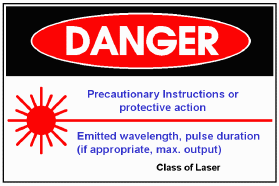
Any room where a laser is located must be adequately marked on the entering door and in the room so that everyone (students, faculty, staff, and/or visitors) is aware of its presence.
Security of the equipment against inadvertent intrusion must always be considered when operating a laser.
At least two people should be present at all times when lasers are in operation. Under no circumstances should a room containing an active laser be left unattended or unlocked.
Ventilation of the room must be considered to remove any accumulation of hazardous gases or fumes that are generated in the operation of the laser.
All personnel in the laser area should be informed about the potential eye hazard of accidental exposure to the beam. It is the responsibility of the project supervisor to give each person concerned a copy of these rules and ensure that all safety precautions are observed.
More detailed information is given in the American National Standard for the safe use of lasers (ANSI Z136.1-1973) and OSHA 29 CFR 1910.32 for eye protection; 21 CFR 1040 (U.S. Food and Drug Administration’s control of commercial devices); and OSHA’s 29 CFR 1926.54 construction uses. These standards cover facilities, program requirements and safety measures. It is strongly recommended these standards be reviewed as supplementary information to be followed.
UWM Resources
- Draft Laser Audit Form (PDF)
- Laser Safety Signs Order Form
- Laser Safety Training (PDF)
- Laser Safety Exam
Additional Resources
- Laser Hazards, OSHA Safety and Health Topics
- Laser Hazards, OSHA Technical Manual
Many laboratories at UWM require the use of vacuum systems. Several buildings have centralized vacuum systems for laboratories (e.g., Chemistry, Lapham, Enderis). Laboratories may also use other dedicated vacuum equipment. Vacuum may be used for:
- evacuating glass vessels, Dewar flasks, desiccators, cold traps and other chambers
- separation procedures involving distillation and extraction
Your building’s central vacuum system is not intended and must not be used to eliminate chemical wastes. Using the system for chemical waste disposal is in violation of good environmental stewardship and applicable regulations. Improper use of the system will result in reduced service life of the system and increased maintenance costs for your department.
Prior to set up and operation, you need to perform a risk assessment regarding potential hazards.
Vacuum work can result in an implosion, creating the hazard of flying glass and spilled chemicals. Systems at reduced pressure, which are subject to rapid pressure changes, may result in the possibility of liquids being pushed into unwanted locations.
Water-sealed or carbon rotary vane pumps can generate significant heat and friction. Therefore, when pulling a vacuum on a system that generates flammable vapors, care must be taken to ensure hazardous concentrations are not generated in the system.
Please consult with your instructor, supervisor or safety committee for additional safe lab practices involving vacuum systems. Please be sure to document these procedures in your chemical hygiene plan. You need to consider:
- How will you prevent liquids and corrosive gases from being drawn into other laboratory components or the building’s central vacuum system? Traps (Kjeldahl) and condensers should be used to insure these chemicals do not enter the vacuum system.
- Whether relief valves are necesssary for your vacuum work?
- What methods are necessary to protect vacuum pumps?
- What maintenance schedules are necessary, including changing the vacuum pump oil? Pump oil needs to be disposed as a chemical waste.
- How to properly vent the vacuum pump exhaust in a safe and environmentally acceptable way? In most cases, vacuum procedures shall be performed in a fume hood.
Other laboratory safety considerations involving vacuum systems may include:
- What glassware is suitable for vacuum work, and how do you inspect this glassware?
- What methods will you use to protect from implosion? Vessels and other glassware shall be wrapped to reduce fragmentation upon implosion.
- What methods and safe work practices will you use to perform distillations that involve flammable or toxic materials?
- How will you instruct and monitor your lab personnel on safe and proper procedures for work involving vacuum systems?