About the ISCP
The UWM Institute for Systems Change and Peacebuilding (ISCP) works to align university and community interests in equitable partnership to engage with these complex and ever-changing systemic drivers.
To bring about transformative and sustainable change, we work to build long and deep relationships that are rooted in trust as a path toward advancing equitable power dynamics, learning, adaptation and emergence. Through these relationships, we collaborate with campus and community partners to co-create community-based initiatives that engage these complex challenges with holistic systems thinking and participatory processes.
Contact

- William Collins Kohler Chair in Systems Change and Peacebuilding
- Associate Professor
- sandym@uwm.edu
- 414-229-1173
- Enderis Hall 617
The vision of the UW-Milwaukee Institute for Systems Change and Peacebuilding is:
University and community interests and assets are aligned in equitable partnership and mutual vitality to engage the complex interacting systems that affect health, well-being and sustainable peace.
The mission of the UW-Milwaukee Institute for Systems Change and Peacebuilding is:
- Convene and facilitate the deep and evolving dialogue among diverse members of the community, university faculty, students and alumni that builds the relationships necessary to engage difficult conversations addressing issues important to the community
- Employ participatory systems-thinking approaches to co-create shared understandings of context and theories of systems change that support strategies and proposals supporting aligned actions for collective impact.
History
The Institute builds on recommendations from the 2019 five‑year review of the Master of Sustainable Peacebuilding program to strengthen university–community partnerships. Its goal is to better align and mobilize shared expertise and resources to address the complex challenges of the 21st century—challenges made even more urgent by disparities highlighted during the pandemic and by ongoing movements for racial equity and justice.
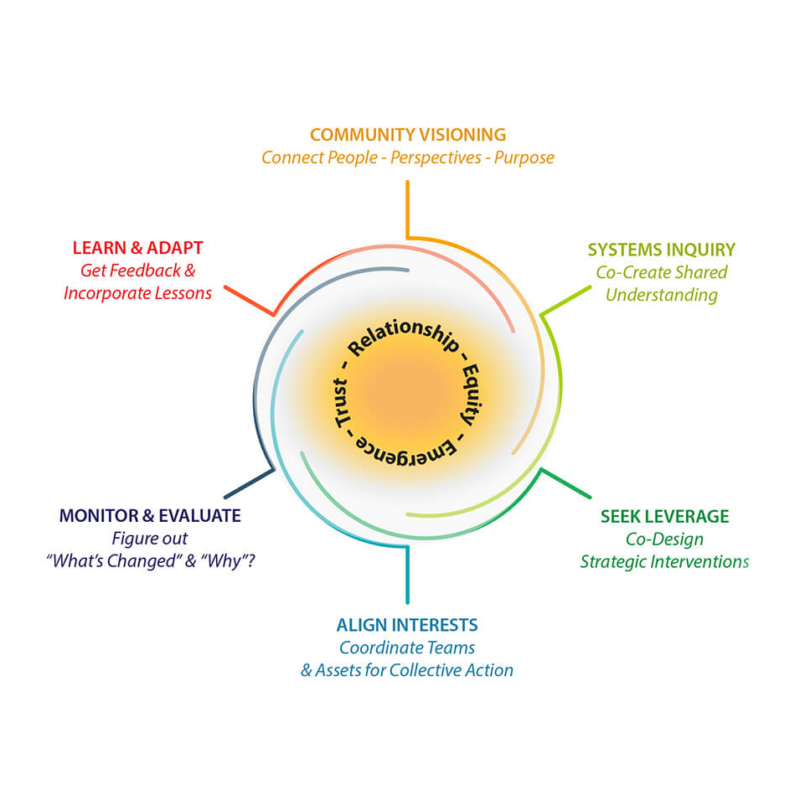
The Systems Change Learning Cycle
The demands of complex environments often over-match traditional practices that tend to be overly linear, static, and dependent on a level of command and control that is unrealistic in such environments. The Institute is designed to help remedy this challenge through bridging theory and basic research into complex human and environmental systems with applied research and practice. To this point, a core operating tenet of the Institute is valuing practice-based evidence (local and traditional knowledge) as essential in building evidence-based practice (evaluation and research) throughout the Systems-Change Learning Cycle.
Community Visioning
Convene UWM and community members to facilitate conversations around shared challenges and shared future visions in order to cultivate collaborative networks and enduring partnerships.
Systems Inquiry
Engage participatory methods and systems tools to develop shared language, explore theories of change and create collective understanding of complex challenges.
Seek Leverage
Develop strategies for change and identify the potential for co-designed initiatives that enhance equity, community resilience and well-being.
Align Interests
Enable coordinated and collective action, and pursue funding for community-driven projects that support interprofessional and transdisciplinary research as well as learning and professional practice.
Monitor & Evaluate
Employ holistic complexity-aware monitoring and evaluation methodologies using qualitative and quantitative methods that inform learning and adaptive changes based on the information gathered.
Learn & Adapt
Accompany UWM and community partners in communicating the information gathered, incorporating feedback, and re-evaluating vision and strategies for continued progress.