English, Minor Minor
The minor in English focuses on English literature. (English also offers a minor in Writing, Editing, and Publishing, and the Film Studies minor includes many English courses.)
Minoring in English provides students with a wealth of intellectual and practical learning, a foundation to future success. In today's interconnected world, the ability to read carefully, think imaginatively, understand others, and communicate across all types of platforms and formats is essential.
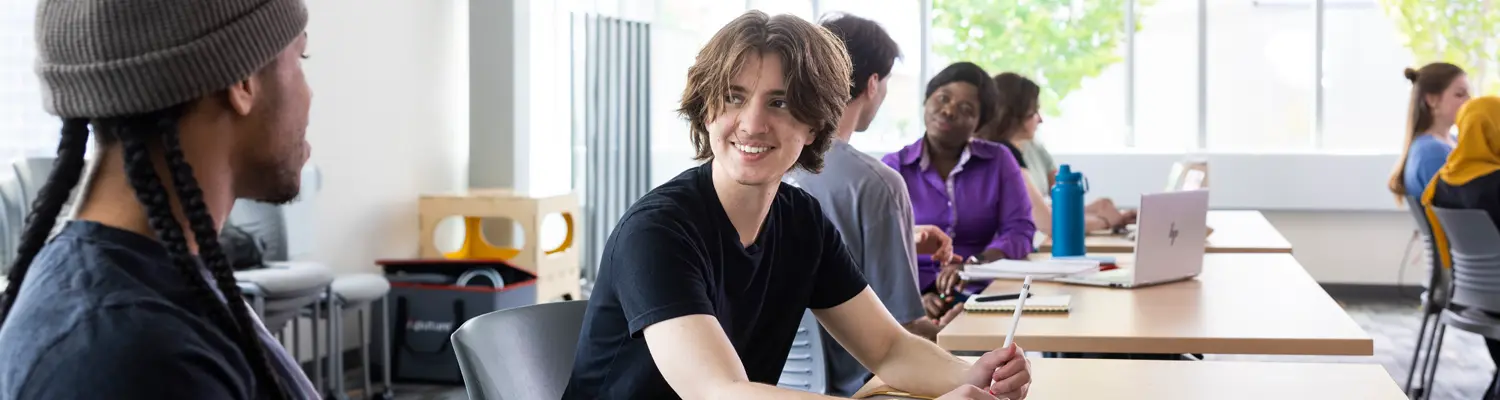
In small classes, our students learn to understand the power and possibilities of the English language across the centuries and around the world. Students learn to think critically, write persuasively, argue logically, delve deeply into history, and explore their own creativity. Students are challenged to examine their own assumptions, sharpen their writing, and learn how to read and understand even the most difficult works, from fiction to philosophy.
Program Type
Minor
Program Format
On Campus
What pairs well with an English minor?
Everything! What career doesn’t involve the written word in some way! But these majors will find an English minor particularly valuable and valued by future employers:
- General Business
- Marketing
- Journalism, Advertising & Media Studies
- Data Science or Data Analytics
- Theater
- History
- Communication
- Design & Visual Communication
- Political Science
- Film or Film Studies
- Public Health

Requirements
The College of Letters and Science requires that students attain at least a 2.0 GPA on all credits in the minor attempted at UWM. In addition, students must attain a 2.0 GPA on all minor credits attempted, including any transfer work. The minor in English requires 18 credits, with at least 9 in residence at UWM, as follows:
| Code | Title | Credits |
|---|---|---|
| ENGLISH 215 | Introduction to English Studies | 3 |
| Select 3 of the following courses in Literature and Cultural Theory: | 9 | |
| Survey of English Literature, Beginnings to 1500 | ||
| Survey of English Literature, 1500-1660 | ||
| Survey of English Literature, 1660-1798 | ||
| Survey of English Literature, 1798-1900 | ||
| Survey of English Literature: 1900 to the Present | ||
| Survey of Irish Literature | ||
| Survey of American Literature to 1865 | ||
| Survey of American Literature, 1865-1965 | ||
| Survey of Contemporary American Literature | ||
| The Art of Fiction: | ||
| The Development of the Novel: | ||
| The Development of the Short Story | ||
| Film and Literature | ||
| LGBTQ+ Literature: | ||
| The Development of Drama: | ||
| Comedy: | ||
| Modern Drama: | ||
| The Art of Poetry: | ||
| The Development of Poetry: | ||
| Survey of American Indian Literature | ||
| Survey of Ethnic Minority Literature | ||
| Survey of U.S. Latino/a Literature | ||
| Survey of Asian American Literature | ||
| Survey of African-American Literature to 1930 | ||
| Survey of African-American Literature, 1930 to the Present | ||
| Survey of Current Literary and Cultural Theory | ||
| World Literatures Written in English: | ||
| Shakespeare | ||
| Milton | ||
| Writers in English Literature, 1500-1660: | ||
| Writers in English Literature, 1660-1798: | ||
| Writers in English Literature, 1798-1900: | ||
| Writers in English Literature, 1900 to the Present: | ||
| Writers in American Literature, 1500-1900: | ||
| Writers in American Literature, 1900 to the Present: | ||
| Writers in African-American Literature: | ||
| Women Writers: | ||
| Studies in Literature, 1660-1800: | ||
| Studies in Literature, 1800-1900: | ||
| Literature in Context: | ||
| Literature and the Other Arts: | ||
| Studies in African-American Literature: | ||
| Studies in Irish Literature: | ||
| Studies in American Indian Literature: | ||
| Studies in World Literature Written in English: | ||
| Studies in U.S. Latino/a Literature: | ||
| Studies in Asian-American Literature: | ||
| Studies in Theory and Criticism: | ||
| Seminar in Irish Literature: | ||
| Seminar in American Literature: | ||
| Seminar in Modern Literature: | ||
| Seminar in Literary History: | ||
| Seminar in Critical Theory: | ||
| Seminar in Literature and Culture: | ||
| Seminar in Literature by Women: | ||
| Seminar in Literature and Sexuality: | ||
| Seminar in Literature and the Other Arts: | ||
| Seminar in African-American Literature: | ||
| Seminar in American Indian Literature: | ||
| Select a minimum of 6 credits in additional English courses numbered 300 and above | 6 | |
| Total Credits | 18 | |
Letters & Science Minor Advising
Advising for the minor takes place within the department by a faculty member or staff member. Follow the steps using the "Declare a Minor" button on the department’s website which may include instructions on how to select a faculty advisor if there is more than one to choose from.
Students who already have an L&S college advisor because their degree plan is in L&S can discuss the minor with them as well since they will be familiar with any minor in L&S. Students who are working on a degree from a UWM college other than the College of Letters & Science will not need an L&S college advisor for just a minor and one will not be assigned. These students should work with the faculty or staff advisor they receive as part of the minor declaration process or contact the department directly for assistance.
Applicants who have not started classes at UWM yet who wish to declare a minor should wait until they are registered for their first UWM classes and then can declare the minor using the “Declare a Minor” button on the program’s website. If you have questions about the minor before then, contact let-sci@uwm.edu.