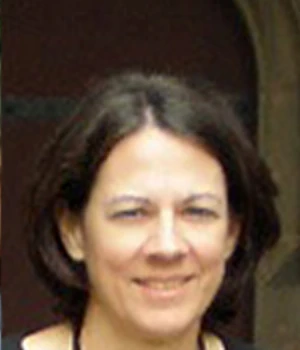
Patricia Mayes
- Professor Emerita, Department of English
Education
- PhD, UC-Santa Barbara
- MA, San Diego State University
Research Interests
The broad theme that ties Professor Mayes's research together is a focus on analyzing how language is used to accomplish social action in various contexts. For example, she has looked at how reported speech functions in conversational English, how similar genres are constructed in Japanese and English, and how particular grammatical forms function in discourse.
Her current research involves investigating the relationship between language, power, and identity in institutional contexts and developing a framework for analyzing the micro-level construction of power relations through social interaction.
- Discourse Analysis
- Sociolinguistics
- Language & Gender
- Language & Culture
- Second Language Writing
Selected Publications
Mayes, Patricia D. “The discursive construction of identity and power in the critical classroom: Implications for applied critical theories” Discourse & Society 21.2 (2010): 189-210.
Mayes, Patricia D. “Linking micro and macro social structure through genre analysis” Research on Language and Social Interaction 38. (2005): 331-370.
Mayes, Patricia D. “Genre as a locus of social structure and cultural ideology: A comparison of Japanese and American cooking classes” Discourse across language and cultures Ed. Moder, C., and Marinovic-Zic, A.. John Benjamins. (2004).
Mayes, Patricia D. Language, social structure, and culture: A genre analysis of cooking classes in Japan and America Amsterdam: John Benjamins. 2003.
Mayes, Patricia D. “The transitive/intransitive construction of events in Japanese and English discourse” Meaning through language contrast 1. Ed. Jszczolt, K.M., and Turner, K.. (2003): 277-291.
Mayes, Patricia D. “Quotation in spoken English” Studies in Language 14. (1990): 325-363.