10.21.2019
“Self-Portraits” by Emily Townsend
Self-Portraits
by Emily Townsend
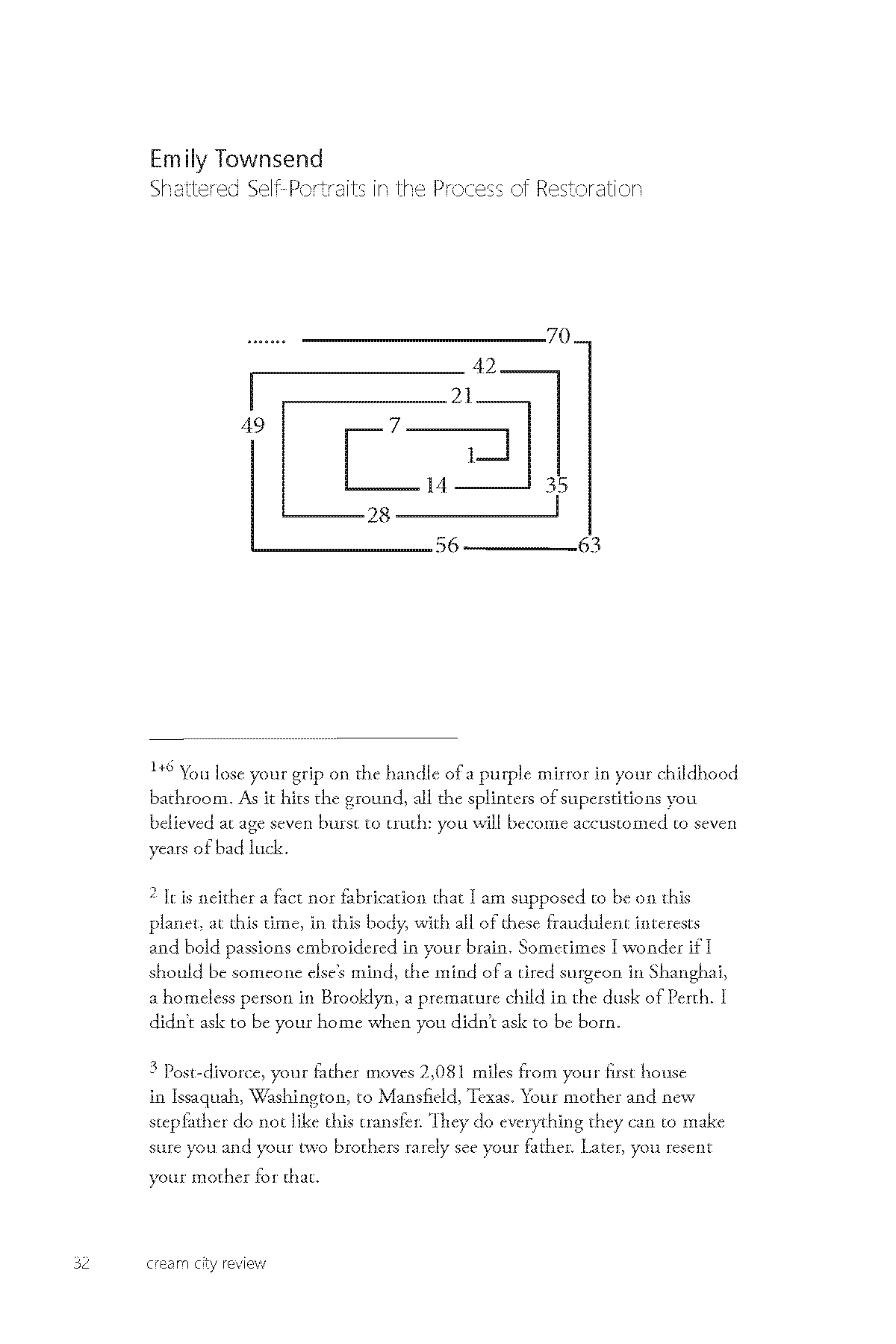
My senior year of undergrad, I took a nonfiction workshop twice. I was still getting adjusted to the genre, spilling out my secrets for classmates who barely knew me. I was also exploring experimental forms in essays: Leslie Jamison’s The Empathy Exams, Kristen Radtke’s Imagine Wanting Only This, Maggie Nelson’s The Argonauts. In both semesters, we covered Jenny Boully’s The Body. I remember one student (now a great friend and editor) brilliantly attempted the form in a different way, and I admired both essays so much that I wanted to try it myself.
“Shattered Self-Portraits in the Process of Restoration” borrows Boully’s form of total footnotes, and my adjustments are the equations in every footnote that is a multiple of 7. Because I broke a mirror twice in fourteen years, the second at the tail-end of the first’s seven years of bad luck, it seemed that the number seven was cursed. It conveniently lifted when I turned 21. Hence the maze at the beginning of the essay: each multiple of seven is like a path inside a labyrinth that I cannot get out. One multiple will lead to a different multiple that isn’t in a correct sequence, enacting a step forward or a step backward. The last footnote’s equation is 70-69, which leads the reader back to footnote one. Even you can’t get out of this chaos.
This essay opens up my first collection, originally set to be a sort of unconventional table of contents like Dave Eggers’ prologue for A Heartbreaking Work of Staggering Genius, but then I read The Body and made each footnote a foreshadowing to the rest of the book. The blank text is essentially the entire book yet it is expatriated, as I felt while growing up away from my hometown during formative years. What bookends this essay is a 40-page rebuttal: written a year later, I finally understood my pessimism was because I willingly put myself through pain, not because of a delusion with broken mirrors. I assigned blame to an object rather than to myself because I didn’t want to properly deal with it.
Sometimes I believed my body and my brain were two entirely separate entities. I constantly struggled with figuring out where I belonged during those bad-lucked years: I was displaced from my hometown due to my parents’ divorce, I was purposely making everything harder for myself as punishment. So I took this superstition of broken mirrors and blamed my unhappiness on the accidents of dropping cheap glass onto my bathroom floor. My brain falsely assured me of a lot of things—“after high school, you’ll move back home;” “don’t worry, people actually like you”—and made me imagine a distinct person I wanted to have been real, but it was a figment of my imagination so desperate to have someone fill in that space. The ontology of my brain on its own seemed to be completely detached from my body.
The most interesting thing about this piece, to me, is how I realized I was wrong and selfish. Rarely do essays make me change my mind on myself, but I had gone through such a colossal shift of feeling lonely to feeling loved back to feeling lonely and then back to feeling loved that the distance I went through both physically and emotionally forced me to see I took so much for granted. A month after I finished writing this I moved to Eugene, Oregon, to see if my love for the Pacific Northwest was still real after a hiatus of not living there for sixteen years. It turned out to be extremely lonely and solipsistic. When I returned to Texas for grad school, I realized my friends and the community were what made me happy and alive. My first two years of college were rough, but that senior year was actually beautiful and involved and I felt like I finally had a place to fit in. I’m a bit terrified to leave in a couple months.
I’m eternally grateful Cream City Review nominated this essay for a Pushcart; it’s a great way to feel validated for a life story that gave me so much pain yet I wanted to share it with anyone willing to read. When I drive between my mother’s house and wherever I’m living while in school, I often think that I wouldn’t have such a story to tell if I didn’t go through what happened, if I stayed in one place after all, if I chose to be optimistic and bright instead. My material would either be a lot different or nonexistent. I enjoy writing dark stuff to help me confront my issues and reassign whatever blame I pin on something else back onto me. It humanizes me, forces my brain and body to rejoin, and make me see the world a little more clearly.
*
Emily Townsend is a graduate student in English at Stephen F. Austin State University. Her works have appeared in Superstition Review, Thoughtful Dog, Noble / Gas Qtrly, Santa Clara Review, cahoodaloodaling, Watershed Review, The Coachella Review, The Coil, and others. A 2017 AWP Intro Journals Award nominee, she is currently working on a collection of essays in Nacogdoches, Texas.
*Townsend’s non-fiction “Shattered Self-Portraits in the Process of Restoration” appears in Issue 42.1 of Cream City Review.
09.20.2019
Results of the 2019 Summer Prize in Fiction and Poetry
Results of the 2019 Summer Prize
in Fiction and Poetry
We’d like to thank everyone who submitted to our inaugural Summer Prize in Fiction and Poetry. Without you, this would not have been possible, and we are grateful for your participation and trust in our journal. Please join us in congratulating the winners, runner-ups, and finalists of the 2019 Summer Prize!
Winner of the 2019 Fiction Prize selected by Ramona Ausubel:
“The Pig Queen” by Sheldon Costa
Ramona Ausubel says, “’The Pig Queen’ delighted me with its strangeness and discomfort coupled with precise imagery and funny lines.”
Runner-Up of the 2019 Fiction Prize selected by Ramona Ausubel:
“Structural Report” by Debbie Vance
Ramona Ausubel says, “’Structural Report’ is also full of surprises and very thought provoking.”
Finalists:
“Hannah Vechter and the Mockup Man” by Robert Long Foreman
“The Beasts are All Around” by Laura Price Steele
“Renewal” by Adam Byko
“The Witch’s Tooth” by Kate Felix
“The Blessing of the Animals” by Caitlin Rae Taylor
“Euphony” by Natalie Villacorta
Winner of the 2019 Poetry Prize selected by Aimee Nezhukumatathil:
“My Mother Tries to Teach Me How to Garden” by Hannah Dow
Aimee Nezhukumatathil says, “This poem demonstrates how a whole life can be unearthed in the fecundity of a garden. So much richness found in these stanzas, especially in the turning over of word origins, all for it ending with a magnificent last sentence that I haven’t been able to stop thinking about for days.”
Runner-Up of the 2019 Poetry Prize selected by Aimee Nezhukumatathil:
“mountains before mountains were mothers” by Aimee Herman
Aimee Nezhukumatathil says, “This poem’s heartbeat resides in the thrum of its footnotes, fastening bright connections between the “mathematics of your body” and the body as landscape in unexpected and elegant ways.”
Finalists:
“I looked up one day” by Matthew Baker
“Body” by Alana Baum
“The Water, the Truth, the Water” by Stacey Balkun
“Agoraphobia” by Janine Certo
“Only Once Driving in Cincinnati” by Kirk Schlueter
“Rapids” by Tyler Dettloff
“The Wolf as Pick-up Artist” by Emily Cole
“I wrapped the animals I skinned around your hands and neck” by Jacob Lindberg
* * *
Thank you all again for your wonderful work. Be sure to keep an eye out for our Winter Issue 43.2 to read these winning works!
*Banner art: from Gabriel Silva’s “Gold 1”, which appears in Issue 42.2 of Cream City Review.
09.16.2019
“Some Thoughts on Motherhood, Daughterhood, and Water” by Gail Aronson
Some Thoughts on Motherhood, Daughterhood, and Water
by Gail Aronson
Once a man approached me while I was reaching up to a high shelf in a used bookstore. He said unrepeatable things, and then asked me if I enjoyed sex. The employee behind the front counter intervened and these two men had a conversation, while I leafed through pages, pretending I’d stopped paying attention. When the bookstore employee said to the other man he couldn’t “do that” (that meaning verbally harass me) the other man replied, “but look at her, she’s beautiful.” (Sidebar, I’m not beautiful at all, just a woman.) During this conversation I had a dissociative moment, as if I’d just submerged myself into water and the edges were fuzzy—I was somewhere else. I realized these men were talking about me but not to me, as if I wasn’t there, as if I wasn’t a person at all. There have been plenty of other situations by virtue simply of being a woman that I’ve felt more endangered or disrespected. But this conversation struck me with a sense of invisibility.
At this time in my life, I worked with children. One child always remarked that I looked like his mother. As a nanny, other mothers often told me—while walking a stroller down the street or opening my arms to this toddler and all of her buoyant joy as she bunny-hopped from the edge of the YMCA pool and into my arms—that my charge looked just like me. For a woman of age with children in tow, motherhood was assumed.
There is something I struggle to describe that feels mechanical about daily life. Necessary habits of walking down the same streets, drinking from that particular coffee mug, coming up to the wind and rain against my cheeks as I have before. Our actions are filled with circles, and our minds circle back to those repeated circular days, of rising and falling back to sleep again.
When I wrote “The Only Daughter on the Coast of Mothers” I was captivated by the expected roles of womanhood. I wished to play with an imagined future reality in which a woman comes to know herself by being surrounded by what she isn’t. I wanted to remove the personal memories we associate with our upbringings, to illustrate a space in which women exist without men, but are still performing the cultural norms of what came before. Roles we inherit often emerge from this learned automation, doing things as our mothers once did simply because that’s the way we came to know how to do that thing at all. Can mothers mother without daughters? This, logically, seems like a silly question with an easy answer. I wanted to push beyond the factually apparent. To impress upon the everyday something less usual and mechanical that contributes to my own sense of invisibility, an atmosphere distant as the sea with just as much of its substance and complexity inside, underneath.
Of course, I am a visible person living my life in the world, just like everyone else. I am a woman, a daughter. An inner life can be difficult to reconcile with reality and the way others see you. Within the surreal conceit of a coast of mothers and a single daughter who mysteriously wash up to its shores, I hope the boundaries between the interior dreamlike states and exterior reality begins to muddle and melt away.
For me, I can’t separate a sense of complicated personhood from gender. My stories often include, only or mostly, women-identified characters. Not that I dislike men. In reality, the bookstore employee did exactly as any thoughtful, kind person would do. It isn’t easy to intervene, to defend a complete stranger. I don’t blame him that, in the moment, my life felt somehow robotic, my personhood invisible.
That the repetition of everyday life can begin to feel like a kind of automation seems inextricable from how the reality of lived experience is infected and skewed by capitalist culture. Street signs repeat and the lines between who we are and how we can create ourselves through material things naturally blurs. If, as human beings, we are to change or be changed by our own creations, I wonder what is next for humans as we evolve with the earth, which we continue to ruin. An earth we continue to treat as a thing rather than as a living, breathing home. As the atmosphere is altered, how will we change? I hope that the story might subtly lean into this without a direct critique. I often think about our world of capital and how the objects of our lives might encourage a reframing of commodity.
What is a woman, a person, when seen from a distance?
Mother. Daughter. And so on.
When I am most myself, as a writer and (mostly) as a person, I am drowning and floating all at once. Away from linearity, inside the feedback and fuzz, a muffled thing you strain to understand, and yet, it draws you in.
My mother wanted, always and without exception, to be a mother. Or this is how her story goes, how she chooses to tell it. She had me and I became an adult daughter. A nanny at the time, I was also a writer-woman-person at the YMCA pool with this impossibly perfect little new life. And into that momentary nothingness, dipping underneath the waveless not-so-deep water with a child who is a girl who will be a woman, and most of all who is not mine—these are the kinds of palpable and otherworldly moments – I cherish these the most.
*
Gail Aronson is a fiction editor for Omnidawn Publishing and her work recently appears or is forthcoming in Nat. Brut, Midwestern Gothic, The Adroit Journal, The Offing, Dream Pop, and elsewhere. She lives and works in Pittsburgh. Find her online @gailaronson. Aronson’s fiction “The Only Daughter on the Coast of Mothers” appears in Issue 42.2 of Cream City Review.
07.16.2019
“Flash Is Not” by Jonathan Cardew
Flash Is Not
by Jonathan Cardew/ @cardewjcardew
I am a flash fiction writer, which means I write flash fiction. When I say this to people, they usually ask me what flash fiction is and I oblige them with an explanation. It’s very short fiction. It’s like a paragraph or a page. A flash. They nod in acknowledgement. Oh, they say. Oh, right.
It’s the qualifier, of course. The flash bit. Why specify? And I don’t always—most of the time, I just say I write fiction; I’m a fiction writer; I’m a fiction writer of works of a certain length.
So the flash bit is a justification? Or a badge of honor?
I decided to hit up Twitter, asking in my tweet to finish the sentence: “Flash is not…”
I don’t know why I flipped the question to a negative; why ask what something is not? But it seemed appropriate since flash fiction thrives in negative space.
The following are twenty-two tweet replies, in no particular order, finishing my sentence and attempting to answer that question in a different way:
Flash is not comfortable (@tabethanewman)
Flash is not timid (@wreffinej)
Flash is not your grandfather’s nose hairs (@rgvaughan)
Flash is not plodding (@Christopher_All)
Flash is not written to please anyone (@taniahershman).
Flash does not settle in; it doesn’t settle at all (@fabulistpappas)
Flash is not waiting (@VeronicKlash)
Flash is not to disrupt the flow of what it’s not, but I have a pressing question about what it is… reading for a lit mag and flash coming in 5-6 pages long doesn’t seem, well, flashy. Thoughts? (@bronwynnhdean)
Flash is not compliant (@melostrom)
Flash is not a boring rambling snoozefest (@ingram_wallace)
Flash does not seek to explain itself (@Jayne_Martin)
Flash is not devoid of depth and emotion (@laurabesley)
Flash is not meretricious (@Robcodbiter)
Flash is not a poem (@karjon)
Flash is not kind of a poem (@laurabesley)
Flash is not feeble (@melostrom)
Flash is not a matter of fewer words. It’s not an anecdote or a sketch or a vignette. It’s a much longer story that is compressed and written with a lot of words that you just don’t happen to see (@francinewitte)
Flash is not to be underestimated (@writingcircles)
If flash is not a vignette, when can you write a vignette? Poor maligned vignettes. I feel they need a home, recognition, tlc. Or are they the juvenile frame for flash? (@wordpoppy)
Flash is not welcoming (@steveXisXoc)
Flash is not very long (@nlordlancaster) A banana isn’t flash fiction (@samaveris)
[Tweets republished by permission of the authors]
*
Jonathan Cardew‘s stories appear in Passages North, Wigleaf, JMWW, Cleaver Magazine, People Holding, and others. He edits fiction for Connotation Press. Originally from the U.K., he lives in Milwaukee, Wisconsin.
07.11.2019
Interview with 2019 Summer Poetry Prize Judge Aimee Nezhukumatathil
Interview with 2019 Summer Poetry Prize Judge
Aimee Nezhukumatathil
 In honor of our inaugural 2019 Summer Prizes in Fiction & Poetry, Managing Editor Su Cho conducted a micro-interview with our Poetry Prize Judge, Aimee Nezhukumatathil. Read on to learn more about the insistence of joy, what makes a poem stand out, and the things Aimee Nezhukumatathil would tell her past and future self!
Aimee Nezhukumatathil is the author of four books of poetry, most recently Oceanic. Her honors include a Pushcart Prize and a fellowship from the National Endowment for the Arts. Her collection of nature essays is forthcoming from Milkweed Editions and she is professor of English in The University of Mississippi’s MFA program.
Su Cho is the Managing Editor of Cream City Review and a PhD student at University of Wisconsin-Milwaukee, where she is an Advanced Opportunity Fellow. Her poems are forthcoming/can be found in Colorado Review, Cincinnati Review, Pleiades, The Journal, Crab Orchard Review, and elsewhere.
*
1. Every time I read your poems, I can’t help but see the value of the joy of discovery, and that joy, in turn, creates community. During this tumultuous political time, maintaining and nurturing joy is not only important but also work. How does this feel for you? Do you think this relationship has changed for you over time? Or do you see it manifest in different ways as you keep writing?
Oh thank you so very much! It’s not exactly a conscious development *towards* joy and wonderment, but rather an insistence for it. And it is most definitely work—though my pals would absolutely say I’m an optimist, my very closest pals know I’m a worrier and over-thinker, especially in light of the political and environmental concerns we’ve been facing. But this is nothing new. As a woman of color, I have known for a very long time that the world operates very differently for me than say, my white husband. Add that to us raising two mixed boys who have some of the most kind and wondrous hearts I know and even though I have an overwhelming sense of dread and despair most days for the world they will live in when I am long gone—it becomes even more imperative for me to point out beauty and yes, joy on this planet for them. This doesn’t, however, mean that I ignore darkness and ‘scary’ topics in my writing. But I suppose I do try to lean toward light. I think for many people, it’s more helpful to fight for things we love, rather than out of a reflex of fear. I mean—many of our political leaders would rather women of color be in a constant state of fear and panic. So when I turn towards joy and beauty in my writing, it is most certainly work. But it’s the most beautiful and important responsibility in work I’ve ever had.
2. You’ve written so many great collections of poetry. How would you describe your journey as a writer and teacher from Miracle Fruit (2003) until now? What has evolved? What has remained steadfast?
You are too kind, but talking about my work this way gives me the heebie-jeebies—I’d rather you or other readers make such conjectures/observations. But I will say I definitely feel more comfortable to push against my love/hate relationship with linebreaks and to make my lines and white space more expansive than the tight/neat blocks of my earlier poems. Over the course of four books, I think—I hope—I’ve expanded my gaze to larger concerns of the natural world. And there’s at least one constant for my poetry: that most of my poems can be read as love poems. Or at the very least, born of love.
3. What makes a poem stand out to you? Is there a poem or a book you can’t let go of right now?
When I get to a poem, I want to be surprised—with the poem’s music, images, and/or the physical look of it on the page. I don’t ever want to be able to guess the next line or image, or know how the poem will end, and I want to also feel like I don’t want the poem to end in the first place. I want to stay in that poem’s world, like stepping into the landscape of one of those snow globes—I want to be shaken up and even after all the shaking settles down, I want to look down at my feet and know my world is not the same. I’ve recently loved Mira Jacob’s Good Talk, and a new poetry collection out any day: Former Possessions of the Spanish Empire, by Michelle Peñaloza, and just read the astonishing new one from Carmen Gimenez-Simth. Oooh—and Natalie Scenters-Zapico’s Lima :: Limón.
4. If you could travel to the past, what would you tell your past self? If you could go forward in time, what wouldn’t you want your future self to forget?
I’d tell my size-2 twenty-something self, that I wasn’t chunky in the flippin’-slightest, and to tell my twenty-something poet-self that the only advice ever worth taking in the literary world is: to floss, assume kindness in those you don’t know (unless proven otherwise), and give thanks by helping out others who come after. I was always going to write—no one needed to remind me to write and read widely. But simply put: doing these very specific things would always keep me writing, and give me more opportunities to write and teach. And I’m a Capricorn—I don’t forget things. 😉 But I’d try to forget who told me if I wanted to be a successful writer, I needed to keep writing at the forefront of my life, no matter the cost (sleep, relationships, etc). I’d argue that I’d feel better about myself when writing isn’t at the front of my life—that I’m a more expansive writer and mentor because I have other interests and people with whom I love to share them with, not in spite of. And my folks are still alive, but they live far away in Florida, so I’d remind my former self to drive and visit as often as possible back when they lived just an hour away from me when I was in grad school in Ohio. Also I’d always want to remember our family vacations: both when I was a little girl, sleeping in the backseat of our blue Oldsmobile, and also now that my boys are still little(-ish) and begging for us to stop at any rock shop they see advertised on the road.
*
Submissions to our 2019 Summer Prizes in Fiction and Poetry are open until August 1st. Click here for full guidelines.