About the Department
The department critically examines the cultures, societies and political economies of people of African origin and descent, and exposes students to historical texts and literature, modern social issues, philosophical questions and political crises through an African-centered lens. Students learn to view complex situations from multiple perspectives; synthesize known information and hypothesize about the unknown; apply lessons from the past to problems of the present; and critique past practices. African and African Diaspora Studies is relevant to everyone, regardless of race, gender, ethnicity, nationality or religion.
The major and minor prepare students for a wide range of careers in business, management, government, education, public health, communication, social services and public policy. Our majors and minors practice a range of professions in medicine, law, criminal justice, performing arts, sports, media, journalism, and religious ministry. The Department takes great pride in the array of careers that distinguishes its graduates. The major in African and African Diaspora Studies also provides students with a foundation for graduate studies in disciplines like economics, political science, sociology, history, English, anthropology and communication.
The African and African Diaspora Studies faculty is recognized nationally and internationally for its expertise. Faculty specialization includes: racial identity, folklore, African religions, gender relations, social movements, racism, African American history, public health, Black politics, Black feminist criticism and theory, international finance and trade in African countries, economics in the Black community, and transnational migration.
History of the Department
Black Studies emerged in the 1960s as an outgrowth of the Civil Rights and Black Power Movements and the demand for scholarly recognition and scrutiny of the life experiences and perspectives of peoples of African descent in the United States and across the world. The Department of African and African Diaspora Studies at the University of Wisconsin-Milwaukee traces its origins to May 1968 when the university approved the creation of the Center for Afro-American Culture. That Center was one of the first two Afro-American Studies programs in the United States and was developed in response to student demands and grassroots movements here in Milwaukee and across the nation.
The Center for Afro-American Culture at UWM was established in 1968 and opened in 1969, with a curriculum that was framed broadly. Over the years, African and African Diaspora Studies has strengthened its foundations in order to better meet expanding student demand and incorporate new disciplinary developments. By 1971, the Center achieved departmental status and became the Department of Afro-American Studies. In 1980, the department implemented a BA degree program organized around two concentrations: political economy and public policy, and culture and society. In 1986, the department began offering a minor in Afro-American Studies.
In 1994, the department was renamed to the Department of Africology, a term coined by long-time department chair Dr. Winston Van Horne, to reflect the focus on experiences of people of African descent all over the world. The name change was meant to signal the department’s broad international perspective and distinguish it from those that focused exclusively on either African-American or African Studies. In 2018, the department changed its name once again, this time to the Department of African and African Diaspora Studies. This name continues to signify a global focus but reflects changing norms and attitudes about nomenclature within the discipline. Current faculty in the Department of African and African Diaspora Studies examine issues facing people of African descent all over the world, including in sub-Saharan Africa, Latin America, the Caribbean, Europe, and the United States.
In June 2008, the department was granted approval for a PhD program by the University of Wisconsin Board of Regents, and the first doctoral students began the PhD program in the fall of 2010. The PhD program is one of only about two dozen doctoral programs in African and African Diaspora Studies in the nation and has graduated several PhDs who now hold faculty and non-profit positions around the country. In December 2018, the department was granted approval for a master’s program by the by the University of Wisconsin Board of Regents. The faculty is anticipating receiving master’s students into the program in the fall of 2020.
From the time of its inception, the Department of African and African Diaspora Studies has implemented programs that foster meaningful exchanges between the university and the wider Milwaukee community. Beyond educating future leaders and community members, the relationship between UWM African and African Diaspora Studies and Milwaukee is promoted through Black History and Liberation Month programming, involvement of the African and African Diaspora Studies faculty with Community Brainstorming where the faculty presents once a year, and study abroad programs that take students to Ghana, Ethiopia, and Belize.
About Winston Van Horne
In recognition of his immense contribution and at the request of the Department of Africology, the UWM Faculty Senate unanimously voted in favor of naming a classroom on his behalf on December 13, 2012. On Friday, April 26, 2013, UWM officially re-named Mitchell Hall, Room 206, the Winston Van Horne Seminar Room. We invite you to view the ceremony.
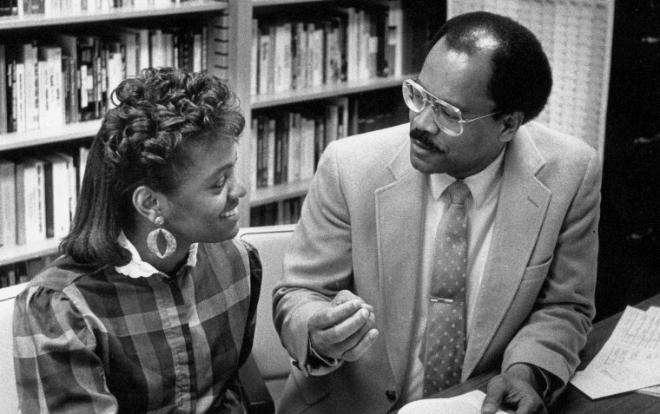
Dr. Van Horne was born in Jamaica and came to UWM in 1978, where he served magnanimously until his death. Some of his contributions include:
- navigating the Afro-American Studies Program to the Department of Africology;
- chairing the Department of Africology three times and being credited with creating the word Africology;
- serving as principal author of the Ph.D. program in Africology;
- serving on the faculty senate since 1980 (being absent for only required lapses); and
- directing the UW System Institute on Race and Ethnicity for ten years.
In commemorating Dr. Van Horne, one of his Africology colleagues wrote the following: “Though he liked to work often in the shadow, Winston’s voice boomed and resonated far afield – his presence felt, if unseen. His vision carried beyond the confines of campus and town, reaching a global audience. He birthed a discipline, at once father and mother, but he would always say that Africology was simultaneously the newest discipline and the oldest. He had reasons for that argument, anchored in an understanding of African cosmological truths. Now that he has retreated to a well-deserved rest, he shall continue to work in the shadow, and his presence will continue to be felt, if unseen.”
Dr. Evelyn Higginbotham
In the 1960s, students in Wisconsin and across the country struggled to create a place for Black Studies in the university. The Center for Afro-American Studies at the University of Wisconsin-Milwaukee was approved in 1968 and opened in 1969, evolving over time into a department that today offers undergraduate and graduate degrees. In the intervening decades, students and faculty continued to create scholarship centering the unique and critical perspectives and knowledge of Africans and the African Diaspora. At the 50th anniversary event in 2019, our keynote speaker was Dr. Evelyn Higginbotham. She is an esteemed alumna and honorary degree recipient who was on campus at the time of the student struggles for Black Studies. Dr. Higginbotham is the former chair of African and African American Studies and former chair of History at Harvard University.
Prof. Higginbotham reflected on the important history of Black Studies programs on our campus as well as the urgent need for African and African Diaspora Studies in our world today and for our future. After her presentation, she joined in a conversation with Dan Burrell (one of the student demonstrators during the inception of the department and its first Chair), Clayborn Benson (a UWM alum and director of the Wisconsin Black Historical Society), and Charmane Perry (a graduate of the department’s PhD program) to discuss the turbulent days of the program’s establishment and how Black Studies programs continue to press for transformation of campuses and communities.